
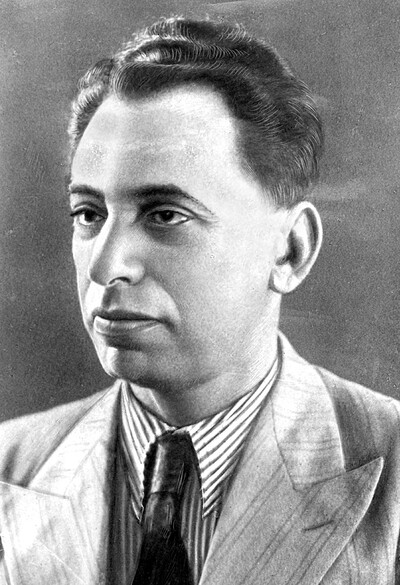
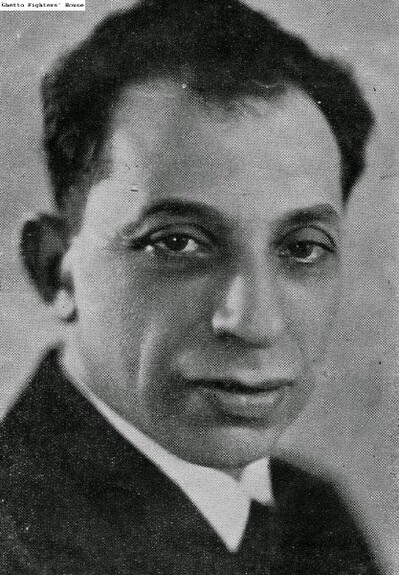
Bergelson, Dovid
August 12, 1884–August 12, 1952
He was a prose author, playwright, and essayist, born in Okhrimovo (Sarna), Ukraine, a younger son of elderly parents. By the time of his birth, they had already married off older sons and daughters. Bergelson’s father, Refuel, was a major timber and grain merchant, a scholar, and a Talner Hassid. His mother came from an elite, wealthy family. Their affluent home was astir with all manner of business people, and not one of them later emerged in Bergelson’s artistic memory as a model or hero for his novels or stories. When he was nine years of age, his father died; and when he was fourteen, his mother did as well. His older brothers and sisters devoted themselves to his education. He attended religious elementary school, and for general subjects he had a private tutor.
In 1901 he moved to Kiev and lived there with one of his brothers; in 1903 he left for Odessa and the following year for Warsaw. All these years he studied as an external (auditor) student, dedicating himself mainly to self-education, engrossing himself industriously to Hebrew and Russian literature, familiarizing himself with the Jewish nationalist and social movement during that violent era, and making acquaintances in circles of Jewish intellectuals.
Bergelson began writing at about age thirteen or fourteen, initially in Russian and Hebrew. In 1906 he sent Hazman (The Times) a story entitled “Reikut” (Emptiness)—the Hebrew version of [his subsequent first novel] Arum Vokzal (At the Depot). The editors did not accept it, and Bergelson turned to writing in Yiddish. The initial efforts to have his work appear in Yiddish publications in Vilna and Warsaw also did not succeed at that time.
In 1909 he published in Warsaw, at his own expense, Arum Vokzal. The work attracted quite a response in literature, and the critics noted that he was an artist with talent, with a distinctive style and his own outlook on the world. Arum Vokzal was republished several times. His novel Nokh Alemen (When All Is Said and Done), which appeared in 1913 in Vilna, was highly impressive. This novel and his story In a Fargrebter Shtot (In a Backwoods Town) which was published in Kiev in 1919 brought him the general recognition of the highest rung of prose writers. Together with the classical authors and comparable modern writers, such as Sholem Asch and Avrom Reyzen, he became a central figure in literature as an artistic innovator with his own distinctive style.
Bergelson contributed to: Di Yidishe Velt (The Jewish World), Der Yidisher Almanakh (The Jewish Almanac) edited by Shemarye Gorelik, Bikher-Velt (Book World) in Kiev, Milgroym (Pomegranate) in Berlin, Forverts (Forward), Folks-Tsaytung (People’s Newspaper), Morgn-Frayhayt (Morning Freedom), and Emes (Truth), among others.
In addition to fictional writing, from time to time he published articles of an essayist character, a few of which—such as “Briv tsu der Yunger Yidisher Inteligents” (Letter to Young Jewish Intellectuals), “Dikhtung un Gezelshaftlekhkeyt” (Poetry and Society), and “Der Gesheener Oyfbrokh” (The Damage Caused), among others—in their time had a certain impact on the forms of Jewish critical thought.
The years of WWI brought a pause to Bergelson’s writings. After the Russian Revolution in March 1917, he was in Kiev among the founders of the Kultur-Lige (Culture league) and contributed to its ramified work. From 1917, he concurred in the building of a new culture and literature. He worked for the Yidisher Folks-Farlag (Jewish People’s Publishers), founded by the Kultur-Lige, as well as on the editorial collective for the anthologies Eygns (Our Own [1918-1920]) and Oyfgang (Rise [1919]).
He took part in the Ukrainian Jewish cultural movement in the midst of civil war and pogroms. In 1920 he moved to Moscow, though in 1921 he left the Soviet Union and settled in Berlin which was then one of the biggest centers of Jewish culture. In 1924 he made a trip on behalf of ORT ([Russian acronym for:] Society for Handicraft and Agricultural Work among the Jews of Russia) through Romania, primarily visiting the Jewish communities of Bessarabia and Bukovina which Romania had at that time annexed.
Shortly after his return to Berlin, a crisis emerged in Bergelson’s attitude toward the Bolshevik Revolution, and he began to manifest his own willingness to join in with the journal In Shpan (In Line). As editor he saw two issues (1926) of the monthly journal to fruition. He was a regular correspondent for the Forverts, but in 1926 he discontinued working with this newspaper, returned to the pro-Soviet camp, made a trip to Soviet Russia, and became a contributor to the Communist newspaper Frayhayt (Freedom), as well as to Emes in Moscow and Morgn-Frayhayt in New York, and to a string of other Soviet Yiddish periodical publications. At the time, he openly declared his recognition of the proletarian dictatorship. In his public appearances, he spoke ironically of classical Yiddish literature.
At the end of 1928, he made a trip to North America. The circles around Morgn-Frayhayt arranged a tour for him through the Jewish centers in the United States. He stayed there for six months, before returning to Berlin. On his return trip to Soviet Russia, in the early summer of 1929, he stopped over in Paris. He then returned to Berlin, but did not stay there for long. In 1933, after Hitler’s rise to power, he left Germany, lived for a short time in Copenhagen, Denmark, and then settled back down in the USSR in 1934. That same year he traveled to Birobidzhan (Birebidzhan, Birebidzshan), but afterward he settled permanently in Moscow, where he published his epic novel Bam Dnyeper (By the Dnieper).
When the Soviet-German war erupted in June 1941, Bergelson was in Kuibyshev. He was active in the Jewish Anti-Fascist Committee and served on the editorial collective of the newspaper Eynikeyt (Unity). He signed on with the well-known Soviet appeal to the Jews in the entire world that he followed with zeal in line with the Soviet regime. After WWII he was back in Moscow. Scarcely any news about him made it from behind the iron curtain until 1948, when Stalin’s regime launched a ruthless murderous action against Yiddish literature and its most significant authors.
He appeared at a Yiddish literary evening, as the Yiddish state theater performed one of his plays and the state publishing house published a portion of his writings. Then, on December 23, 1948, Bergelson was arrested and charged with multiple “sins” against the Soviet Union. The Yiddish world was stunned by the news that Bergelson and other Soviet Yiddish writers had been arrested. Together with twelve members of the Jewish Anti-Fascist Committee, he was murdered on August 12, 1952.
On March 7, 1953 the Forverts published for the first time a cable from L. Krishtal, special correspondent for the newspaper in Russia, noting that Bergelson was among the Yiddish writers who were murdered by the Stalin regime in 1952. The news was subsequently corroborated by the Communist Yiddish Folks-Shtime (Voice of the People) in Warsaw and republished in the Communist Yiddish newspapers throughout the world.
For detailed bio-bibliographical information on Bergelson, see:
Khone Shmeruk, ed., A Shpigl af a Shteyn (A Mirror on a Stone) (Tel Aviv: Di Goldene Keyt, 1964; Jerusalem: Hebrew University, 1987); and
Joseph Sherman and Gennady Estraikh, eds., David Bergelson from Modernism to Socialist Realism (Leeds: Taylor and Francis, 2007).
Among Bergelson’s books:
Arum Vokzal (Warsaw, 1909), 93 pp., second printing (Vilna, 1911), third printing (Berlin, 1922), fourth printing (Vilna, 1929), and republished on several occasions in Soviet Russia;
Nokh Alemen (Vilna: B. A. Kletskin, 1913), 344 pp., second printing (Vilna: B. A. Kletskin, 1929), new edition (Moscow: Emes, 1935), 340 pp.;
Dos Goldene Kaykele (The Golden Little Ball), a story (1917), 7 pp.;
Droyb, Ertseylungen (Small Fry, a Stories) (Kiev-St. Petersburg: Idisher folks-farlag, 1919), 76 pp.;
In a Fargrebter Shtot (Kie: Idisher Folks-Farlag,, 1919), 60 pp., second printing (Berlin: Vostok, 1922), 155 pp.;
Mayse-Bikhl (Storybook) (Kiev: Kultur-Lige, 1919), 48 pp., second printing (Berlin, 1923);
Opgang (Sewage) (Kiev: Kultur-Lige, 1920), 227 pp., second printing (Berlin, 1922), third printing (Vilna, 1929), fourth printing (New York, 1955);
Geklibene Verk (Collected Works), four volumes (including: Opgang, Arum vokzal, Der Toyber [The Deaf Man], Yerusholaim [Jerusalem], In a Fargrebter Shtot, Droyb [Small Fry], Der Letste Rosheshone [The Last Rosh Hashanah], In Eynem a Zumer [Together One Summer], and Nokh Alemen) (Berlin, 1922-1923);
Shturemteg, Dertseylungen (Stormy Days, Stories) (Kiev: Kultur-Lige, 1927), 290 pp., new edition (Vilna: B. Kletskin, 1928), 303 pp.;
Der Tsenrubldiker (The Ten-Ruble Note) (Moscow: Emes, 1928), 59 pp.;
Velt Oys, Velt Eyn (World In, World Out) (Vilna: B. Kletskin, 1929), 275 pp.;
Mides-hadin (A Stern Judgment) (Kiev: Kultur-Lige and Vilna: B. Kletskin, 1929), 265 pp.;
Di Broytmil, Drame in 3 Aktn (The Flour Mill, a Drama in Three Acts) (Vilna: Kletskin, 1930), 114 pp., staged under the titles Der Toyber (The Deaf Man) and Oybn un Untn (Over and Under);
Tsugvintn (Draughts) (Vilna: B. Kletskin, 1930), 278 pp.;
Bam Dnyeper, two volumes (Moscow, 1932, 1936), 575 pp., second printing (Moscow, 1936), fifth printing (Moscow, 1947);
Dovid Bergelson in Shul (Dovid Bergelson in School), compiled by D. Kurland and M. Hoder (Minsk: State Publ., 1933), 248 pp.;
Birebidzhaner Dertseylung (Birobidzhan Story) (Moscow: Emes, 1934, 1939), 275 pp.;
Yordim, Dertseylung (Déclassés, a Story) (Moscow: Emes, 1936), 18 pp.;
Sheyvit Gedalye (Sheyvit Gedalye) (Moscow: Emes, 1936), 16 pp.;
Tsvishn Lebedike Mentshn (Among Living People) (Minsk: State Publ., 1936), 125 pp.;
Note (Note) (Moscow: Emes, 1936), 15 pp.;
Trot Nokh Trot, Dertseylungen (Step After Step, Stories) (Moscow: Emes, 1938), 319 pp.;
Tsugast, Fartsaykhenungen (Tsu di Valn in di Oyberratn fun di Farbandishe Republikn) (Visiting, Notes on the Elections in the Supreme Council of the U.S.S.R.) (Moscow: Emes, 1938), 18 pp., (Riga: Kamf, 1940), 14 pp.;
Lebn Pantser-Tsug (Near an Armored Train) (Moscow: Emes, 1929), 50 pp.;
Sholem-Aleykhem (Sholem Aleichem) (Moscow: Emes, 1939), 29 pp.;
Birobidzhan, an Algemeyne Iberzikht fun der Idisher Avtonomer Gegnt (Birobidzhan, a General Report on the Jewish Autonomous Region) (Moscow, 1939), 34 pp.;
Yidn un di Foterland-Milkhome (Jews and the War of the Fatherland) (Moscow: Emes, 1941), 23 pp.;
Dertseylungen (Stories) (Moscow: Emes, 1941), 318 pp.;
Geven iz Nakht un Gevorn iz Tog (It Was Night and it Became Day), stories (Moscow: Emes, 1943), 31 pp., second printing (Buenos Aires: IKUF, 1944), 46 pp.;
Naye Dertseylungen (New Stories) (Moscow: Emes, 1947), 175 pp., second printing (Buenos Aires: IKUF, 1949), 222 pp.;
A Shverer Kharakter (A Severe Character) (Bucharest: Federatsye funem Farband fun di Yidishe Ḳehiles in di Rumenishe Folḳs Republiḳ, 1946);
Noveln (Stories) (Warsaw: Yidish Bukh, 1959), 117 pp.;
Ale Verk (Collected Works) (Buenos Aires: IKUF, 1961), 4 vols.;
Oysgeveylte Verk (Selected Works) (Moscow: State Publ., 1961), 763 pp.;
Oysgeklibene Shriftn (Collected Writings) (Buenos Aires: Yoysef Lifshits-fond, 1971), 317 pp.;
Kh’vil Lebn! Loy Omus Ki Ekhye (I Shall Live! Never Say Die), a play in three acts was published in the IKUF (Jewish Cultural Association) Almanac (New York, 1967), pp. 131-80.
A few of his works were reprinted many times in Vilna, Warsaw, and later in the Soviet Union. His writings for the stage include:
Di Broyt-Mil, performed in Soviet Russia and the United States, and staged as well in Germany at the Piscator Theater;
Bam Telefon (At the Telephone), a drama in three acts, published in Frayhayt (New York) (March-April, 1929);
In Yidishn Gerikht (In a Jewish Courtroom), a comedy in one act;
Prints Ruveni (Prince Reuveni), a drama in four acts (New York: IKUF, 1946), 126 pp.;
Mir Viln Lebn (We Want to Live), a play in two acts, published in Shpigl (Mirror) (Buenos Aires, 1946).
His works have been included in: the anthology Birebidzhan (Birobidzhan) (Moscow, 1936); Deklamater fun der sOvetisher Yidisher Literatur (Reciter of Soviet Yiddish Literature) (Moscow: Emes, 1934); Far der Bine: Dertseylungen, Pyeses, Lider (For the Stage: Stories, Plays, Poems), with musical notation (together with Yekhezkl Dobrushin and Elye Gordon) (Moscow, 1929), 136 pp.; Tsum Zig (To Victory) (Moscow, 1944); Komyug, Literarish-Kinstlerisher Zamlbukh ([Jewish] Communist Youth, literary-artistic anthology) (Moscow: Emes, 1938); Farn Heymland in Shlakht! (For the Homeland in Battle!) (Moscow: Emes, 1941). A portion of Bergelson’s writings have been translated in Hebrew, Russian, German, and English.
Bergelson came to Yiddish literature with great enthusiasm to build and to create. Organically evolving from Mendele and Sholem-Aleykhem, he embodied in his early years a high level in the history of modern Yiddish literature. He created patterns of an impressionistic, individual psychological, and at the same time ordinary art of storytelling in the post-classical period of modern Yiddish literature.
“His style was an extraordinary achievement,” wrote Bal-Makhshoves, “one that excelled in its frugality, refinement, and fresh expressiveness. Bergelson’s novels do not submit to retelling. Not in the story primarily nor in the realistic descriptions, but in the hazy mood and the peculiar atmosphere that he creates. In Bergelson’s manner of writing, there is more music than description.”
He allowed himself, however, to fall “in line” with so-called “socialist realism,” and he ceased writing according to his own earlier will. “In his Soviet period, he seriously sinned against artistic truth,” noted Shmuel Niger. “His style was no longer as cultivated and sophisticated as it had been in his earlier work…. He still made use, though not as often as earlier, of the refined tools of the jeweler and diamond cutter.”
Sources: Zalmen Reyzen, Leksikon, vol. 1 (with bibliography); Abrom Avtshuk, Etyudn un Materialn tsu der Geshikhte fun der Yidisher Literatur Bavegung in Fsrr (Studies and Material for the History of the Yiddish Literature Movement in the Soviet Union) (Kharkov, 1934), pp. 131-33; Grigorii Aronson, in Der Veker (New York) (January 29, 1938); Shloyme Bikl, Detaln un Sakhaklen, Kritishe un Polemishe Bamerkungen (Details and Sum Totals, Critical and Polemical Observations) (New York, 1943); Bal-Makhshoves, in Kritik (Kiev, 1920) and in Tsukunft (August 1928); Y. Bronshteyn, Atake (Attack) (Moscow, 1931), see index; Y. Gabua, in Naḥalim loḥashot (Tel Aviv, 1953); B. Grabard, in Zamlbikher (New York, 1945), vol. 4, pp. 378-97; Y. Dobrushin, Dovid Bergelson (Moscow, 1947); B. Tutshinski, Beyn Hashmoshesn un Shturmvintn (Twilight and Tempest) (Chicago, 1935); Kh. Lits, “Hasifrut haidit betargum ivri” (Yiddish Literature in Hebrew Translation), Hasefer haivri (New York, 1948); N. Mayzil, Doyres un Tkufes in der Yidisher Literatur (Generations and Epochs in Yiddish Literature) (New York, 1942); Mayzil, in his Forgeyer un Mittsaytler (Forerunner and Contemporary) (New York, 1946), pp. 301-14; Shmuel Niger, Lezer, Dikhter un Kritiker (Reader, Poet, and Critic) (New York, 1928), in Tsukunft (September 1933 and January 1943), in Tog (October 9, 1949), and in Zamlbikher, vol. 8 (New York, 1952), pp. 85-105; Niger, Yidishe Shrayber in Sovet-Rusland (Yiddish Writers in Soviet Russia) (New York, 1958), pp. 282-341; L. Finkelshteyn, in Veker (New York (December 1, 1949); D. Kurland, in Visnshaft un Revolutsye (Kiev) 3-4 (1935); Khayem Krol, Arum Zikh (Around Itself) (Vilna, 1930), pp. 42-43; Melech Ravitch, in Yorbukh (New York, 1948); Sh. Brianski, D. Bergelson in Shpigl fun der Kritik, 1909-1932 (D. Bergelson in the Light of Criticism, 1909-1932) (Kiev, 1934), 77 pp.; M. Mizhiritski, Dovid Bergelson (Dovid Bergelson) (Kiev-Kharkov, 1935), 163 pp.; Avrom Novershtern, Strukturele Aspektn in Dovid Bergelsons Proze, fun Zayne Onheyb biz Mides-Hadin (Structural Aspects in Dovid Bergelson’s Prose, from his Beginning to [his novel] A Stern Judgment); In Der Sho fun Oyspruv, Publitsistik fun di Milkhome-Yorn (In a Time of Trial, Journalism from the War Years) (Moscow: Sovetski Pisatel, 1985), 63 pp.