
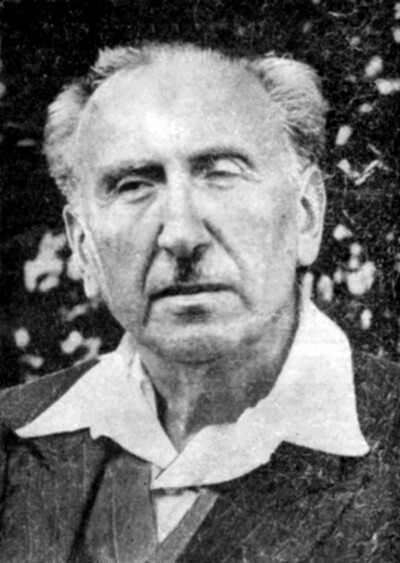
Shats-Anin, Maks
June 22, 1885–January 13, 1975
A journalist, historian, and professor, he was born Maks-Urye Shats in Friedrichstadt (Jaunjelgava), Latvia. At the start of the twentieth century, he joined the democratic movement. He studied law in St. Petersburg University and in 1909 completed his studies in Berne. His German doctoral dissertation on the nationalities problem caused a stir in socialist circles. In 1912 he returned to Riga, and from 1916 he was living in St. Petersburg and Kiev. From 1919 he worked as a practicing attorney in Riga.
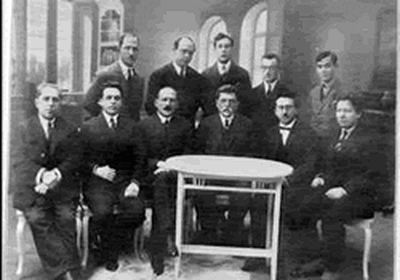
Earlier, after the 1905 Revolution, he led an illegal group of literary, artistic, and cultural figures—known as Arbeter-Heym (Workers’ Home)—and was arrested on several occasions. He was theoretically and practically among the leaders and ideologues of Zionist socialism, later in the United Jewish Socialist Labor Party and its representative in the small central Rade; in 1922 he switched to Communism.
Following the fascist coup in Latvia, he was forbidden from appearing in public, but he continued his work illegally. After severe physical torture in Latvian prisons, in 1928 he lost his eyesight, but this did not break his energy. In 1937 he was a delegate to the Congress for Jewish Culture in Paris.
He was evacuated during WWII to Alma-Ata and later Moscow. After the war, he returned to Riga in 1945 and again took up his literary and scholarly work, publishing in the Russian press.
When Sovetish Heymland (Soviet Homeland) launched publication in Moscow, he published his memoirs in it (including his meetings with Sholem-Aleichem and Vladimir Mayakovsky, as well as other people and events).
He wrote lyrical and philosophical essays, socialist journalism, and ideological Party articles in Latvian, Russian, German, and especially in Yiddish in: Fraynd (Friend) (1906-1907); the Vilna organs of Zionist socialism, Der Nayer Veg (The New Way), Der Veg (The Way), and Dos Vort (The Word); Dos Idishe Frayland (The Jewish Free Land) in Vienna (1910), which he published with Latski-Bertoldi; Tsukunft (Future)—including a major work entitled “Klas un Natsyon” (Class and Nationalist) in 1910; Naye Tsayt (New times) in Kiev (1917-1919), of which he was co-editor; Der Idisher Proletaryat (The Jewish Proletariat), vol. 2 (Kiev, 1918); the collection Tsum Ondenk fun M. B. Ratner (To the Memory of M. B. Ratner) (Kiev: Brothers A. un M. Zayezdni, 1919); Baginen (Dawn) in Riga (1920); Afn Shvel (On the Threshold) (1921); Kultur un Arbet (Culture and Labor) (1922); Sambatyon (Sambation) (1922); Flekn (Spots) (1922; this last collection from Riga was published by Arbeter-Heym); the weekly newspaper Naye Tsayt in Riga (from 1923 he was the most active contributor); In Shpan (In Line) in Vilna (1926), edited by Dovid Bergelson in Berlin; Hamer (Hammer), Yidishe Kultur (Jewish Culture), Morgn Frayhayt (Morning Freedom), and Zamlungen (Collections)—in New York; Bleter (Newspaper) in Kovno (1940); and Folks-Shtime (Voice of the People) in Warsaw; among others.
After the entrance of the Red Army into Latvia (June 20, 1941), he edited the daily Kamf (Struggle) and the literary periodical Oyfboy (Construction). Shats-Anin also published critical essays on Russian and Latvian literature and on issues of Jewish culture and Yiddish writers (Mendele, Sholem-Aleichem, Y. L. Perets, Avrom Goldfaden, Dovid Bergelson, and others).
In book form:
Der Veg funem Yudishen Proletaryat (The Path of the Jewish Proletariat) (Warsaw: Tsukunft, 1918), 32 pp.;
Herman Kohen (Hermann Cohen) (Riga: Arbeter-Heym, 1922), 32 pp.;
Fun Roym tsu Tsayt, Gedanken tsu a Kultur-Filosofye (From Space to Time, Thought on a Philosophy of Culture) (Riga: Arbeter-heym, 1922), 72 pp.;
Di Revolutsye Als Psikhologisher Protses (The Revolution as Psychological Process) (Riga: n.p., 1923), 72 pp.;
Kunst als Forgefil fun Makht (Art as a Presentiment of Power) (Riga: n.p., 1924), 45 pp.;
Di Idn in Letland (The Jews of Latvia) (Riga: OZE, 1924), 72 pp.;
Gezelshaftlekhe baṿegungen ba yidn far 1917 (Social movements among Jews before 1917) (Riga: Bikher far alemen, 1930), 164 pp.;
Krizis fun der Burzhuazer Kultur (Crisis in Bourgeois Culture) (Riga: n.p., 1932), 87 pp.;
Biro-Bidzhan, Nekhtn-Haynt-Morgn (Birobidzhan, Yesterday-Today-Tomorrow) (Warsaw: Iberboy, 1933), 95 pp.;
Di Gezelshaftlekhe Bavegungen Ba Yidn Tsvishn der Ershter un Tsveyter Milkhomes (The Social Movements Among Jews Between the First and Second Wars) (Riga, 1941).
He died in Riga.
Seated second from right
Sources: Zalmen Reyzen, Leksikon, vol. 1 (under “Anin”); Yitskhok Yanasovitsh, Mit Yidishe Shrayber in Rusland (With Yiddish Writers in Russia) (Buenos Aires, 1959), pp. 185-96; Khayim Shoshkes, in Tog-Morgn-Zhurnal (New York) (October 7, 1962); Sovetish Heymland (Moscow) 6 (1965); Itonut yehudit shehayta (Jewish Press That Was) (Tel Aviv, 1973), p. 386; Yeshurin archive, YIVO (New York).