
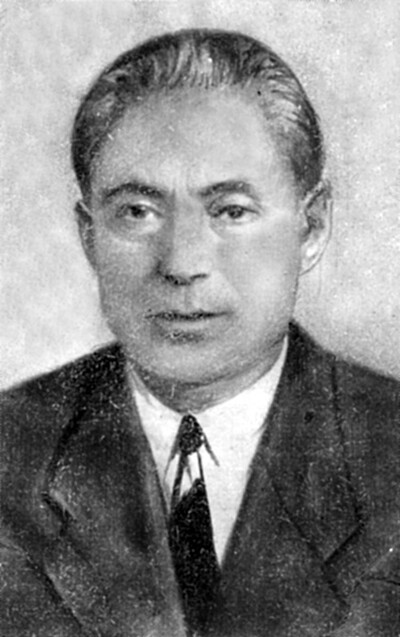
Loytsker, Khayim
1898–1970
He was a literary critic and linguistic, born in the town of Kanyev (Kaniv), Ukraine, to a father who was a leather worker. He received a traditional Jewish education both at home and in religious primary school, and at the same time a general education in a Russian school. He was later an intensive self-learner. In the early 1920s he founded a children’s home in his hometown for orphans and pogrom victims, and he worked there as an educator and teacher. He went on to organize a youth home in the city of Boslev (Bohuslav), while he taught language and literature in a middle school. In 1930 he graduated from the literature and linguistics division of the Second Moscow State University, continued his pedagogical activities, and turned his attention to scholarly work in the field of Yiddish linguistics and pedagogy.
At that time he debuted in print with poetry and dramatic studies in children and youth magazines in Moscow. He published articles in scholarly publications (see below), such as the Kiev journal Di Yidishe Shprakh (The Yiddish Language). He lectured in the linguistics section in the Department of Soviet Yiddish Literature, Language, and Folklore in the Ukrainian Academy of Sciences. From 1931 he was a research student, and thereafter a scholarly collaborator in the philology section of the Kiev Institute of Jewish Culture in the Academy. In 1937 he successfully defended his dissertation and became a “candidate (Russian equivalent to PhD) in Philological Science.”
He continued his research on questions of language and style in the artistic Yiddish literature: Sholem-Aleichem, Dovid Hofshteyn, Dovid Bergelson, and others. He dedicated a series of works to actual problems of pedagogy, connected to teaching language and literature in Jewish schools—when such schools were in existence. In the 1920s and 1930s, he achieved much in the field of preparation of textbooks for language and literature for Jewish schools, and actively participated in the collective work on the great Russian-Yiddish dictionary which only appeared after his death.
In 1942 he—together with Elye Spivak and Moyshe Maydanski—worked on a text in Yiddish and Russian “concerning the Yiddish literary language, its history, and its contemporary state,” as well as on a text concerning “issues in new word creation in Soviet Yiddish poetry.” Portions of these works appeared over the course of 1942-1943 in publications of the Ukrainian Academy of Sciences. He completed a work, entitled “Di Shprakh fun Dovid Bergelson” (The Language of Dovid Bergelson), and was working on the language of Perets Markish. In 1946 he was working on a study, “Sholem-Aleykhem in Ukraine” (Sholem-Aleykhem in Ukraine).
In 1948 he was head of the literary division of the Ukrainian Academy of Sciences.
He was arrested on May 5, 1949, charged with “anti-Soviet activities” and “espionage associations with Americans,” and sentenced to fifteen years of forced labor. He was freed on April 27, 1955, and from that time until the end of his life, he produced nothing further in the field of Yiddish literary or linguistic research. He was later “rehabilitated” (i.e., exonerated).
Among his important published articles: on language in Shmuel Godiner’s novel Der Mentsh mit der Biks (The Man with the Rifle), in Di Yidishe Shprakh (1930); “Tsu der Lektsik un Vortbildung bay Dovid Hofshteyn” (On Dovid Hofshteyn’s Vocabulary and Language Education), Di Yidishe Shprakh (November-December 1930), cols. 25-30; “Vegn Reyd-Antviklung in di Eltere Klasn” (On Speech Development Among the Older Classes), Ratnbildung (Soviet Education) (Kharkov-Kiev) 3 (1934), pp. 53-64; “Vegn dem Tsushtand Funem Shprakh-Limed in Shul” (On the Standing of the Field of Language in School), Afn Shprakhfront (On the Language Front) (Kiev) 3-4 (1935); “Vegn der Leksik fun Albertons Personazhn” (On the Vocabulary of Alberton’s Personages), Afn Shprakhfront 1 (1937), pp. 47-65; “Vi Azoy di Yidishe Tsaytungen in Ratn-Farband Zetsn Iber Stalins Redes” (How the Yiddish Newspapers in the Soviet Union Translate Stalin’s Speeches), Afn Shprakhfront 2.2 (1937), pp. 65-96; “Frages fun Dikhterishe Iberzetsung” (Questions of Poetic Translation), Afn shprakhfront 2.3 (1937), pp. 21-70, an analysis of the Yiddish translations of Pushkin’s poetry rendered by Dovid Hofshteyn, Ezra Fininberg, Lipe Reznik, Moyshe Khashtshevatski, Yosl Kotler, and Hersh Remenik; “Humor in Sholem-Aleykhems Shprakh” (Humor in Sholem-Aleichem’s Language), Afn Shprakhfront 2.4 (1937), pp. 17-66.
His books include: Tsum Nayem Lebn, Khrestomatye far Onfangs-Shuln fun Algemeyner Bildung far Dervaksene (Toward a New Life, a Reader for Beginning School in General Education for Adults), with Y. Baksht and G. Entin (Moscow-Kharkov-Minsk: Central People’s Publishers, USSR, 1930), 245 pp.; Shprakh-Genitungen (Language Exercises), with A. Gelbman (Kiev-Kharkov: Ukrainian State Publishers for National Minorities, 1936), 103 pp., second edition (1937), third edition (1938), 112 pp.; Yidish in Shul (Yiddish in School), “according to the materials of inquiry, May 1935” (Kiev: Ukrainian State Publishers for National Minorities, 1936), 67 pp.; Gramatik (Grammar), “textbook for the fifth and sixth classes in middle school” (Kiev: Ukrainian State Publishers for National Minorities, 1938), with Moyshe Shapiro, part 1, “Morphology”; Gramatik un Ortografye, Lernbukh far 3tn Klas (Grammar and Orthography, Textbook for the Third Class), with Ayzik Zaretski (Kiev, 1938), 135 pp., appearing in numerous editions, among them Kovno (Society of Lovers of Knowledge, 1940); Zamlung fun Sistematishe Diktantn far der Onfang- un Mitl-Shul (Collection of Systematic Dictations for Elementary and Middle School), with Moyshe Shapiro (Kiev, 1940), 143 pp.
Sources: N. Rubinshteyn, Dos Yidishe Bukh in Sovetn-Farband 1933 (The Yiddish Book in the Soviet Union, 1933) (Minsk, 1935), p. 67; Rubinshteyn, Dos Yidishe Bukh in Sovetn-Farband 1934 (The Yiddish Book in the Soviet Union, 1934) (Minsk, 1935), p. 63; Rubinshteyn, Dos Yidishe Bukh in Sovetn-Farband 1935 (The Yiddish Book in the Soviet Union, 1935) (Minsk, 1936), pp. 19, 29; Biblyografishe Yorbikher fun YIVO (Bibliographic Yearbooks from YIVO), vol. 1 (Warsaw, 1928); Y. Mark, “Yidishe Lingvistishe Arbet in Sovetn-Farband) (Yiddish Linguistics Work in the Soviet Union), YIVO-Bleter (New York) 16.1 (September-October 1940), pp. 31ff, 16.2 (November-December 1940), pp. 150-54; A. Kahan, in Eynikeyt (Moscow) (July 15, 1942; April 5, 1943; April 2, 1946); M. Man, in Di Goldene Keyt (Tel Aviv) 34; Chone Shmeruk, comp., Pirsumim yehudiim babrit-hamoatsot, 1917-1961 (Jewish Publications in the Soviet Union, 1917-1961) (Jerusalem, 1961), see index.