
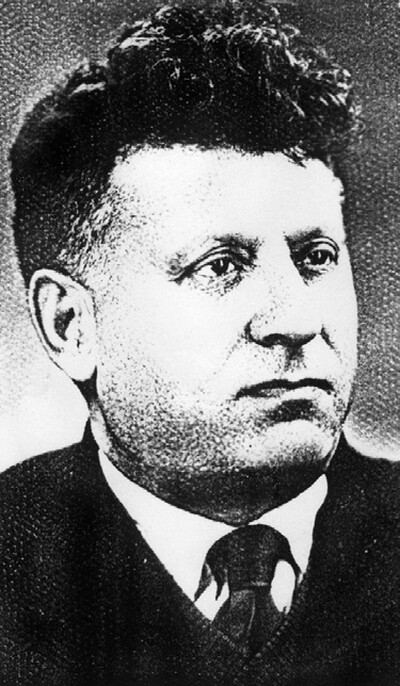
Lurye, Note
January 15, 1906–November 28, 1987
He was a prose author, born in the old Jewish colony of Roskoshnaya (Roskoshnyy), Zaporozhye (Zaporizhzhya) district, Ukraine, into the family of peasant colonists. During a pogrom in 1919, the majority of the residents in the colony were massacred, and he moved with his family to Hulyaypole. He studied in religious primary school, and privately during the revolutionary and Civil War years.
In 1922 he began his wanderings across Ukraine and Byelorussia. He worked for the Jewish agricultural firm of Krasovshtshine near Minsk and studies in evening courses. In 1923 he became a student at the Jewish pedagogical technicum in Minsk and became a member of the Minsk literary group that assembled around the newspaper Der Yunger Arbeter (The Young Worker); in 1925 he debuted in print with a story in the journal Yungvald (Young Forest) in Moscow. Over the years 1926-1931, he studied in the Yiddish division of the Second Moscow State University and worked on the editorial boards of the Moscow periodicals: Pyoner (Pioneer) and Yungvald. In 1929 he published a longer story, “Baynakht af Pashe” (In the Pasture at Night), in Der Emes (The Truth), which introduced him to the larger world of literature.
His main theme was the life of ordinary Jews in villages, especially those far from the social and economic processes underway in conjunction with collectivization. Over the years he published stories in all the Soviet Jewish newspapers, periodicals, and anthologies in Moscow, Kiev, Kharkov, and Minsk.
In 1932 he brought out the first part of his life work, Der Step Ruft (The Steppe Calls) (Moscow: Emes), 206 pp. [second edition (Minsk: Byelorussian State Publishers, 1934)], which was dedicated to the same rural theme. This novel brought him recognition as a prime example of realism, was included in school programming, and won enthusiastic acclaim from Dovid Bergelson, Moyshe Litvakov, and other prominent writers. In circles of readers and writers, he was even anointed as the “Jewish Sholokhov.” Lurye received such widespread recognition that at the first all-Soviet writers’ conference, in August 1934 in Moscow, he had the honor of appearing on stage to lecture on young Soviet Yiddish literature.
From 1931 to 1941 he was a resident of Odessa, and he was one of the central figures in Soviet Yiddish literature. Der Step Ruft was translated into Russian, Ukrainian, and other languages, and it was performed on the stage. The second part of the novel soon appeared in print, and shortly after the war part three as well. With the outbreak of the Soviet-Nazi war, Lurye was mobilized in the first days of the fighting, and he was at the front for the entire war.
He was arrested in the early 1950s together with other Yiddish writers and was sentenced initially to a term of twenty-five years in prison which was subsequently reduced to ten years. After Stalin’s death he was set free (April 27, 1955), and he lived in Odessa. In the post-Stalin years, he went on to produce major works, essays, and numerous stories.
He served on the editorial board of Sovetish Heymland (Soviet Homeland) in Moscow from its first issue in 1961. Shortly after entering the ninth decade of his life, he conceived a major autobiographical work, but he was only able to complete the first few chapters which were published as a supplement to the journal Sovetish Heymland after his death.
His work was included in the anthology In Undzere Teg (In Our Time) (Moscow: Sovetski Pisatel, 1983) 558 pp. edited by Arn Vergelis.
“Note Lurye wanted to be,” wrote Shmuel Niger, “a priest of proletarian literature—and he became its victim. Had that not been the case, he would certainly have been more original and profound. He surely had artistic talent. He demonstrated this when he left the class struggle for a while to nature, and when he felt free of control.”
Among his books: Der Step Ruft, Roman, Baarbet far der Shul (The Steppe Calls, a Novel, Adapted for the Schoolroom) (Minsk: Byelorussian State Publishers, 1934), 178 pp.; A Pasazhir, Shkheynim (A Passenger, Neighbors) (Moscow, 1937), 29 pp.; A Libe Baym Yam (A Love by the Sea) (Moscow: Emes, 1938), 31 pp.; Ba Mir in Land, Fartseykhenungen (Near Me In Country, Jottings) (Kiev: Ukrainian State Publishers for National Minorities, 1938), 58 pp.; Dertseylungen (Stories) (Kiev, 1939), 170 pp.; Der Letster Individual (The Last Individual), a story (Kiev: Ukrainian State Publishers for National Minorities, 1939), 25 pp.; A Zun fun Folk (A Son of the People) (Kiev: Ukrainian State Publishers for National Minorities, 1939), 27 pp.; Khane Uskatsh (Hannah Uskatsh) (Kiev: Ukrainian State Publishers for National Minorities, 1939), 27 pp.; Der Step Ruft, parts 1 and 2 together (Kiev, 1941; Moscow: Der Emes, 1948), 599 pp. Himl un Erd (Heaven and Earth), a novel (Moscow: Sovetski Pisatel, 1965), 306 pp.; Yam un Himl, Roman, Dertseylungen un Fartseykhenungen (Sea and Heaven, a Novel, Stories, and Jottings) (Moscow: Sovetski Pisatel, 1978), 286 pp.; Ba Undz in Odes (With Us in Odessa) (Moscow: Sovetski Pisatel, 1980), 60 pp.
He began to write a long autobiographical novel, Di Geshikhte fun a Libe (The Story of a Love),[1] of which several chapters appeared in Sovetish Heymland 7-8 (1988). He also translated V. Korolenko’s Agripus un Menakhem, der Zun fun Yehude (Agripus and Menahem, the Son of Judah) (Kiev: Kultur-Lige, 1922), 30 pp. His work appeared in: Deklamater fun der Sovetisher Yidisher Literatur (Reciter of Soviet Yiddish Literature) (Moscow: Emes, 1934); Komyug, Literarish-Kinstlerisher Zamlbukh ([Jewish] Communist Youth, Literary-Artistic Anthology) (Moscow: Emes, 1938); and Shlakhtn (Battles) (Kharkov-Kiev: Ukrainian State Publishers for National Minorities, 1932).
[1] Elsewhere this unfinished work is referred to as Yorn un Teg (Years and Days) (JAF).

Sources: A. Vorobaytshik, in Shtern (Minsk) (June 1932); N. Mayzil, in Literarishe Bleter (Warsaw) 32 (1932); Mayzil, Dos Yidishe Shafn un der Yidisher Arbeter in Sovetn-Farband (Jewish Creation and the Jewish Worker in the Soviet Union) (New York, 1959), see index; D. Bergelson, in Naye Erd (Riga) (September 1932); Yekhezkl Dobrushin, Ed., In Iberboy, Literarishe Kritishe Artiklen (Under Reconstruction, Literary Critical articles) (Moscow, 1932); Sh. Klitenik, Verk un Shryaber (Work and Writer) (Moscow, 1935); Al. Pomerants, Inzhinyern fun Neshomes (Engineers of Souls) (New York, 1943), p. 45; I. Fefer, in Eynikeyt (Moscow) (February 7, 1943); Y. Katsenelson, in Morgn-Frayhayt (New York) (March 11, 1956); Shmuel Niger, Yidishe Shrayber in Sovet-Rusland (Yiddish Writers in Soviet Russia) (New York, 1958), pp. 381-87; M. Shklyar, in Folks-Shtime (Warsaw) (November 18, 1961); Chone Shmeruk, comp., Pirsumim yehudiim babrit-hamoatsot, 1917-1961 (Jewish Publications in the Soviet Union, 1917-1961) (Jerusalem, 1961), see index; N. Mayzil, Tsurikblikn un Perspektivn (Retrospectives and Perspectives) (Tel Aviv, 1962), see index; A. Pomerants, Di Sovetishe Haruge Malkhes (The [Jewish Writers] Murdered by the Soviet Government) (Buenos Aires, 1961), p. 487.