
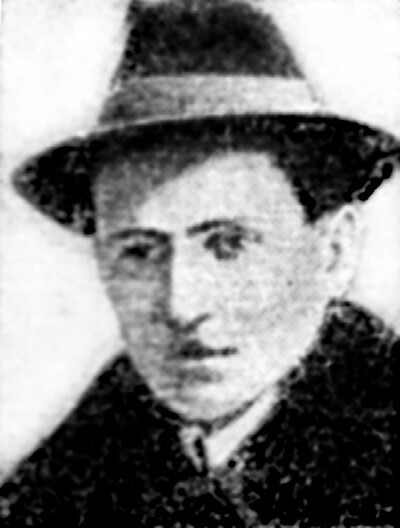
Margolis, Yedidye
September 22, 1884–1949
He was a prose author, born in the village of Pushchiki (Pustiki), near Vawkavysk (Wołkowysk), Grodno province, Russian Poland (now, Belarus). His grandfather was among the first Jewish colonists in the colony of Gliliya in Vawkavysk district, and his father, R. Moyshe Tsvi Margolis, was a timber merchant and a follower of the Jewish Enlightenment. He received a traditional Jewish education. Until age fourteen he studied with itinerant schoolteachers in the neighboring town of Porazava and later in the Vawkavysk yeshiva. He went on later still to study foreign languages on his own, as well as philosophy, history, and literature, while becoming interested in music, painting, and theater.
While still quite young, he began to compose lyrical, philosophical poetry in Hebrew as well as in Russian. At age eighteen he threw in with the socialist movement and became a member of the Vawkavysk organization of the Bund.
His literary activity began in 1904 (using the pen name “Leo Margulisov”) with critical and journalistic articles in
Avrom Reyzen’s serials—
Khanike-Blat (Hanukkah Paper) and
Khamish-oser-bishvat-blat (Tu Bishvat Paper) — and in
Yorbukh Progres (Progress Annual) (Warsaw: Progres, 1904), 164 pp.
That same year, he moved to the United States and settled in New York, where for about four years he worked in a sweatshop making ladies’ purses, while publishing sketches, poems, essays, and articles in the Yiddish press such as:
Dovid Listik’s weekly Der Arbayter (The Worker),
Fraye Arbeter-Shtime (Free Voice of Labor),
the territorialist Dos Folk (The People),
Idisher Kempfer (Jewish Fighter),
Di Tsukunft (The Future), and
the collection Troymen un Virklekhkeyt (Dreams and Reality),
among others.
He was a member of the contemporaneous literary group Di Yunge (The Young Ones) and (together with Yoyel Entin, Moyshe Shmuelzon, and M. Y. Khayimovitsh) edited the anthology
Yugend (Youth) (New York, 1907).
He also assisted in bringing out
Dovid Ignatov’s first story Tsvey Kreftn (Two Powerful Ones), to which he added a preface.
He was also a cofounder of the journal of humor
Der Kibitser (The Kibitzer) (New York, 1908).
Due to overexertion with work—at the sweatshop and at night writing—he acquired an eye ailment, and in 1908 he returned to Russia. Over the years 1908-1913, he lived in Warsaw, where he brought out a collection of stories and continued publishing in various literary works, among them:
the anthology Lebens-Klangen (Sounds of Life) (Warsaw: Leben, 1912), edited by Moyshe Stavski;
the weekly Der Shtrahl (The Beam [of light]), “an illustrated weekly newspaper for the Jewish family” (Warsaw, 1913);
Frishmans-Yubileum-Bukh (Frishman’s Jubilee Volume) (Warsaw: Universal, 1914), 184 pp.;
and the like.
In partnership with his father, he built a brick factory, which afforded him the capacity to publish his books.
The outbreak of WWI, however, ruined him financially, and in 1915 he was living like a refugee in Russia. He was drafted in 1916 into the Tsarist army, but due to his poor health, he was released from duty. In 1917 he was living in Petrograd, where he participated in the Office Convening a Jewish Conference. He returned to Vawkavysk in 1918, and then in 1920 returned to Soviet Russia. Over the years 1920-1922, he was a technical contributor to the Jewish Division of the Commissariat for Ethnic Affairs in Moscow, and later (until 1930) he was the proofreader on the editorial board of Der Emes (The Truth) in Moscow.
He published several books of prose over the following years. His last work was a story entitled
“In di Khayes-Negl” in the literary collection Tsum Zig (To Victory) (Moscow: Emes, 1944), edited by Perets Markish, and
his name appeared under a greeting to Dovid Bergelson on the latter’s sixtieth birthday, published in Eynikeyt (Unity) in Moscow (April 1944).
Further biographical information remains unknown.
From his writings published in various newspapers, journals, and anthologies in Europe and the United States, those in book form include:
Dertseylungen (Stories) (Warsaw: Di Velt, 1909), 107 pp.;
Fun Hayntike Tsaytn, Satirn un Novelen (Of Contemporary Times, Satires and Novellas) (Warsaw: Tsentral, 1912), 155 pp.
Under the influence of Chekhov’s plays, he wrote
Shir hayikhed (The Song of Unity), a drama in three acts (Warsaw: Tsentral, 1913), 56 pp., in which he attempted to describe the nostalgia of Jewish youth and their religious searching;
Margolis had earlier, during his time in America, published a play entitled “Fun lEbn” (From Life) in Idisher Kempfer (Philadelphia) 16-19 (1906).
In his Soviet period, he published in pamphlet format:
Vayte Shayn, Fragment un Ferzn (Distant Glow, Fragments and Verses) (Moscow: Avtor, 1922), 14 pp.;
Milkhome-Tsayt, Skitse (Wartime, Sketch) (Moscow: Avtor, 1922), 16 pp., written in Ryazan' in 1917;
Nay-Tehilim, Gezangen (New Psalms, Songs) (Moscow: Avtor, 1922), 16 pp.;
Amkho, a Folks-Drame in Dray Aktn (Jewish People, a Folk Drama in Three Acts) (Moscow, 1923), 28 pp.;
Tsvishn Frontn, Dertseylungen (Between Fronts, Stories) (Moscow-Kharkov-Minsk: Central People’s Publisher, USSR, 1930), 109 pp.;
In Smolyarnye, Dertseylung (In Smolyarnya, a Story) (Moscow: Emes, 1936), 76 pp.;
Poyerim, Dertseylung (Peasants, a Story) (Moscow: Emes, 1939), 199 pp.;
Sokhrim, Dertseylung (Merchants, a Story) (Moscow: Der emes, 1941), 148 pp.
He also translated
Yirmye hanovi (Jeremiah the Prophet [original: Yirmiya hanavi]) by Moritz Lazarus (Warsaw: Velt-Biblyotek fun B. Shimin, 1909), 96 pp.
He penned the preface to a small book of poems by Elishe Radin entitled Heroik (Heroic) (Homyel', 1921), 33 pp.
Among his published work that did not appear in book form:
his great chronicle of New York, “Zundel Bregman,” the first part of which appeared in the weekly Dos Folk and in Petrograd’s Togblat (Daily newspaper) in 1918;
the story “Yosele Boym” (Joey the Tree), from the life of Jewish homeless;
as well as dramas, poetry, and more.
Sources: Zalmen Reyzen, Leksikon, vol. 2, with a bibliography; Zalmen Zilbertsvayg, Leksikon fun Yidishn Teater (Lexicon of the Yiddish Theater), vol. 2 (New York, 1934); Moyshe Litvakov, In umru (In anxiety) (Moscow, 1926), pp. 103-4; Shmuel Niger, in Literarishe Bleter (Warsaw) (Warsaw) (April 29, 1927); Niger, in Di Tsukunft (New York) (May-June 1942); D. B. Tirkel, in Pinkes fun amopteyl fun YIVO (Records of the American division of YIVO), vol. 1 (New York, 1927-1928), p. 261; Avrom Reyzen, Epizodn fun mayn lebn (Episodes from my life), vol. 2 (Vilna, 1929); Y. Bronshteyn, in Atake, almanakh fun roytarmeyishn landshuts-literatur (Attack, almanac of the Red Army’s national defense literature) (Moscow-Kharkov-Minsk, 1930); Sh. Chayes, Otsar beduye hashem (Thesaurus Pseudonymorum; Treasury of pseudonyms) (Vienna: Glanz, 1933), p. 194; D. Ignatov, in Di Tsukunft (December 1944); Ignatov, Opgerisene Bleter, eseyen, farblibene ksovim un fragmentn (Torn off Pages, essays, extant writings, and fragments) (Buenos Aires: Yidbukh, 1957), pp. 68ff; B. Mark, in Folksshtime (Warsaw) 40 (1947); Volkovisker yizker-bukh (Wołkowysk memorial volume), edited by Dr. Mozes Aynhorn (New York, 1949), vol. 2; N. Mayzil, Dos yidishe shafn un der yidisher shrayber in sovetnfarband (Jewish creation and the Jewish worker in the Soviet Union) (New York, 1959), see index; Chone Shmeruk, comp., Pirsumim yehudiim babrit-hamoatsot, 1917-1961 (Jewish Publications in the Soviet Union, 1917-1961) (Jerusalem, 1961), see index; documents in the archives at YIVO.