
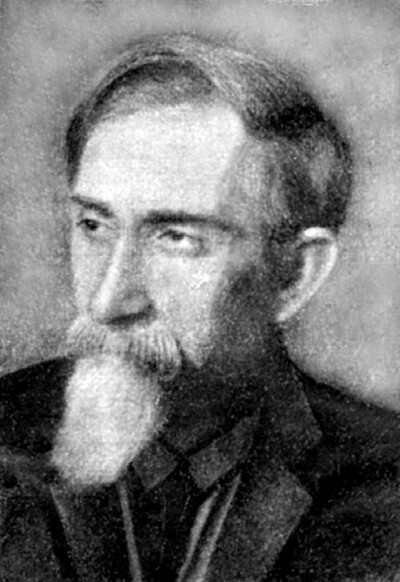
Nusinov, Yitskhok
July 14, 1889–November 30, 1950
He was a literary scholar and critic, born in Chernigov (Chernihiv), Volhynia, Ukraine. His father who descended from rabbis was himself a follower of the Jewish Enlightenment, and he held as a lessee a glass factory. Nusinov studied with private tutors and later on his own. From 1906 he was active in the Bund and organized illegal Jewish evening schools and libraries in the Volhynia region. In 1910 he graduated as an external (auditor) student from a high school in Warsaw. In 1912 he organized in Korosten' a Yiddish school, the only one of its kind in Volhynia and one of two or three such schools in Ukraine.
In early 1914 he traveled to Italy and went on later to Switzerland where he studied literature, philosophy, philology, and art. At the same time, he was studying French, German, English, and Italian.
The years of WWI were for him not only a time of deepening his general knowledge, but of strengthening his world view. He was a supporter of the Bolshevik stance on the bloodbath of the war, an opponent of a defensive position concerning the Russian fatherland.
In Switzerland where he was recovering from spinal cord tuberculosis, he gained news of the February Revolution (1917) and proceeded to travel to Russia. En route back, he stopped in Kiev, chaired the provincial committee of the Bund in Chernigov, and served as vice-chairman of the Jewish community council. In late 1919 he joined the Communist Party and for a time was in charge of the Jewish section of the Party in Kiev. In late 1920 he became chairman of the Kultur-Lige (Culture League) in Kiev and co-editor of its publishing house, in which he devoted his attention to editorial and publishing work.
In the autumn of 1922 he began a new period in his life when he settled in Moscow and joined the Russian Association of Scholarly Research Institutes of the Social Sciences (RANION). Two years later, he defended a dissertation on
The Problems of the Historical Novel, Victor Hugo and Anatole France (see below),
and he was selected as a member of the Communist Academy where he devoted himself to pedagogical and scholarly work. In this era, he published a significant series of scholarly research dedicated to Yiddish, Russian, and foreign literatures. He was a professor of Western literature in the Moscow Institute of Red Professors, a professor of the history of Yiddish and Western European literatures at Moscow State Pedagogical Institute where he was for a time chair of the department of the history of Western European literature. He taught such courses as: the history of Yiddish literature and literature of peoples of the West, in the Yiddish section of Moscow’s Mayrevke (Communist University of National Minorities of the West); and the history of Yiddish literature in the nineteenth century, in the Yiddish linguistics department of No. 2 University.
He also wrote for Russian-language publications on Yiddish literature, including many entries on Yiddish writers in
Bol'shaia Sovietskaia Entsiklopediya (Great Soviet Encyclopedia) and
in the Soviet Literaturnaia Entsiklopediya (Literary encyclopedia).
His creative range as a critic and literary researcher was exceedingly broad: issues of art theory and aesthetics, the Yiddish classics and Soviet Yiddish writers, theater, Western European writers, and the Russian classics.
His essay devoted to Mendele Moykher-Sforim,
“Fun Bukh tsu Bukh” (From Book to Book), an analysis of Mendele’s texts and variants of his works, served as the foreword to Mendele’s Dos Vintshfingerl (The Wishing Ring) and Masoes Benyomen Hashlishi (Travels of Benjamin III).
In 1926 he also published an essay on Sholem-Aleichem’s beginnings with
Yudishes Folksblat (Jewish People’s Newspaper), and
later he wrote about Sholem-Aleichem’s Idishe Romanen (Yiddish Novels) and Mayses far Yidishe Kinder (Stories for Jewish Children). He also devoted a fair number of articles to Y. L. Perets. He published several dozen articles on the founders of Soviet Yiddish literature—concerning the work of Izi Kharik, Perets Markish, Dovid Bergelson, Der Nister, Itsik Kipnis, and Arn Kushnirov.
He did not, however, evade the campaign against “bourgeois cosmopolitanism,” the anti-Semitic attack on Jewish culture. According to Sheyne-Miriam Broderzon, he was arrested, as was the case with many other writers, on January 18, 1949, brought to the Lubianka Prison, a sick man, and there he died on November 30, 1950 in utter destitution.
His literary activities in Yiddish began with
Folks-Tsaytung (People Newspaper) in Kiev
—and later with:
Komunistishe Fon (Communist Banner) in Kiev;
Emes (Truth) in Moscow; and
Der Shtern (The Star) and
Di Royte Velt (The Red World)
— in Kharkov;
among others.
Together with Nokhum Oyslender and Dovid Hofshteyn, he edited the series
Lirik (Lyric), ten booklets (Kiev: Kultur-Lige, 1921).
He published a series of important books in Russian and Yiddish on Yiddish, Russian, and French literature, as well as a Russian volume
Problema Istoricheskogo Romana, V. Giugo i A. Frans (The Problem of the Historical Novel, V. Hugo and A. France) (Moscow, 1927), 319 pp.
He edited editions of the Russian classics which included Lev Tolstoy. He was also involved in pedagogical work, serving as a professor in the Gorky Institute for Language and Literature in the Soviet academy and other senior schools. He published hundreds of research works in all the important journals and scholarly publications, both Yiddish and Russian, many of them not reproduced in book form.
He also edited:
the Soviet Perets-Oysgabe (Perets Edition) (1926);
Mendele’s Gezamlte vErk (Selected Works) (Moscow: Emes, 1935);
the Russian translation of Yoysef Opatoshu’s Poylishe Velder (Polish Woods) [as V Polskikh Lesakh (442 pp.)]; and
was co-editor of the collection Sovetish (Soviet) and other journals.
Nusinov was a sharp polemicist, but even more he was the object of attack on the part of all the important Soviet Jewish critics, such as Moyshe Litvakov, Yashe Bronshteyn, Khazkl Dunets, Arn Gurshteyn, Meyer Viner, Dovid Kurland, Maks Erik, and others, who found in him every sort of “deviation from the Party line,” and they virulently polemicized against many of his opinions and attitudes. During WWII he was very active on the Jewish Anti-Fascist Committee.
He co-edited (with Leyb Kvitko and Yitskhok Katsenelson) the first anti-Hitler pamphlet,
Dos Blut Ruft tsu Nekome! (The Blood Cries Out for Revenge!) (Moscow: Emes, 1941), 114 pp.
He was also one of the signatories of the appeal,
“Tsu di Yidn fun Gor der Velt” (To Jews Throughout the World) of the Moscow Anti-Fascist Committee (June 1942).
He was a member of the historical commission of the Committee and in the Jewish section of the theater society. According to a published report, at a meeting in 1944 of Yiddish writers in Moscow, he publicly demanded that the writers and the Committee call upon the Soviet government to accommodate the evacuated Jews in Crimea.
Other books include:
Teoryes (Theories), literary-critical articles (Moscow: Central Publishers, 1926), 58 pp.;
L. Toltsoy, M. Gorki, A. Tshekhov (L. Tolstoy, M. Gorky, A. Chekhov) (Moscow: Central Publishers, 1930), 207 pp.;
Maksim Gorki, Zamlbukh fun Marksistishe Kritik (Maxim Gorky, Collection of Marxist Criticism) (Moscow: Emes, 1932), 245 pp.;
Problemen fun Proletarisher Literatur (Issues in Proletarian Literature) (Kharkov: State Publ., 1932), 204 pp.;
Khaver Inzhiner (Comrade Engineer), a drama written with Yekhezkl Dobrushin, staged in 1932 in the Yiddish and Russian theaters of Moscow, Odessa, and other cities, produced under the title “Spets” (Specialist) by Shloyme Mikhoels in the state theater.
His work also appeared in:
Osher Shvartsman (Osher Shvartsman) (Kiev: Ukrainian State Publishers for National Minorities, 1939); and
Farn Heymland in Shlakht! (For the Homeland in Battle!) (Moscow: Emes, 1941).
Sources: Zalmen Reyzen, Leksikon, vol. 2; Zalmen Zilbertsvayg, Leksikon fun Yidishn Teater (Lexicon of the Yiddish Theater), vol. 2 (New York, 1934); A. Gurshteyn, in Tsaytshrift (Minsk) 1 (1926); Visnshaftlekhe Yor-Bikher (Scholarly Annuals) 1 (Moscow, 1929); L. Kvitko, statement in Di Royte Velt (Kharkov) 9 (1929), p. 195, (1932), p. 15, (1936), pp. 44-56; Y. Bronshteyn, in Atake, Almanakh fun Roytarmeyishn Landshuts-Literatur (Attack, Almanac of the Red Army’s National Defense Literature) (Minsk, 1930), pp. 301-18; Dr. Y. Shatski, ed., Arkhiv far der Geshikhte fun Yidishn Teater un Drame (Archive for the History of Yiddish Theater and Drama) (Vilna-New York, 1930), pp. 465-66; A. Osherovitsh, in Di Royte Velt (1931), p. 122; Z. Reyzen, in YIVO-Bleter (Vilna) 1.3 (1931), pp. 193-207; B. Brogin (Froim Oyerbakh), in Morgn-Zhurnal (New York) (January 13, 1932), concerning Litvakov’s attack on Nusinov; M. Osherovitsh, in Forverts (New York) (July 21, 1932); Kh. Dunets, Far Magnitboyen fun der Literatur (On the Great Works of Literature) (Minsk, 1932), pp. 62-63; D. Kurland, in Afn Visnshaftlekhn Front (Minsk) (1934), p. 150; Shmuel Niger, in Di Tsukunft (New York) (November 1934); Borekh Glazman, in Idisher Kemfer (New York) (October 1940); H. Vaynraykh, Blut af der Zun (Blood on the Sun) (New York, 1950), pp. 10-11; A. Pomerants, in Edelshtadt Gedenk-Bukh (Memorial Volume for [Dovid] Edelshadt) (new York, 1953), p. 534; Pomerants, Di Sovetishe Haruge Malkhes (The [Jewish Writers] Murdered by the Soviet Government) (Buenos Aires, 1962), pp. 485-87; Chone Shmeruk, comp., Pirsumim yehudiim babrit-hamoatsot, 1917-1961 (Jewish Publications in the Soviet Union, 1917-1961) (Jerusalem, 1961), see index; P. Zelmanovski, in Folksblat (Tel Aviv) (December 6, 1962); Ernest I. Simmons, Through the Glass of Soviet Literature (New York, 1953), p. 146; Y. Lifshits and M. Altshuler, comps., Briv fun Yidishe Sovetishe Shraybers (Letters of Soviet Jewish Writers) (Jerusalem, 1979/1980), pp. 351-66.
YITSKHOK NUSINOV wrote a critical essay on Hamlet for the edition of Y. Goldberg's translation of Shakespeare's Hamlet .- Minsk : Melukhe-farlag fun Vaysrusland. Natssekter, 1934.- 197, [2] pp.