
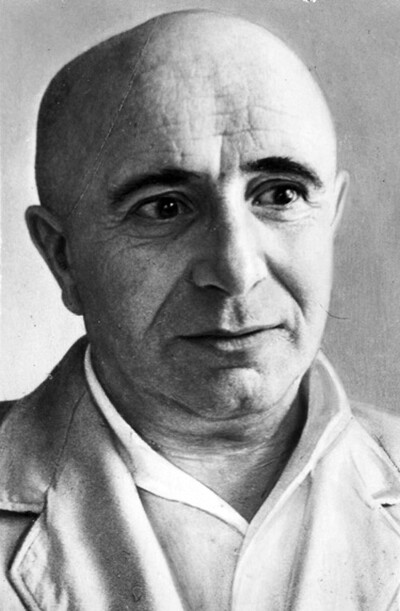
Remenik, Hersh
July 5, 1905–1981
He was a literary scholar and critic, born in the town of Monastyryshche, Kiev district, Ukraine. He was orphaned as a child but from a well-to-do family. He began studying in a religious elementary school at age six, reading a great deal from his childhood years in Hebrew, Yiddish, and Russian, and as he later wrote, he lived with images from literature, actually memorized entire chapters of Tanakh, and was drawn to the works of Pushkin and other classic writers of premodern and modern literature. He was compelled early on to go to work.
As Feyge Polyak, his later longtime life companion, writes in her memoirs, Remenik was the darling of the town, as everyone called him Hershele for his joyous character, his spiritedness, and his ever-ready willingness to help his friends.
He graduated from the Odessa Pedagogical Institute and became a teacher in Kalinindorf, the center of the ethnic Jewish district in Ukraine. He taught language and literature at the local ten-year school there and at the Kalinindorf Jewish Pedagogical Technical School.
At the same time, he was a contributor to the local newspaper, Kolvirt-Emes (Collective Farm Truth). In the 1920s he joined the Komsomol (Young Communist League).
He debuted in print in 1927, after studying at the Pedagogical Institute and being a member of the literary group of Yiddish writers, with an article entitled “Der Komyug un di Yidishe Literatur” (The Komyug [Young Communist League] and Yiddish Literature) in Odeser Arbeter (Odessa Laborer).
In 1937 he completed a stint (begun in 1934) as a research student at the Lenin Pedagogical Institute in Moscow and defended a dissertation on Sholem-Aleichem’s novels, for which he received the title of candidate (Russian equivalent to PhD) in philological sciences. (In 1972 he received his doctoral degree in philological science from the Maxim Gorky Institute of World Literature in Moscow for a thesis on Sholem-Aleichem’s creative work.) He was a teacher of Yiddish literature and language in Odessa schools and in pedagogical institutes in Moscow, Minsk, and Homyel'.
He evaded the bloody year of 1937, but he was arrested in late 1939 and languished for sixteen years in prisons and camps. And, when he was freed and “rehabilitated” (i.e., exonerated), he was still unable to return to work on Yiddish literature.
Over the years 1955-1964, he worked as a lecturer in Russian literature at the Yaroslav Pedagogical Institute and turned to research in that field. His volume on the poetry of Aleksandr Blok belongs to this era (1959, see below), as do a number of articles. He contributed a foreword to the publication of a collection of writings by Perets Markish in Russian translation. This was effectively an attempt to return to research in Yiddish literature.
With the launch in 1961 of Sovetish Heymland (Soviet Homeland) in Moscow, he became a regular contributor, and from 1964 until the end of his life, he managed the literary critical division of the journal. Only a small portion of his research work appears in his published books.
He died in Moscow.
Remenik’s principal critical and research work began around 1930. From that point, he published a series of studies on Yiddish literature—both from the classical era and from subsequent times including the Soviet period. He published a large number of essays in Di Royte Velt (The Red World), Shtern (Star), Prolit (Proletarian Literature), and Sovetish Heymland (Soviet Homeland) on: Mendele Moykher-Sforim, Sholem-Aleichem, Y. L. Perets, Dovid Bergelson, Leyb Kvitko, Perets Markish, Itsik Fefer, Izi Kharik, and others. He also wrote articles on literature and approaches to literature. Especially important were his essays:
“Sholem-aleykhem un di revolutsye” (Sholem-Aleichem and the Revolution), Shtern 5 (1936);
“Sholem-aleykhems kamf far realizm in di 80er yorn” (Sholem-Aleichem’s struggle for realism in the 1880s), Shtern 5-6 (1938);
“Osher shvartsman un di yidishe dikhtung” (Osher Shvartsman and Yiddish poetry), Prolit (Kiev) 9-10 (1931).
He primarily wrote a great deal for Sovetish Heymland:
“Unzer dikhtung in nokhoktyaber-peryod” (Our poetry in the post-October period) 3 and 4 (1967);
“Di oktyaber-revolutsye un di yidishe literatur” (The October Revolution and Yiddish literature) 11 (1967);
“Der tsveyter tom menakhem mendl” (The second volume of “Menakhem Mendl”) 2 (1969); and
an essay in Russian on the development of fictional writing, 2, 4, 12 (1975).
He wrote overviews of Yiddish literature for the Soviet Kratkaya Literaturnaya Entsiklopediya (Short Literary Encyclopedia), vol. 2 (1964) and for the Bolshaya Sovetskaya Entsiklopediya (Great Soviet Encyclopedia), vol. 9 (1972). He provided a preface to Mendele’s Masoes Benyomen Hashlishi, Fishke der Krumer (Travels of Benjamin III, Fishke the Lame) (Moscow: State Publishers, 1959).
In Russian he published three books: Poemy Aleksandra Bloka (The Poems of Aleksandr Blok) (Moscow: Sovetskii Pisatel', 1959), 178 pp.; Sholom-Aleikhem, Kritiko-Biograficheskii Ocherk (Sholem-Aleichem, a Critical-Biographical Work) (Moscow: State Publishers, 1963), 201 pp.; and Ocherki i Portrety, stat'i o Evreiskikh Pisateliakh (Essays and Portraits, Essays on Yiddish Writers) (Moscow: Sovetskii Pisatel', 1975), 424 pp. In Yiddish: Problemen fun der Haynttsaytiker Yidisher Sovetisher Literatur (Problems of Contemporary Soviet Yiddish Literature), supplement to Sovetish Heymland 5 (1980), (Moscow rpt.: Sovetski Pisatel, 1980), 62 pp.; and Shtaplen, Portretn fun Yidishe Shrayber (Rungs, Portraits of Yiddish Writers) (Moscow: Sovetski Pisatel, 1982), 370 pp.
“The last fifteen years,” wrote Uran Guralnik, “Remenik has worked with a great deal of success in his beloved critical genres of literary portraits, surveys, and analytical reviews. Together he turned gladly to generalized theoretical historical articles, raising questions of great principled meaning…. He approaches his own national literature with general national literary criteria and considers its accomplishment by the same scale, not forgetting, naturally, the national innovativeness and the specific qualities of Yiddish literature.”
Dr. Elye (Elias) Shulman
Sources: Moyshe Notovitsh, in Folks-Shtime (Warsaw) (August 28, 1965); Yankev Shternberg, in Kratkaya Literaturnaya Entsiklopediya (Short Literary Encyclopedia) (Moscow, 1971), p. 252; Elye (Elias) Shulman, Di Sovetish-Yidishe Literatur (Soviet Yiddish Literature) (New York, 1971), see index; Shulman, in Forverts (New York) (June 15, 1980); Uran Guralnik, in Sovetish Heymland (Moscow) 7 (1975); Hersh Smolyar, in Fray Yisroel (Tel Aviv) (June 1977); Fray Yisroel (November 20, 1977; November 28, 1977); Hersh Remenik, in Sovetish Heymland 8 (1980).