
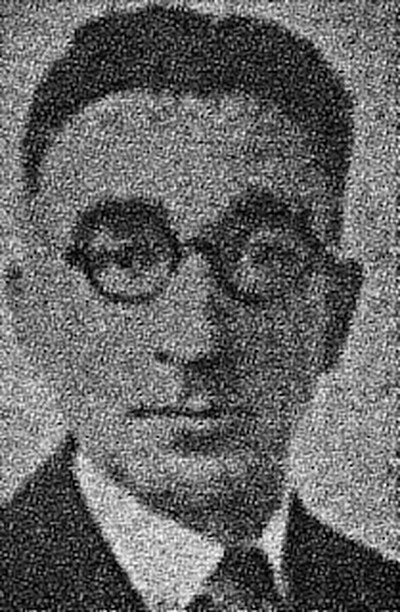
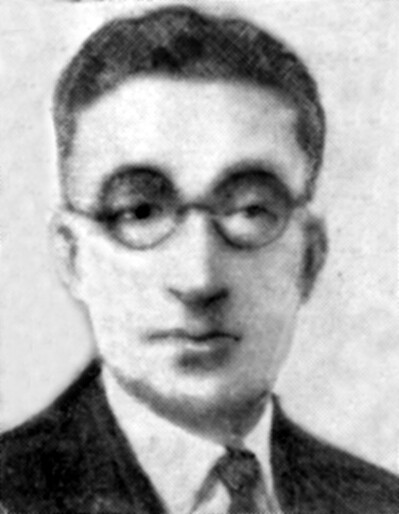
Epshteyn, Shakhne
July 10, 1883–July 21, 1945
He was a literary research, journalist, editor, and community leader, born in Ivye (Iwie, Iwye), Vilna district, Lithuania, into a Hassidic family of rabbis and followers of the Jewish Enlightenment. Until age sixteen he studied with itinerant schoolteachers and in yeshiva, while at the same time learning Russian and reading a great deal in Hebrew. He evinced talent early on at painting and traveled to Warsaw with the goal to study painting, but later he began to prepare external ways to matriculate.
In 1903 he joined the Bund, and in 1905 he was arrested and thrown into the Warsaw citadel prison until the amnesty following the October Manifesto. He then left Warsaw at this point, moved to Vilna, and there commenced his literary activities in Yiddish in the Bundist
Folkstsaytung (People’s Newspaper)
with journalistic articles (earlier he had contributed work to a Russian newspaper in Vilna). As a delegate of the Smorgon organization, he participated in the seventh conference of the Bund in Lemberg. At the time of the second election to the Duma, he led an election campaign for the Bund in Grodno Province. Through a provocation he was arrested under the name Yosl Ginzburg, spent months in prison at the Warsaw Citadel, and under the name Ginzburg was deported for two years to Yarensk in Vologda Province, from which three months later he escaped. He then spent time living illegally in Vilna and later traveled abroad.
From Vienna he wrote for the American Yiddish press. In late 1909 he arrived in New York, for a short time worked as secretary for the central association of the Bund, and he was one of the founders of the Jewish Socialist Federation and co-edited its biweekly organ
Yidisher Sotsyalist (Jewish Socialist).
He later co-edited the weekly
Di Naye Velt (The New World),
served as secretary of the editorial board of the journal
Di Tsukunft (The Future),
and co-edited a series of other periodicals. In 1913 he became editor of
Glaykhhayt (Equality), the weekly organ of the International Ladies’ Garment Workers’ Union, and
he also contributed to:
Arbeter (Worker),
Fraye Arbeter-Shtime (Free Voice of Labor),
Forverts (Forward), and
Avrom Reyzen’s Dos Naye Land (The New Land),
among other serials.
Following the February Revolution (1917), he returned to Russia and worked there for the Bundist
Folkstsaytung in Kiev.
He also wrote for the Odessa Marxist newspapers in Russian, but after the first split in the Bund, he joined the Kombund (Communist Labor Bund) and later the Jewish Komfarbund” (Communist Union). After the Soviets took Odessa, he was appointed co-editor of
Izvestiya (News) in Odessa
editor of a literary-artistic journal in Russian, in which he wrote under the pen names Aleksandr Kucher, Burov, and Arkadiev. He also contributed to
Vokh (Week), edited by Aleksander Khashin.
He later became editor of the Yiddish-language daily
Komunistishe Shtim (Communist Voice).
At the time of Denikin invasion, he left Odessa for Moscow, together with the Komfarband joined the Russian Communist Party, and was named editor of the daily newspapers
Der Shtern (The Star) and
Izvestiya
— in Vitebsk.
In the spring of 1920, he returned to Moscow for the tenth conference of the Jewish section [of the Communist Party], and he was selected to be editor of the Yiddish state publishing house. He was also made chairman of the Yiddish literary association.
In the summer of 1921, he traveled to the United States, and he edited under the pseudonym Yoysef Barson the weekly
Der Emes (The Truth) in New York,
where he remained until 1929. He assisted in unifying the leftist elements of the Jewish Socialist Federation with the Communist Party. Following the split in the Socialist Federation, when the majority joined the Communists, he became co-editor of a united organ, the weekly newspaper
Naye-Emes (New Truth),
which quickly changed to a daily called
Frayhayt (Freedom),
and he was one of its principal editors. He was also co-editor of the Communist monthly
Der Hamer (The Hammer),
and he thus played a central role in creating a Yiddish Communist press. Later, he traveled on to Russia, where in May 1929 he was appointed editor-in-chief of the major Kharkov monthly journal,
Di Royte Velt (The Red World).
From the latter half of the 1930s, he lived and worked in Moscow, and when the Jewish Anti-Fascist Committee was established in 1942, he became first secretary and editor of the newspaper
Eynikeyt (Unity).
He died unexpectedly in Moscow under utterly unexplained circumstances. He also made use of pen names such as: Y. Berman and A. Shmildner.
His books include:
Der Shnee, A Drame in 4 Akten (The Snow, a Drama in Four Acts) (New York: Mayzel et Co., 1911), 79 pp., translation from the Polish work by Stanisław Przybyszewski’s Śnieg; Knut Hamsun, Byografye (Knut Hamsun, a Biography) (Warsaw: Kultur, 1911), 23 pp.;
Y. l. Perets Als Sotsyaler Dikhter (Y. L. Perets as a Social Poet) (New York: M. N. Mayzel, 1916), 72 pp.—the same book under the title Dos Arbets-Folk in Y. L. Peretses Verk (Working People in the Works of Y. L. Perets) (Ekaterinoslav: Di Velt, 1918), 71 pp.;
Frilings-Toyt, Eynakter fun Arbeter-Lebn (Spring Death, a One-Act Play of Workers’ Lives), second printing (Kovno-Berlin: Idish, 1921), 22 pp., writing under the pen name Yoysef Barson;
Mitn Viln Funem Folk, Drame fun Revolutsye in Fir Akten (With the Will of the People, a Drama of Revolution in Four Acts) (New York: Jewish federation of the Workers’ Party, 1923), 78 pp., translation from the Russian work by Sergei Sabatiev;
Inem Land fun der Sotsyaler Revolutsye (In the Land of the Social Revolution), vol. 1 (New York: Frayhayt, 1928), 403 pp.—the same book with the title Barg arop (Downhill) (Kharkov: Ukrainian State Publishers, 1929), 235 pp., vol. 2 (New York, 1929)—under the title In Tsurikmarsh (Return March) (Kharkov, 1933), 178;
Osher Shvartsman, Monografye (Osher Shvartsman, a Monograph) (Kharkov: Ukrainian State Publishers, 1929ru), 105 pp.;
Der Internatsyonaler Royter Tog (The International Red Day) (Kharkov: Central Publishers, 1929), 15 pp.;
Baym Oyfgang, 1905-1909 (At the Rise, 1905-1909) (Moscow: Central Publishers, 1929), 132 pp.;
Y. Stalin (J[oseph] Stalin) (Kharkov: Ukrainian State Publishers, 1930), 59 pp.;
Lenin, Kak Ya Evo Videl (Lenin, How I Saw Him) (Kharkov, 1931); and
as editor, Di Yidishe Kinstlerishe Literatur un di Partey-Onfirung (Yiddish Artistic Literature and Party Direction) (Kharkov: Ukrainian State Publishers, 1929), 124 pp.
Sources: Zalmen Reyzen, Leksikon, vol. 2; Y. Nayman, in Tsukunft (New York) (April 1915); Z. Vaynper, Oyfkum (New York) (March 1927); M. Olgin, in Frayhayt (New York) (June 1928); Ve-ke (Vevyorke), in Di Royte Velt (Kharkov) (July 1929); Y. Opatoshu, in Literarishe Bleter (Warsaw) (November 8, 1929); Zalmen Zilbertsvayg, Leksikon fun Yidishn Teater (Lexicon of the Yiddish Theater), vol. 2 (New York, 1934); B. Branin (A. Oyerbakh), in Morgn-Zhurnal (New York) (January 13, 1932); A. Pomerants, in Proletpen (Kiev) (1935), pp. 38, 39, 40, 94; D. Tsarni (Daniel Charney), in Tsukunft (October 1938); obituary notice in Eynikeyt (Moscow) (July 21, 1945); D. Bergelson, in Eynikeyt (July 26, 1945); Y. Dobrushin, in Eynikeyt (July 20, 1946); Shloyme Mikhoels and I. Fefer, in Eynikeyt (August 19, 1947); Sh. Katsherginski, Tsvishn Hamer un Serp (Between Hammer and Sickle) (Paris, 1949), p. 96; Y. Yanosovitsh, in Di Prese (Buenos Aires) (June 25, 1958); D. Shub, in Forverts (New York) (May 6, 1962; March 7, 1965).
Parts from the Inem land fun der sotsyaler revolutsye were published in literary collection Der veg fun farat, kamf kegn bundizm un menshevizm in der yidisher proletarisher literatur (The road from treachery, the struggle against Bundism and Menshevism in Yiddish proletarian literature) (Moscow-Minsk: Central People’s Publishers, USSR, 1932), 150 pp., compiled by A. Kushnirov un Y. Rabin