
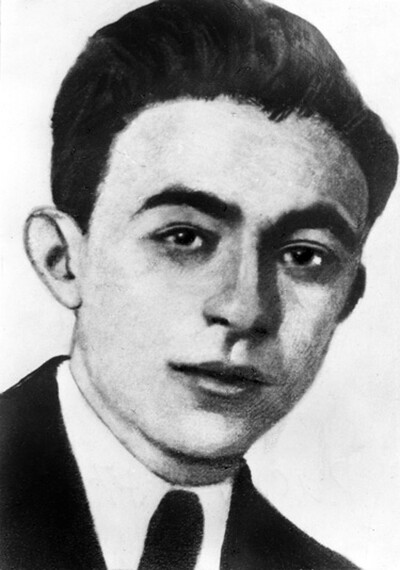
Olyevski, Buzi
1908– autumn 1941
He was a poet and prose writer, born in the town of Chernikhov, Volhynia (Ukraine); his father was a retailer. In 1930 he graduated from the Moscow Pedagogical Institute, and in 1932 he was a doctoral candidate (Russian equivalent to PhD) at the same institute.
He defended his dissertation—“The Creative Work of Dovid Hofshetyn”—for his degree in philology. His first poems were published in Shtern (Stars) in Minsk in 1926. From that point in time, he published poems and stories in various Soviet newspapers, journals, and collections. A talented writer, he reflected in his early work the painful rebuilding process of the Jewish shtetl in the first years after the Revolution and especially in the period of NEP (New Economic Policy) and the events during the Civil War in Ukraine. Later, he sang the praises of heroes of the Civil War. An important theme in his work was the penetration of Jewish youth into major industry. All of these motifs appear in his collections of poetry, In Vuks (Growing) and Shakhte (Mines). Poetry and tales for children also occupied a large pace in his work, as he published work about children, for children, and about the Communist Youth League. In the early 1930s, he left Moscow for Birobidzhan. He worked there for the local Yiddish and Russian press, as well as serving as the secretary of the editorial board of the journal Forpost (Outpost), in which he placed poems, ballads, and sketches dedicated to the construction of the Jewish Autonomous Region and its people who came from all corners of the world with a dream of building a new Jewish home.
He was also a talented prose author, and the motifs of his stories and novels were the same as those of his poems. In particular, he was distinguished for his autobiographical novel Osherl un Zayne Fraynt (Di Geshikhte fun a Yingl) (Osherl and his Friends, the Story of a Lad) (Moscow: Der emes, 1947), 349 pp., which only appeared after his death.
He also wrote about current issues in literature. Among other things, he was the first to publish poems in Yiddish about the air force and aviation. Others wrote music to accompany many of his poems. He also translated a few books from Russian. He was one of the most talented Soviet lyricists and storytellers of the younger generation. Shortly after the Nazi attack on Soviet Russia, he joined the Red Army as an officer. He served in a military division which in 1941 was on the Western front and took part in the first battles there. He died at the front in the autumn of 1941.
Among his books: Far der Bine: Dertseylungen, Pyeses, Lider (For the Stage: Stories, Plays, Poems), with musical notation (together with Y. Dobrushin and E. Gordon) (Moscow, 1929), 136 pp.; In Vuks, songs (Moscow, 1930), 110 pp.; Shakhte, poetry (Moscow, 1933), 132 pp.; Alts Hekher un Hekher: Luft-Fartseykhenungen (Higher and Higher, Aerial Notes) (Moscow, 1933), 63 pp.; Kinder far Mayn Elter (Children for My Old Age), children’s stories (Moscow, 1935), 47 pp.; A Nakht Afn Amur (A Night on the Amur [River]), stories (Moscow, 1938), 240 pp.; Birobidzhaner Lider (Songs of Birobidzhan) (Moscow, 1938); Onheyb Lebn, Dertseylungen (Start of Life, Stories) (Moscow, 1939), 254 pp.; Af Birobidzhaner Erd (On the Soil of Birobidzhan), poetry (Moscow, 1940), 82 pp.; Lider (Poems) (Moscow, 1940), 142 pp.; Mayselekh (Stories) (Moscow, 1940), 31 pp.; Osherl un Zayn Fraynd (Little Asher and his Friend) (Moscow, 1947), 350 pp.
His translations include: Lev Kassil’, Shvambranye (Konduit i Shvambraniya) (The Black Book and Schwambrania), stories (Moscow, 1934), 245 pp.; and S. Dimitriev, Kin Sibir Nokh a Moment (Off to Siberia in a Moment) (Moscow, 1935), 71 pp. His work also appeared in: Kep, Lider Zamlung (Heads, Poetry Collection) (Minsk, 1926), Komyug, Literarish-Kinstlerisher Zamlbukh ([jewish] Communist Youth, Literary-Artistic Anthology) (Moscow, 1938), Shlakhtn (Battles) (Kharkov-Kiev, 1932), Lebn un Kamf, Zamlbukh fun der Yidisher Linker Literatur in Poyln (Life and Struggle, Anthology of Leftist Yiddish Literature in Poland) (Minsk, 1936), Deklamater fun der Sovetisher Yidisher Literatur (Reciter of Soviet Yiddish Literature) (Moscow, 1934), Lider vegn der Royte Armey (Songs about the Red Army) (Moscow, 1938), Farn Heymland in Shlakht! (For the Homeland in Battle!) (Moscow, 1941). He wrote the foreword to Itsik Fefer’s Lider (Poems) (Moscow, 1935).
Sources: Shmuel Niger, in Tsukunft (New York) (February 1930); Literaturnaya Entsiklopediya (Literary Encyclopedia) (Moscow, 1934), vol. 8, pp. 275-76; Sh. Klitenik, in Forpost, no. 2 (Birobidzhan, 1936); N. Levin, in Shtern (Minsk) (January 1940), p. 81; Anon., “Tsvishn di Yidishe Kompozitors” (Among the Jewish Composers), Eynikeyt (Moscow) (July 25, 1942); M. Natovitsh, in Eynikeyt (October 28, 1943); Y. Dobrushin, in Eynikeyt (February 27, 1945); Y. Rabin, in Folks-Shtime, no. 5 (Warsaw, 1948).
[Additional information from: Chaim Beider, Leksikon fun Yidishe Shrayber in Ratn-Farband (Biographical Dictionary of Yiddish Writers in the Soviet Union), ed. Boris Sandler and Gennady Estraikh (New York: Congress for Jewish Culture, Inc., 2011), pp. 23-24.]
Mistake in : S. Dimitriev, Kin sibir nokh a moment (Off to Siberia in a moment) (Moscow, 1935), 71 pp.
Correct "Keyn Sibir nokh a mamont".
(in English mammoth; in Latin mammuthus)
קײנ סיביר נאכ א מאמאנט
ס. דמיטריעװ; יידיש - בוזי אליעװסקי
Keyn sibir nokh a mamont
S. Dmitriev; yidish - B. Olievsky