
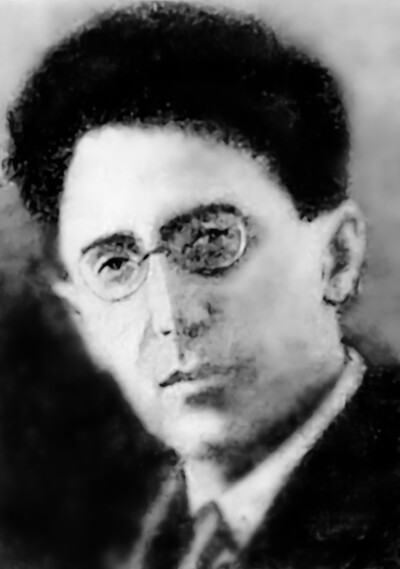
Abarbanel, Mendl
1888–1957
Soviet Yiddish writer who lived in Belorussia. He received an education at home and went to work in his youth as a journeyman carpenter, later in a variety of undertakings. He was one of the first post-revolutionary, proletarian poets in the Soviet Union. He began publishing in Der Frayer Arbiter (Free Worker) in Vitebsk (1918) and in the weekly Kultur un Bildung (Culture and Education) in Moscow (1918).
In the late 1920s, he lived in Kiev, where he published poetry in the Ukrainian Yiddish periodical press. He was a member of the Proletkult (proletarian culture) group (together with Khayim Gildin and Shlomo Yudovin). The majority of his poems have a propagandistic character with political and love-related motifs. His fate remains unknown.
On a genealogical site on the internet a person named Vladimir Kravtsov recalls his family co-living with Mendel Abarbanel in Kharkov in the 1930s. His wife's name was Frida (Frada). The memoirist's grandmother helped her to obtain a job at a local canteen.
In the late 1930s he was reported together with some other Soviet Jewish writers and poets to be part of the Kharkov group, which was characterized by the internal security service as "part of the Anti-Soviet nationalistic organization of Jewish writers."
Later, during World War II, Mendel and Frida Abarbanel were evacuated to Tashkent, Uzbekistan.
After the war, he presumably attended a writers' conference in Kharkov.
Among his books: Af Khvalyes fun Tsaytn (Over Waves of Time) (Kharkov, 1930), 135 pp.; Af der Vogshol (On the Scale), poetry (Kharkov-Kiev, 1934), 133 pp.; In Ritem fun Lebn (In the Rhythm of Life) (Kiev, 1937), 94 pp.; Kindheyt (Childhood), poems (Kharkov-Kiev, 1939), 103 pp.; Af Undzer Erd (On Our Earth) (Kiev, 1940), 193 pp. His writings also appeared in: Ruf, Lider Zamlung (Call, poetry collection) (Minsk, 1935); Almanakh fun Yidishe Sovetishe Shrayber tsum Alfarbandishn Shrayber-Tsuzamenfor (Almanac of Soviet Yiddish Writers to the All-Soviet Writers’ Conference) (Kharkov-Kiev, 1934); Mut (Courage), poetry collection (Moscow, 1920); Shlakhtn (Battles) (Kharkov-Kiev, 1932); Zay Greyt (Get Ready) (Kharkov).
In recent times, musicians and activists Gerry and Leslie Tenney made a clip "Di arbuzn" ("The Watermelons") with a song to the words by Soviet Yiddish poet Mendl Abarbanel. Gerry describes the song as a "sensual, collective farm love song".
* an allusion to Magnitogorsk, one of the great construction sites during the industrialization in the Soviet Union in the 1930s
Sources: Kh. Dunyets, Far Magnitboyen in der Literatur (For Magnit Building in Literature*) (Minsk, 1932); B. Orshanski, in Tsaytshrift 5 (Minsk, 1931).
Архив еврейской истории. Т. 12 / гл. ред. О. В. Будницкий. — Москва / Бостон / СПб.: Academic Studies Press / Биб лиороссика, 2022. — 391 с. ISBN 978-1-644698-59-4 (Academic Studies Press) ISBN 978-5-907532-22-9 (Библиороссика) (Archive of the Jewish History. Vol. 12/ ed.-in-chief O. V. Budnitsky. - Moscow/ Boston/ St.-Petersburg: Academic Studies Press/ Bibliorossika, 2022)
Е. И. Меламед (Киев) «Донесениями вновь завербованного агента “Кант”...» Еврейские писатели под надзором спецслужб сталинского режима (E. I. Melamed (Kiev) "Reported by the newly recruited agent "Kant"..." Jewish writers under the supervision of the special service of Stalin's regime")
MENDL ABARBANEL translated from Russian into Yiddish chapters from N.A. Nekrasov's Vemen lebt zikh gut in Rasey : Kapitlen fun der poeme (orig.: Кому на Руси жить хорошо (Russian) = Кому на Русi жити добре (Ukranian)).- Odes; Kharkov : Kinder-farlag bam Ts.K. L.K.Yu.F.U., 1938.- 37, [3] pp., ill.
װעמען לעבט זיך גוט אין ראסײ
קאפיטלען פון דער פאעמע
נ. א. נעקראסאװ ; ײדיש - מ. אבארבאנעל ; קינסטלער - מ. שטשעגלאװ
Vemen lebt zikh gut in Rasey : Kapitlen fun der poeme
N. A. Nekrasov ; yidish - M. Abarbanel; kinstler - M. Tscheglov
His fate: during the evacuation of Jews to the Soviet backland he was moved to Tashkent and later settled in the village of Jangichek in Uzbekistan. After the war he moved back to Kiev and died there in 1957.
From his non-propagandist poems the best known is probably Di arbuzn (or S'iz der step) from the book Zingt mayn folk (1946 - not in the list above), which was set to music by American Jewish composer Bena Yomen (1901 - 1970).