
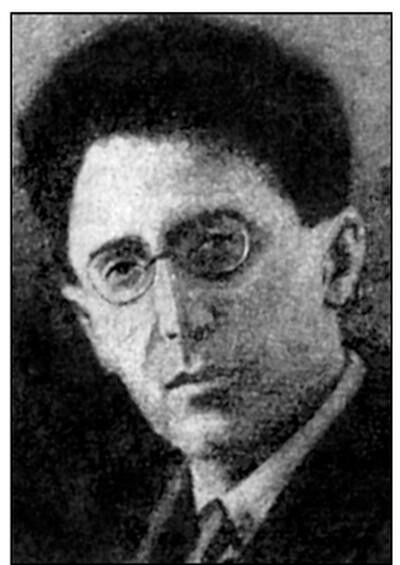
Abtshuk, Avrom
1897-1937
A writer of prose and a literary researcher, he was born in Lutsk, Volhynia. He graduated middle school (1919) in Lutsk, and in 1921 he settled in Kiev, where he worked as a teacher of Yiddish language and literature in a Jewish workers school, a researcher in the Yiddish department of the Ukrainian Academy of Science, later a scholarly associate in the literature and criticism section of the Kiev Institute for Jewish Culture. He performed teaching duties and wrote articles in the field of literary criticism and literary scholarship.
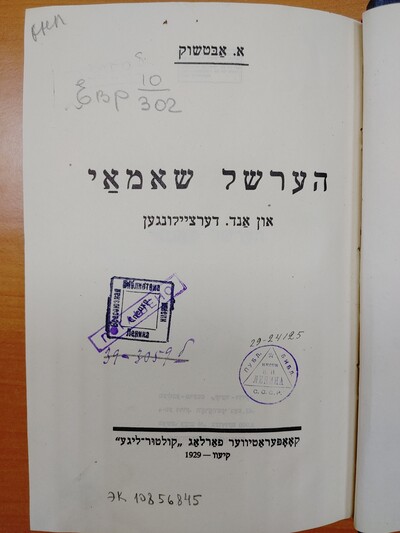
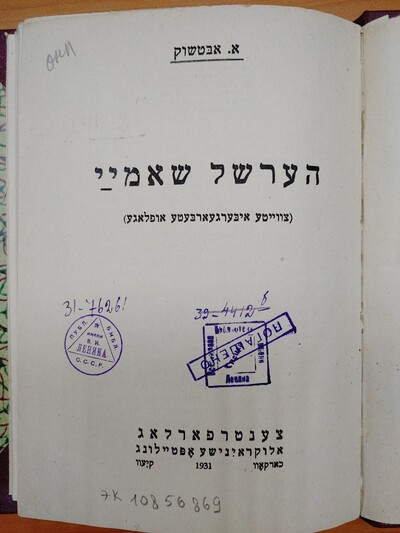
In 1926 he began to publish stories in Di Royte Velt (The Red World) about the civil war and about Jewish life in Poland after WWI. He made quite an impression with his novel Hershl Shamay (2 vols., 1931-1934) in which he more or less took an objective, artistic, and in places humorous posture to portray the process of industrializing Jewish labor in a Soviet factory.
He was also active in the linguistics conference in Kiev in May 1934. He worked on the editorial staff of Prolit (Proletarian Literature), a journal of proletarian writers in Ukraine. He was accused in 1936 of “Trotskyist” tendencies, which was said to have been manifested in Hershl Shamay, and of Jewish nationalism in 1937, and other anti-Soviet tendencies, after which he was arrested.
His books include: Hershl Shamay un Andere Dertseylungen (Hershl Shamay and Other Stories) (Kiev, 1929), 316 pp.; Zikh Ayngeshlosn (Locked in) (Kiev, 1930), 62 pp.; Hershl Shamay (second, revised edition, Kiev, 1931), 157 pp.; Kuzbas (Kiev, 1932), 72 pp.; In Kamf Kegn Sonim (In Struggle Against Enemies), stories, with M. Khashtshevatski (Minsk: Melukhe farlag, 1932), 28 pp.; Dertseylungen (Stories) (Kiev, 1933), 135 pp.; Hershl Shamay (part 2) (Kiev, 1934), 182 pp.; Etyudn un Materialn tsu der Geshikhte fun der Yidisher Literatur Bavegung in FSSR (Studies and Material for the History of the Yiddish Literature Movement in the Soviet Union) (Kharkov, 1934), 290 pp.; In der Bargiker Shorie (In the Mountainous Island) (Kiev, 1934), 24 pp.; Barishevs Brigade (Barishev’s Brigade) (Kiev, 1934), 34 pp.; Vegn undzer Proze (On our Prose) (Odessa, 1934), 47 pp.; Mendele Moykher-Sforim, zayn Lebn un Zayne Verk (Mendele, the Bookseller, his Life and Work) (Kiev, 1927), 47 pp.; in addition, a series of textbooks for literature and social knowledge, as well as translations from Soviet literature.
Also: Arbetbukh far Gezelshaftkentenish (Workbook for Social Knowledge) (Kiev: Kultur Lige, 1929), 334 pp.; Literatur, Lernbukh (Literature, Textbook), with M. Mizhiritski (Kharkov-Kiev: Melukhe-Farlag far di Natsyonale Minderhaytn, 1932), 124 pp.; Literatur, Lernbukh, with A. Holdes and F. Shames (Kharkov-Kiev: Melukhe-Farlag far di Natsyonale Minderhaytn, 1934), 232 pp.
Pieces published in: Ukrayne, Literarish-Kinstlerisher Almanakh (Ukraine, Literary-Artistic Almanac) (Kiev, 1926), Shlakhtn (Battles) (Kharkov-Kiev, 1932), Der Arbeter in der Yidisher Literatur (The Worker in Yiddish Literature) (Minsk, 1931).
He died in a Soviet camp in 1937.
Sources: Zalmen Reyzen in Algemayne Entsiklopedye, Vol. 1; Shmuel Niger, “Revolutsye un Humor” (Revolution and Humor), Tog (New York, 1929) and “In der Sovetish-Yidisher Literatur” (In Soviet Yiddish Literature), Tsukunft (New York, February 1930); Yoysef Opatoshu, in Di Vokh 4 (1929); M. Mizhiritski, “a Freydiker Onzog” (A Joyous Announcement), Di Royte Velt 10 (1929); Kh. Sh. Kazdan, “Di Yidishe Litsektsye af Ukraine” (The Yiddish Literary Section in Ukraine), Vokhnshrift far Literatur (Warsaw) (June 10, 1932); Y. Pat, “S’iz Gut…” (It’s Good…), Vokhnshrift far Literatur (Warsaw) (December 6, 1934); A. Damesek, “Di Soynim Unter a Literarisher Maske” (The Enemies Beneath a Literary Mask), Shtern (Minsk, October 1936); N. Y. Gotlib, “Tsvantsik Yor Yidish-Sovetishe Literatur” (Twenty Years of Soviet Yiddish Literature), Yoyvl-Bukh 30 Yor Keneder Adler (30-Year Jubilee Volume of the Canadian Eagle) (Montreal, 1938); “Di Letste Shafungen fun De Sovetishe Yidishe Shrayber” (The Last Creations of the Soviet Yiddish Writers), Keneder Adler (March 30, 1953).
Ester Rozental-Shnayderman wrote about Avrom Abtshuk and his "Hershl Shamay" in Af vegn un umveg, zikhroynes, geshenishn, perzenlekhkeytn (Along ways and byways, memoirs, events, personalities), vol. 3, part 1 (Tel-Aviv, 1982).- pp. 180-280.
A. Abtshuk's Barishevs brigade (Barishev’s brigade=Бригада Барышева) was published in the Reader:
Literarishe-materialn: tsum bukh af literatur farn 6-tn lern-yor/ tsunoyfgeshtelt - a kolektiv unter Sh. Gulkos onfir.- Kharkov; Kiev: Melukhe-farlag far di natsionale minderhaytn in USRR, 1932.- 186, [2] pp.
ליטערארישע-מאטעריאלנ: צומ בוכ אפ ליטעראטור פארנ 6-טנ לערנ-יאר
צונױפגעשטעלט - א קאלעקטיװ אונטער ש. גולקאס אנפיר
Chapters from "Hershl Shamay" were published in the Reader:
Literatur: literarishe materialn tsum arbetsbukh - "Literatur un shprakh" farn 7-tn lernyor/ Sh. Gulko.- Kiev: kooperativer farlag "Kultur-Lige", 1931.- 336 pp.
ליטעראטור: ליטערארישע מאטעריאלנ צומ ארבעטסבוכ - ליטעראטור אונ שפראכ פארנ 7-טנ לערניאר
ש. גולקא
Pieces from "Hershl Shamay" were published in literary-artistic almanac:
Almanakh VUSPP (Alukrainishe asotsiatsie fun proletarishe shrayber : yidishe sektsie/ kinstlerishe formirung - kinstler B. Blank un M. Fradkin.- Kharkov: Tsentrfarlag, 1929.- 363, [4] pp., ill.
Фрадкин, Моисей Залманович=Фрадкин, Михаил Зиновьевич (1904-1974) - artist
Бланк, Бер Пинхусович=Бланк, Борис Павлович (1897-1957) - artist
Avrom Abtshuk wrote together with M. Mizhiritski and Y. Rodak literature textbook for the 5th school year:
Literatur: lernbukh farn 5 lernyor/A. Abtshuk, M. Mizhiritski, Y. Rodak.- Kharkov; Kiev: Melukhe-farlag far di natsionale minderhaytn in USRR, 1932.- 80 pp., ill.
Abtshuk's pieces published in the reader for the 4th class:
Literatur (Literature): lernbukh farn 4 shulyor/Y. Ravin un V. Shats.- Minsk: Melukhe-farlag fun Vaysrusland. Natssekter, 1933.- 174, [2] pp., portr.
Pieces published in the reader for the 5th class in 7 year schools:
Farn finfyor (Over the five-year period): arbet-bukh af literatur farn 5 klas fun zibnyorike shuln in 2 parts/Y. Ravin un V. Shats.- Moskve; Kharkov; Minsk: Tsentraler melukhe-farlag fun FSSR. Vaysrusishe opteylung, 1931.
Ershter theyl (Part 1).- 186, [2] pp.
AVROM ABTSHUK contributed his work to literary collection 14 oktiabers (14 Octobers): literarishe zamlung/tsunoyfgeshtelt A. Kushnirov un Y. Rabin.- Moskve: Farlag Emes, 1931.- 421, [3] pp.
One more textbook for literature that contains critical articles by Avrom Abtshuk and about Abtshuk's works: Hantbukh: far yidisher literatur/ tsunoyfgeshtelt - O. Holdes, F. Shames.- Kharkov; Kiev: Tsentrfarlag, 1931.- 320 pp.
האנטבוכ: פאר יידישער ליטעראטור
צונױפגעשטעלט - א. האלדעס, פ. שאמעס
Photos courtesy of the Russian State Library in Moscow, Center of Oriental literature.
AVROM ABTSHUK translated from French into Yiddish Honoré de Balzac's Foter Gorio. (orig.: Père Goriot) - Kiev; Kharkov : Melukhe-farlag far di natsionale minderhaytn in USRR, 1935.- 311 pp.
פאטער גאריא
אנארע דע-באלזאק ; פונ פראנצױזישנ - א. אבטשוק
AVROM ABTSHUK translated from Russian into Yiddish Israel Agol's childhood memories Ikh vil lebn (orig.: Хочу жить = I want to live).- Kharkov; Kiev : Melukhe farlag far di natsionale minderhaytn in USRR, 1936.- 252, [3] pp.
איכ װיל לעבנ
י. אגאל ; יידיש - א. אבטשוק
Ikh vil lebn
I. Agol ; yidish - A. Abtshuk
There is one more earlier edition of Abtshuk's Vegn undzer proze (On our prose).- Kharkov; Kiev : Melukhe farlag far di natsionale minderhaytn in USRR, 1932.- 46,[1] pp.
AVROM ABTSHUK wrote Dos gevet (Змагания (Ukranian)=Соревнование (Russian)=The Competition/Bet).- Moskve; Kharkov; Minsk: Tsentrfarlag. Alukrainishe opteylung, 1931.- 19, [1] pp.
דאס געװעט
א. אבטשוק
Correction in the English translation of the title and explanation of the geographical noun :
שאריא = Шория = Shoriya is not an island but a geographical mountainous region in Sibiria located to the south of Kemerov region on the border of the Altai and Sayan mountains. Abtshuk's essey tells about the biggest metallurgical plant in Kuznetsk coal basin and cities Tel'bes (Тельбес) and Temirtau (Темиртау).
אינ דער בארגיקער שאריא
У горнiй Шорiї (Ukranian)
В горной Шории (Russian)
In mountainous Shoriya (English)
AVROM ABTSHUK wrote a roman In eyner a forshtot :roman (In a suburb).- Kiev : Melukhe-farlag far di natsionale minderhaytn in USRR, 1937.- 242, [2] pp.
אינ אײנער א פארשטאט
ראמאנ
א. אבטשוק
Among his translations to Yiddish are the novels The Forty-First by Boris Lavrenyov (published in Kiev 1929) and The Father Goriot by Honoré de Balzac (published in Kiev 1935, possibly translated from a Russian translation).
He died in prison in 1937. After the death of Stalin he was rehabilitated and some of his works were published in Russian translation (Страницы прошлого. Moscow 1965).