
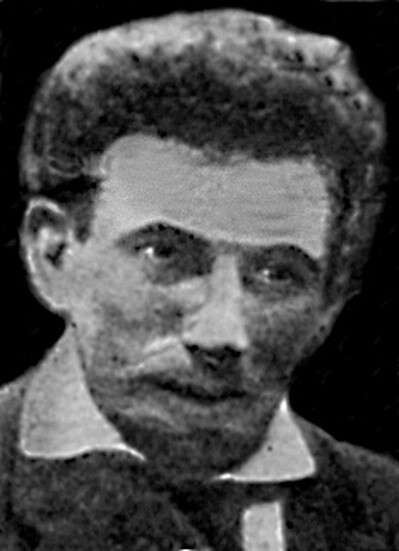
Agursky, Shmuel
April 15, 1884-August 19, 1947
He was a community organizer, historian, and literary researcher, born in Grodno into a family of laborers. He studied until age thirteen in a religious elementary school, and thereafter he studied tailoring. Drawn into the labor movement at a young age, he became involved in the Bundist movement and was forced in 1905 to flee Russia.
He settled in Leeds, England, and from there he wrote as a correspondent for the anarchist publication, Arbayter Fraynd (Workers’ Friend).
In 1906 he left for the United States. For a number of years he worked as a tailor and an insurance agent in Chicago. He also contributed to the local Yidisher Arbayter-Velt (Jewish Workers’ World) and to Fraye Arbeter Shtime (Free Voice of Workers) (New York).
In 1917, together with a group of Russian political émigrés, he left the United States, traveled to Petrograd, and took part in the organization of the Bolsheviks’ Jewish Commissariat. In late 1918 he became commissar for Jewish affairs in Vitebsk Province and editor of Vitebsk newspaper Der Frayer Arbeter (The Free Worker). As a provisional representative of Jewish commissar, Sh. Dimantshteyn, in Moscow, he published the decree regarding the closing down of Jewish community bureaus.
In August 1919 he returned to the United States as a stoker aboard a British cargo ship, where he published articles about Soviet Russia in the Yiddish socialist press.
Soon thereafter he returned to Russia where he edited books, newspapers, and magazines. In the 1920s and early 1930s, he lived in Minsk, where he worked as manager of the party archives of the Central Committee of the Byelorussian Communist Party and head of the Institute of Jewish Proletarian Culture in the Byelorussian Academy of Sciences.
He met Lenin on a number of occasions and primarily spoke with him about the revolutionary movement in America. In 1920, when he was in the United States, he had launched a movement to give Soviet Russia practical assistance, and thus he was again sent to the U.S. with the same mission, before which he met again with Lenin.
In the latter half of the 1930s, a series of newspapers in Minsk and Moscow began publishing articles accusing him of Trotskyist and Bundist “deviations.” He was in Moscow in July 1937, and in March 1938 he returned to Minsk, but that same year he was arrested. Initially thrown into prison in Minsk, at the end of 1939 he was transported to Orsha (Byelorussia), where a court ruled that he was to be exiled to Pavlodar (Kazakhstan). In April 1941, he illegally made his way to Moscow, met with a series of Yiddish writers, and then returned to Pavlodar. He died there on August 19, 1947.
He wrote for the Soviet Jewish press also under the pen names: Ben-Khayem, Shmuel Sinier, and Shmuel Alef.
In the first number of the first Soviet Yiddish newspaper, Varheyt (Truth), he published an article about Yoysef [Joseph] Bovshover. In 1918 he published poems by Bovshover with his own preface (32 pp.). He also wrote about Dovid Edelstat (David Edelstadt). In his literary critical essays, he stood for “rehabilitating the proletarian tradition in Jewish literature.”
On the basis of minimal knowledge, he wrote a great deal about topics in political history and literary history, especially the Bund, and about the Jewish role in the Russian Revolution and socialist literature in Yiddish.
He also wrote articles for Afn Shprakhfront (On the Language Front) (Kiev) and Lingvistishe Zamlungen (Linguistic Compilation), vol. 2 (Minsk). From 1948, his fate—as well as that of other Soviet Jewish writers—was unknown.
His books include: Di Badaytung fun der Ershter Idisher Komunistisher Konferents (The Significance of the First Communist Conference) (Vitebsk, 1918), 11 pp.; Der Yidisher Arbeter in der Komunistisher Bavegung, 1917-1921 (The Jewish Worker in the Communist Movement, 1917–1921), with a forward by Sh. Dimanshteyn (Minsk, 1925), 176 pp.; Di Yidishe Komisaryatn un di Yidishe Komunistishe Sektsyes, 1918-1921 (The Jewish Commissariats and the Jewish Communist Sections, 1918–1921) (Minsk, 1928), 460 pp.; Afn Historishn Front (Kegn der Idealizatsye fun “bund”) (On the Historical Front, Against the Idealization of the “Bund”) (Moscow, Kharkov, Minsk, 1930), 175 pp.; Di Revolutsyonere Bavegung in Vaysrusland, 1863-1917 (The Revolutionary Movement in Byelorussia, 1863-1917) (Moscow, 1931), 270 pp.; Der Moskver Proletaryat af di Barikades, 1905 (The Muscovite Proletariat at the Barricades, 1905) (Moscow, 1931), 54 pp.; Der Kamf Kegn Bund (The Struggle Against the Bund) (Moscow, 1932), 253 pp.; Di Oktyaber-Shlakhtn in Moskve (The October Battles in Moscow) (Moscow, 1933), 116 pp.; Di Sotsyalistishe Literatur af Yidish in 1875-1897 (Socialist Literature in Yiddish, 1875-1897), vol. 2 (Minsk, 1935), 425 pp.
Agurski also translated (and wrote the introduction) to V. Knorin, 1917 Yor in Vaysrusland un Afn Mayrev-Front (The Year 1917 in Byelorussia and on the Western Front) (Minsk, 1927), 96 pp.
He edited: Der Frayer Arbiter (The Free Worker), daily newspaper, organ of the Communist-Bolsheviks (Vitebsk, 1918), published from November 7, 1918 to April 11, 1919; Komunistishe Velt (Communist World), political-literary magazine, semi-monthly organ of the Central Committee of the Community Party (Bolsheviks) and the Central Bureau of the Jewish Sections (Moscow, 1919), published from May 1, 1919 to April 1920; Kamfs-Gezangen (Songs of Struggle) by Morris Vintshevski (Morris Winchevsky) (Minsk, 1924), 24 pp.; Der Shtern (The Star), monthly magazine, together with B. Orshanski, B. Osherovits, Izi Kharik, and others (Minsk, 1925); 1905 in Vaysrusland (1905 in Byelorussia), a collection (with a forward) (Minsk, 1925), 225 pp.; Di Oktyaber-Revolutsye in Vaysrusland (The October Revolution in Byelorussia), a collection (Minsk, 1927), 360 pp.; Lider fun Kamf un Noyt (Poems from Struggle and Hardship) by D. Edelshtat (with an introduction) (Moscow, 1930), 180 pp.; Geklibene Lider (Collected Poems) by Bovshover (with an introduction) (Minsk: “Tsenter” [=Tsentraler Yiddisher Komisaryat], 1931), 190 pp.; Afn Visnshaftlekhn Front (On the Scholarly Front), bulletins from the Institute for Jewish Proletarian Culture of the Byelorussian Scientific Academy (Minsk, 1932-1935), nos. 1-8; Lenin Kegn Bund (Lenin Against the Bund ), with an introduction (Minsk, 1933), 67 pp.; Kegn Bund (Against the Bund), a collection with articles by Agurski and others (Minsk, 1935); Geklibene Verk (Collected Works) of D. Edelshtat, three volumes (together with A. Levitan, K. Marmor, and M. Erik) (Kiev, 1935) (the third volume never appeared); Geklibene Verk (Collected Works) of Morris Winchevsky, six volumes (together with M. Levitan, K. Marmor, and M. Erik) (the fifth volume, Dramas, Minsk, 1935), 278 pp., other volumes never appeared; Izi Kharik, tsu zayn Fuftsik-Yorikn Dikhterishn Veg (Izi Kharik, on the Fifteenth Anniversary of his Poetic Path), a collection (Minsk, 1936), 136 pp.
He died in Pavlodar, Kazakhstan.
Sources: Z. Reyzen, Leksikon, vol. 1, p. 41; D. Tsharni (Charney), A Yortsendlik Aza (What a Decade) (New York, 1943), pp. 227, 250-53, 296; Yankev Leshtsinski, “Stalin un de Amol Barimte Ester fun Bund” (Stalin and the Once Famous Ester of the Bund), Forverts (New York), February 27, 1932; K. Marmor, in Dovid Edelshtat Gedenk-Bukh (Dovid Edelshtat Memorial Volume) (New York, 1952), see index; Aleksander Pomerants, “Edelshtat in der Sovetishe-Yidisher Literatur-Kritik” (Edelshtat in Soviet Yiddish Literary Criticism), Dovid Edelshtat Gedenk-Bukh (Dovid Edelshtat Memorial Volume) (New York, 1952), see index; Sovetish Heymland, Materyaln far a Leksikon fun der Yidisher Sovetisher Literatur (Materials for a Handbook of Soviet Jewish Literature) (1937).