
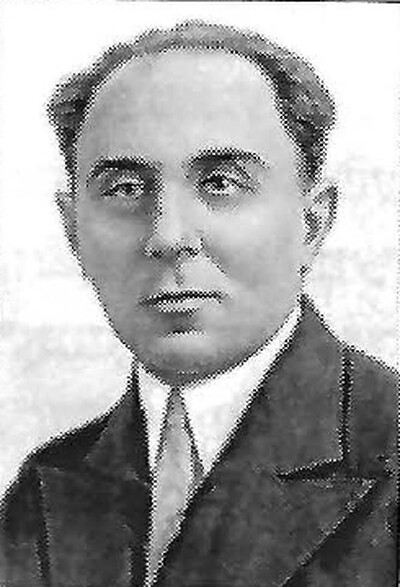
Oyslender, Nokhum
December 13, 1893–September 28, 1962
Poet, prose writer, critic, theater and literary scholar, he was born in Khodorkov (Khodorkiv), Kiev region, into a family of timber merchants. He studied for one year in religious school; from age six he was taught by a tutor at home in Russian. He studied in Russian secular high schools, 1906-1911, in Odessa and Kiev. From 1911 to 1914, he studied medicine at Berlin University. After graduating from the medical department in Kiev (1919), he volunteered as a military doctor in the Red Army.
He penned his first poems and essays at the front. His work Grund-Shtrikhn fun Yidishn Realizm (Main Features of Yiddish Realism) (Kiev, 1919) brought him to the forefront of Yiddish criticism and literary scholarship. In 1920 he endured a march to Arkhangelsk and later to Warsaw. His actual first piece of published writing was a poem in the daily publication, Dos Fraye Vort (The Free Word) (Kiev), and thereafter he published symbolist poetry and literary critical articles in such Kiev serials as Naye Tsayt (New Times), Folks-Tsaytung (People’s Newspaper), and Bikher-Velt (Book World), and Emes (Truth) in Moscow, as well as in Shtral (Beam, 1922-1925), a collection that he edited.
In later work, he analyzed a series of the most prominent Yiddish writers (Shvartsman, Hofshteyn, and others). Aside from several books of poetry, he published a book of creative prose in which he portrayed the Jewish shtetl in the new social circumstances. From 1926 to 1928, he ran the literature section of the Jewish division of the Byelorussian Academy. Thereafter until 1931, he managed the literature section in the Institute for Jewish Culture in the Ukrainian Academy of Sciences in Kiev. Among the academic publications of this institution, he brought out a series of works concerned with the Yiddish classics, important Yiddish writers in Soviet Russia and other countries, and literary history, language, theater, and drama. In the 1930s he published literary historical work, such as “Mendele un Zayne Mitgeyer” (Mendele and Those of his Era), writings on Sholem-Aleichem, and his major work on Yiddish theater, which excelled in its deep scholarly approach to the issues it addressed. He became one of the most important critics, scholars, and historians of Yiddish literature, language, and theater.
Over the years 1931-1933, he edited the collected works of Sholem-Aleichem in Kharkov, important editions of the Yiddish classics, and scholarly journals, anthologies, almanacs, and readers. He also produced a line of textbooks on the subject of Yiddish literature, translated and edited a number of books, and wrote introductions to various other works. During World War II, he was a member of the historical commission of the Anti-fascist Committee. Over the years 1936-1948, he served in the “Office of Teaching Yiddish Language, Literature, and Folklore” in the Ukrainian Academy of Sciences. The final years of his life, he worked in the criticism department of the Moscow-based journal Sovetish Heymland (Soviet Homeland).
Among his books: Lider (Poems) (Kiev, 1917), 46 pp.; Halber Tog, lider (Half a Day, poems) (Smolensk, 1921), 79 pp.; Front (Front) (Kiev, 1922), poetry, 16 pp.; Grund-Shtrikhn fun Yidishn Realizm (1919), 134 pp. (reprinted in Vilna, 1928); Veg-Ayn-Veg-Oys, literarishe epizodn (Way In, Way Out, literary episodes) (Kiev, 1924), 201 pp.; A. Goldfadn, materyaln far a biografye (A. Goldfaden, materials for a biography), with U. Finkel (Minsk, 1926), 104 pp.; Arbet un Kamf, literarishe khrestomatye (Work and struggle, a literary reader), co-authored with Y. Bakst and G. Fridland (Moscow, 1926); Der Yunger Sholem Aleykhem un zayn Roman “stempenyu” (The Young Sholem Aleykhem and his Novel Stempenyu) (Kiev, 1928), 76 pp.; Idishe Literatur, khrestomatye fun literatur un kritik (Yiddish Literature, a reader of literature and criticism), with D. Volkenshteyn, N. Lurye, and E. Fininberg (Kiev: Kultur-Lige, 1928), 374 pp.; Di Geshikhte fun Arbet (The History of Labor), a translation of A. I. Tiumenev’s Istoriya Truda, kratkoe rukovodstvo politicheskoi ekonomii (History of Labor, a short handbook on political economy) (Moscow, 192?), 220 pp.; Af Lodemirer Veg (On the Way to Ludmir) (Kiev, 1930), 227 pp.; Lernbukh Farn Dritn Lernyor (Textbook for the Third Year of Study), co-authored with L. Goldin (Kiev, 1933), 104 pp. (in at least five editions); Leyenbukh far Shuln fun Dervaksene (Textbook for Schools for Adults) (Kiev-Kharkov: Ukrainian state publishers for national minorities, 1933), 100 pp.; Leyenbukh farn 3tn Klas fun der Onfangshul (Textbook for the Third Class in Elementary School), first edition (Kiev-Kharkov, 1935), 128 pp. (fourth and fifth editions, Kiev-Kharkov, 1936; sixth edition, 1937). Yidisher Teater, 1887-1917 (Yiddish Theater, 1887-1917) (Moscow, 1940), 317 pp.
Aleksander Pomerants
Sources: Algemayne Entsiklopedye (General Encyclopedia), vol. 1, p. 268; Zalmen Reyzen, Leksikon, vol. 1, pp. 51-53; A. Gurshteyn, “Der Itsiker Tsushtand fun der Perets-Biografye” (The Present State of the Peretz Biography), Tsaytshrift, no. 1 (Minsk, 1926); idem., “Sakhaklen fun der Mendele-Forshung” (The Sum Total of Mendele Research), Tsaytshrift, no. 2-3 (Minsk, 1928); idem., “A Naye Vendung in der Mendele Forshung” (A New Turn in Mendele Research), Visnshaftlekhe Yorbukh, vol. 1 (Moscow, 1929); Sh. Niger, “A Literatur far Yunge” (A Literature for Youth), Literarishe Bleter (Warsaw, April 29, 1927); idem., “Zukhndik a Yikhes-Briv” (Looking for a Pedigree), Tsukunft (New York, October 1935); Dr. Jacob Shatsky, ed., Arkhiv far der Geshikhte fun Yidishn Teater un Drame (Archive for the History of Yiddish Theater and Drama) (New York, 1930), pp. 465-69; Zalmen Reyzen, “Tsu der Geshikhte fun der Yidisher Haskole-Literatur” (On the History of the Yiddish Enlightenment Literature), YIVO-Bleter, vol. 1, pp. 193-207; A. Abtshuk, Etyudn un Materyaln (Studies and Materials) (Kharkov, 19 34), pp. 50-51; Anon., “Sheferishe Plener fun di Shrayber” (Creative Plans from the Writer), Eynikeyt (Moscow, January 1, 1947); Y. Lifshits and M. Altshuler, comps., Briv fun Yidishe Sovetishe Shraybers (Letters of Soviet Jewish writers) (Jerusalem, 1979).
[Additional information from: Chaim Beider, Leksikon fun yidishe shrayber in ratn-farband (Biographical dictionary of Yiddish writers in the Soviet Union), ed. Boris Sandler and Gennady Estraikh (New York: Congress for Jewish Culture, Inc., 2011), pp. 14-15.]