
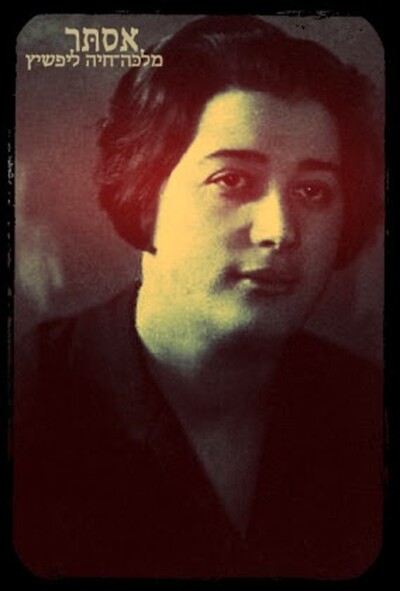
Frumkin, Ester
1880–June 8, 1943
Literary name of Malke Lifshits, she was born in Minsk, Byelorussia, into a well-to-do merchant, modern scholarly home. She took the surname Frumkin from her first husband; her second husband was surnamed Vikhman. Her grandfather was a Hassidic rabbi and scholar, while her father was a follower of the Jewish enlightenment movement, an accomplished man, who wrote Yiddish poetry and prose. Her mother came from the Katsenelenboygn and Rom (Romm) families of Vilna. Until age eleven, Ester studied Tanakh in the original. After graduating from high school in Minsk, she entered the Bestuzhev Course in St. Petersburg, later also an auditor in the University of Berlin. Back in Minsk, she worked for several years as a teacher in the Minsk Professional School for Girls. In 1901 she joined the Bund, and she became active as a party propagandist.
For her first literary piece of work, she translated into Yiddish Vladimir Korolenko’s story, “Di Agode fun Kinig Agripes un Flores, dem Procurator fun Yehude” (The Story of King Agrippa and Flora, Procurator of Judea) (St. Petersburg: Naye biblyotek, 1904)—Rus. “Skazanie o Flore, Agrippe i Menakheme, syne Yegudy” (Story of Flora, Agrippa, and Menakhem, son of Judea). After the Russian Revolution of 1905, she began to play a conspicuous role in the Bundist movement.
She was the Duma correspondent in St. Petersburg for the left-wing Bundist daily in Vilna, Der Veker (The Awakener), (Later Di Folkstsaytung (The People’s Newspaper)) and one of the editors of other Bundist publications. She also participated in editing the Vilna collections of the Bund: Di Naye Tsayt (The New Times), Tsayt-Fragn (Issues of The Times), Di Naye Shtime (The New Voice), and Fragn un Lebn (Issues and Life) in which she wrote under the pen name of D. Katsenelenboygn. Among many other things she published her work on Jewish national education and school issues.
She took part in the Czernowitz Language Conference in 1908, and there she represented the position of “proletarian” Yiddishism, calling for Yiddish to be declared “the”—not “a”—national language of the Jewish people (she published a report from the conference in the collection, Di Naye Tsayt 4 [Vilna, 1909]).
In 1910 the Bundist publisher, “Di Velt” (The World), in Vilna brought out her major work: Tsu der Frage vegn der Yidisher Folkshul (On the Question of the Jewish Public School) (third printing, St. Petersburg, 1917).
Over the years 1910-1914, on several occasions she was arrested, escaped abroad, and became active there as a member of the foreign committee of the Bund. At the start of WWI, she returned to Russia—and in 1914, she was sent at the time of the war to Chervony Bor, Astrakhan district, in the Russian North. After the February Revolution of 1917, she returned to Minsk, joined the Central Committee of the Bund, became editor of the principal Bundist organ, Der Veker (A Daily Newspaper), and was selected to the Minsk city council as well as the Jewish community; she became the director of the education office of the city and the provinces. She ordered the building of new Jewish schools, teachers’ courses of study, and cultural associations; she was on the managing committee of the workers university and lectured there on the nationality question; she wrote a great deal, frequently appeared on stage giving speeches, and truly stood at the center of social, political, and cultural activities of the city. At that time, as was the case earlier, she belonged to the Menshevik wing of the Social Democratic Party.
Following the eleventh congress of the Bund (Minsk, 1919), she moved to the left and became one of the most active propagandists who sought to Bolshevize the Bund. After the split up of the Bund in April 1920, she (together with Arn Vaynshteyn-Yerakhmiel) became the leader of the “Kombund” (Communist Bund). At the Kombund’s dissolution conference in March 1921 in Moscow, she helped bring an end to the Kombund and moved fully over to the Jewish section (Yevsektsiia) of the Alfarbandishe Komunistishe Partey (All-Union Communist Party [=Bolsheviks]). She became a She became a member of Yidgezkom (Jewish Social Committee [for the Relief of Victims of War, Pogroms, and Natural Disasters])
She was a member of the editorial collective of the Moscow-based Communist newspaper Der Emes (The Truth) in which she published a great number of articles, principally about cultural issues, educational problems, and the new way of life. She published theoretical articles in books, and together with Moyshe Litvakov, edited the eight-volume edition of V. I. Lenin’s writings in Yiddish, by herself translating the third volume [see below]; and wrote Lenin, zayn Lebn un zayn Lere (Lenin, his Life and his Teachings).
In the years 1923-1928, she served on the editorial board of Yungvald (Young Forest) and Pyonir (Pioneer); was the editor of Politalefbeyz farn Komyugist (Political Alphabet for a Member of the Communist Youth League) (Moscow, 1925), 183 pp.
Until the liquidation of the former Bundists in the Russian Communist Party in the latter part of the 1930s, Esther was the director of the Jewish section of the Western Institute of the Comintern (The Jewish students in the institute called it the Mayrevke). In 1922 she was named to the post of vice-rector of the Communist University of the National Minorities of the West (under the Comintern) which the Jewish students there referred to as the Mayrevke, and in 1925 she became rector of the university.
The university was shut down in 1936, and within its building was established an institute of foreign languages and Ester was appointed its rector. She worked there until her arrest on January 25, 1938. She was initially sentenced in July 1940 together with a group of former leading figures in the Bund to eight years of exile. She was sent to a camp near the city of Karaganda (Kazakhstan), where she died in the camp hospital on July 9, 1943.
After the purges of 1936, Esther was arrested - and nothing more is heard about her. According to certain bits of information, she was locked up in the Moscow prison Butirki and in 1938 she was alledgely sent to Tshibiv (Ochta), USSR Commisar, in the famous stone isolation cell. And she will have died there around the end of 1938, beginning of 1939; this information was later confirmed by a former Soviet official, who was sent to Ocht-Izshemski-camp.
Among her other books:
Tsu der Frage vegn der Yidisher Folksshul: di Muter-Shprakh un di Folksshul, di Fremde Shprakh in der Yidisher Shul, Yidish, di Yidishe Folksshul un dos Yidishe Folk (On the Question of the Jewish Public School: the Mother Tongue and the Public School, Foreign Tongue in the Jewish School, Yiddish, the Jewish Public School, and the Jewish People) (Vilna, 1910), 97 pp.;
Shul-Fragn (School Issues) (St. Petersburg, 1917);
Hirsh Lekert (Hirsh Lekert) (Moscow: Yungvald, 1922), 39 pp.;
Lenin un zayn Arbet (Lenin and his Work) (Moscow: Tsentr Farlag, 1925), 271 pp. (second printing, 1926);
Mit Lenins Veg (On Lenin’s Path) (Moscow: 1925), 60 pp.;
Oktyabr-Revolutsye (October Revolution) (Moscow, 1928), 332 pp.;
Fuftsen Tsuzamenfor fun Al. K. P. (B), vegn der Opozitsye (Fifteenth convention of the All-Russia Communist Party [Bolsheviks], on the Opposition) (Moscow, 1928), 88 pp.;
a Yiddish translation of Lenin’s Yorn fun der Kontr-Revolutsye (Years of Counter-Revolution) [vol. 3 of Oygeveylte Verk (Selected Works)] (Moscow, 1929), 256 pp.;
the forward to Yidn in FSSR (Jews in the USSR) by A. Brakhman and Y. Zhiv (Moscow, 1930).
Sources: Zalmen Reyzen, Leksikon, vol. 1; A. Liessin, Zikhroynes un Bilder (Memories and Images) (New York, 1954), p. 272; N. Kharin, “Briv fun a Fraynd” (Letter from a Friend), Der Veker (New York) (February 12, 1938); D. Tsharni, in Der Veker (New York) (December 31, 1938); Ben-Tsien Kats, “Di Sore Bas Toyvim fun der Rusisher Revolutsye” (The Sarah, Daughter of Tovim, of the Russian Revolution), Morg Morgn-Zhurnalw York) (February 13, 1931); Yankev Leshtshinski, Tsvishn Lebn un Toyt (Between Life and Death), vol. 1 (Vilna, 1930), pp. 85-95; A. Reyzen, Epizodn fun Mayn Lebn (Episodes from My Life), part 3 (Vilna, 1935), pp. 326-36; A. Litvak, Geklibene Shriftn (Collected Writings) (New York, 1945), p. 195; Gina Medem, A Lebnsveg (A Life’s Path) (New York, 1950), p. 185. Y. Kharlash
XV convention of the All-Russia Communist Party [Bolsheviks] took place in Moscow in 1927. The materials and decrees were published in Russian and later, in 1928 translated and adapted/reworked into Yiddish. The translation of this edition was done by A. Frumkin and Ester checked it out/verified.
צוזאמענפאר פון אל.ק.פ. (ב.) װעגן דער אפאזיציע XV
איבערגעזעצט פון כ’ א. פרומקין ; דורכגעקוקט פון כ’ עסטער
מאסקװע
צענטראלער פעלקער-פארלאג פון פססר
1928, - 88 pp.
XV tsuzamenfor fun al.k.p. (b.) vegen der opozitsie
ibergezetst fun kh' A. Frumkin ; durkhgekukt fun kh' Ester
Moskve : tsentraler felker-farlag fun FSSR