
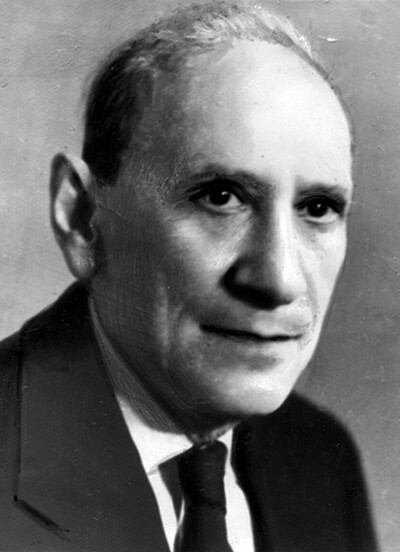
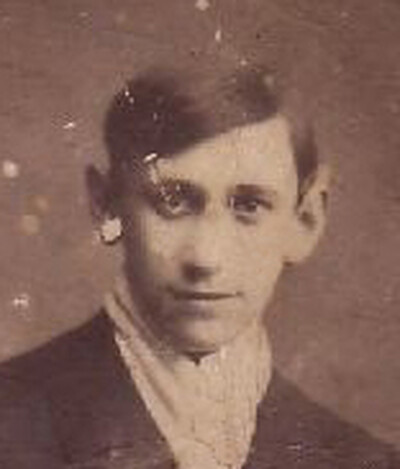
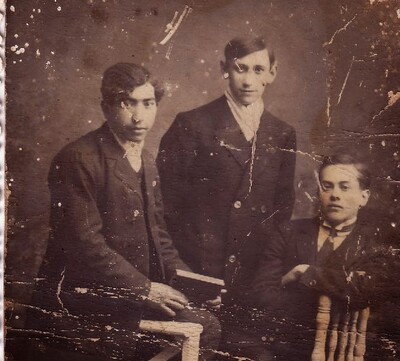
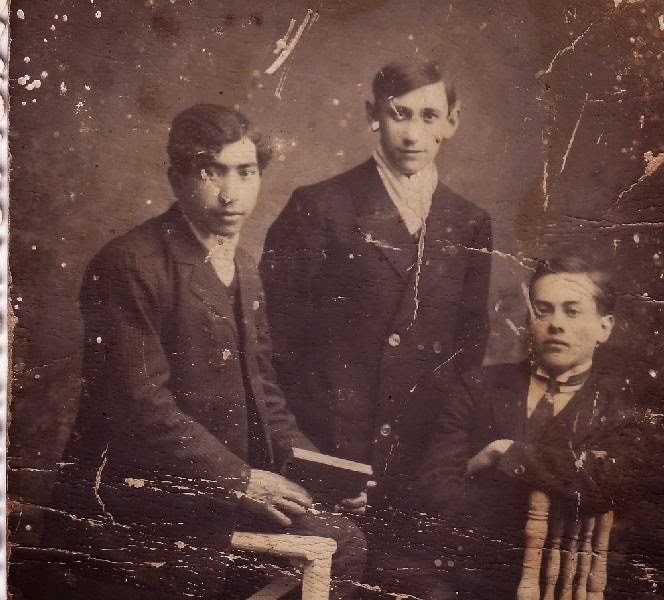
Bloshteyn, Hirsh
January 1, 1895–1978
A writer of both poetry and prose, he was born in Keydan (Kėdainiai), Lithuania, the son of a tailor.At age twelve he lost his father and had to support his mother, while studying with other religious school boys.
His first publication appeared in
1912 in Lebn un Visnshaft (Life and Science) in Vilna,
and later he published in
Yoysef Tunkel’s Der Krumer Shpigl (The Warped Mirror),
in Moment (Moment) in Warsaw, and
in Keneder Adler (Keneder Odler, Canadian Eagle) in Montreal.
During WWI, he was sent to Ukraine with other Jews.He published a major story, entitled
“A Naye Bet” (A New Bed), in Undzer Lebn (Our Life) in Odessa.
He was moved to Kharkov and worked there as a proofreader in the “Yidish” publishing house, translated comedies by Ludwig Fulda, Edmond Rostand, and others for the theater
(1917-1918) Unzer Vinkl (Our Corner),
and published poetry for
Kharkover Tsaytung (Kharkov Newspaper) and
the journal Kunst-Ring (Art Ring).
During the civil war in Russia, he lived in Kuban in the Caucasus and worked as a teacher in a Hebrew-Russian public school. In 1920, he was in Minsk where he worked for and published in
Shtern (Star) and
Veker (Awakener);
in 1921 he returned to Lithuania and contributed to a number of different Yiddish publications as well as for
Frayhayt (Freedom) and
Kundes (Prankster)
— in New York.
Aside from poetry, he wrote reviews and pedagogical treatises.He also translated into Yiddish
a series of poems by Sergei Yesenin.
In 1925 he emigrated to Argentina, and there he published poems, reviews, and feature pieces in
Di Prese (The Press) and
Dorem-Amerike (South America),
edited the journal
Naye Velt (New World),
worked as a school teacher, and founded a Jewish workers organization. In 1931 he departed for the Soviet Union for good and lived in Kharkov.
After WWII, he settled in Czernowitz, was the correspondent for
Moscow’s Eynikeyt (Unity),
and published articles and reportage. When
Sovetish Heymland (Soviet Homeland)
began to appear in print in Moscow, he systematically published poems and memoirs in it. He died in Czernowitz.
Among his books:
Afn zUnentrep (On the Sunny Landing), poems (Kovno: Likht, 1923), 54 pp.;
Shpiglen (Mirrors), a novel (Kovno: Kultur, 1924), 127 pp.;
Arbshulorg, Poeme (Workers’ School Organization, Poems) (Buenos Aires, 1928), 47 pp.;
Lider fun Kamf (Songs of Struggle) (Buenos Aires, 1930), 200 pp.;
Khuan Zhorke Redt, Lider (Juan Zhorke Speaks, Poems) (Minsk: State Publishers, 1932), 157 pp.;
Barikades Unter Palmes, Dertseylungen un Fartseykhenungen (Barricades Under Palm Trees, Stories and Notes) (Kharkov-Kiev: Ukrainian state publishers for national minorities, 1933), 174 pp.;
Lider (Poems) (Kharkov, 1934), 138 pp.;
Ikh bin Yung, Lider un Poemes (I Am Young, Songs and Poems) (Kharkov, 1934), 223 pp.;
Afn Zelbikn Boym (On the Same Tree), stories (Kharkov, 1934), 31 pp.;
Kinder fun Eyn Klas, Dertseylungen vegn Kinder in Argentine (Children in One Class, Stories of Children in Argentina) (Kharkov-Kiev, 1935), vol. 1, 68 pp.;
On a Heym (Homeless), a novel (Kiev: Ukrainian state publishers for national minorities, 1936-1938), 2 vols.;
Lider (Poems) (Kiev: Ukrainian state publishers for national minorities, 1937), 33 pp.;
Di Letste Nayes (The Latest News), stories (Kiev: Ukrainian state publishers for national minorities, 1938), 82 pp.;
Naye Lider (New Poetry) (Kharkov-Kiev, 1938), 268 pp.;
Birobidzhaner Fartsaykhenungen (Birobidzhan Notes) (Kiev, 1939), 24 pp.;
Tsvishn Velt, Dertseylungen (Amidst the World, Stories) (Kiev, 1939), 217 pp.;
Heym (Home), volume 3 of On a Heym (Lvov, 1940), 238 pp.;
Dertseylungen (Stories) (Kiev: Ukrainian state publishers for national minorities, 1941), 58 pp.;
Bam Lirishn Kval, Lider (By a Lyrical Source, Poems) (Moscow: Sovetski Pisatel, 1977), 141 pp.
His work was also included in:
Almanakh fun Yidishe Sovetishe Shrayber Tsum Alfarbandishn Shrayber-Tsuzamenfor (Almanac of Soviet Yiddish Writers to the All-Soviet Writers’ Conference) (Kharkov-Kiev, 1934);
In Shotn fun Tliyes (In the Shadow of the Gallows) (Kiev-Kharkov, 1932);
the anthology Birebidzhan (Birobidzhan, Birebidzshan) (Moscow, 1936);
Tsum Zig (To Victory) (Moscow, 1944);
Komsomolye (Communist Youth) (Kiev, 1938); and
Lider vegn Stalinen (Poems about Stalin) (Kiev, 1937).
Among his pen names: Mordkhe Muler and Tsvi.
Sources: Zalmen Reyzen, Leksikon, vol. 1; Z. Zilbertsvayg, Teater-Leksikon, vol. 1; Y. Botoshanski, Mame-Yidish (Mother Yiddish) (Buenos Aires, 1949), pp. 218, 227-28; Botoshanski, in Tsukunft (August 1931); N. Y. Gotlib, in Lite 1 (1951), p. 1101; “Yidishe Shrayber in Kazakhstan” (Yiddish Writers in Kazakhstan), Eynikeyt (April 15, 1943); T. Fuks, in Naye Prese (New Press) (Paris) (August 14, 1945); M. M. Finzon, in IKUF (Buenos Aires) (September 1944); I. Fefer, in Eynheyt (February 7, 1943); D. Kurland and S. Rokhkind, Yidishe Dikhtung in Amerika (Yiddish Poetry in America) (Minsk, 1932); M. Kipnis, in Eynikeyt (September 26, 1945).
Hirsh Bloshteyn contributed 3 poems (Hent, Uralt, Eybik) to Flamen: zamlbukh gevidmet di interesn un oyfgabn fun der arbeter-yugnt (Flame: a collection dedicated to the interests and tasks of working youth).- Kovne: Aroysgeber Zalmen Khanin; Drukeray Sh. Nayman, 1922.- 126 columns.
פלאמען: זאמלבוך געװידמעטדי אינטערעסן און אױפגאבן פון דער ארבעטער-יוגנט
Hirsh Bloshteyn translated from Russian into Yiddish A.I. Ulianova-Elizarova's book for children Ilitshes kindershe un shul-yorn/ A.I. Ulianova; yidish - H. Bloshteyn.- [Kharkov]: Ukrmelukhenatsmindfarlag, 1936.- 56 pp. (Bibliotek "Zay greyt", 9 (30)
איליטשס קינדערשע אונ שול-יארנ
א. אי. אוליאנאװע-יעליזאראװע; יידיש - ה. בלאשטײנ