
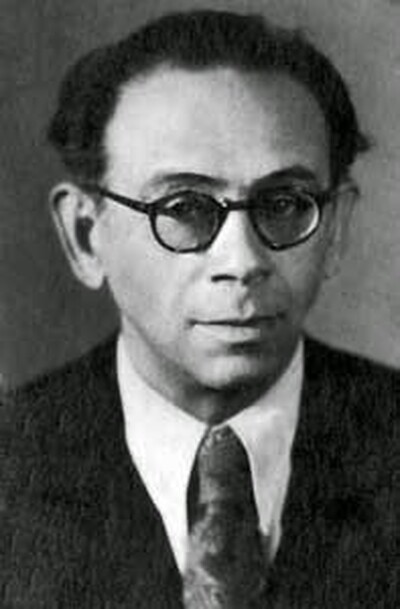
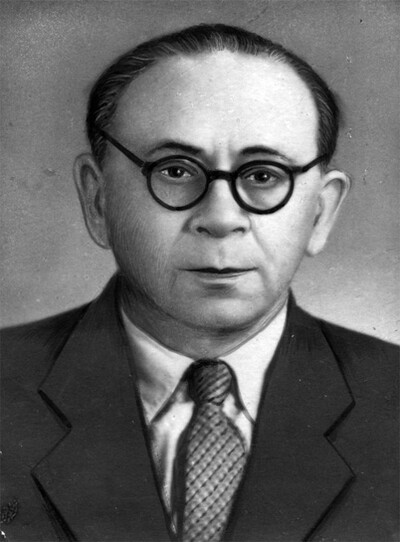
Beregovski, Moyshe
December 15, 1892–August 12, 1961
A folklorist and music scholar, he was born in the town of Termakhivka, Ivanoskiy region, Kiev district, Ukraine. His father Yankl was a private, itinerant teacher in the nearby town of Makarov (Makariv). Until his bar mitzvah he studied in a cheder metukan (improved religious elementary school). In 1905 he moved to Kiev and took the high school curriculum as an external (auditor) student. From 1910 he studied cello, thanks to assistance from teachers who discovered his musical ability. In 1912 he was playing cello in the Kiev Orchestra. After graduating from the Kiev Conservatory (attended 1915-1922) and later the Leningrad Conservatory (1922-1924), he devoted himself to musical training in Jewish schools and among working youth, as well as to collecting Jewish musical folklore. He became choir director and music teacher in the Jewish schools in Kiev (1915-1920), in Leningrad (1922-1924), in the elite Jewish school in the colony of Malakhovka near Moscow (1924-1926), in the Kiev Jewish teachers’ seminary (1926-1928), and in the Pedagogical Technicum (1927-1931). He became an ardent proponent of Jewish musical art, and he was a member of the political-artistic council of the Kiev Jewish musical group “Yidvokans” (Jewish Vocal Ensemble) (1930-1936). Over those years 1930-1936, he managed the ethnographic section and the office of music folklore at the Institute for Jewish Culture in the Ukrainian Academy of Sciences. He was later the head of the folklore section of the office of the teaching of Soviet Yiddish literature, language, and folklore of the same Academy (1937-1947). He received in 1944 the academic title: “candidate (Russian equivalent to PhD) in Musical Science.”
While still young, he began collecting and transcribing Jewish folksongs and folk melodies. He had the opportunity in 1928 to devote himself to work in a more systematic fashion. As the director of the office of folklore and ethnography at the Kiev Institute for Jewish Culture, he conducted a large-scale collection of materials. Over the course of ten years, he assembled over 3,000 musical items of Jewish folklore (songs and melodies). In the late 1940s, when the Institute (already with just an office of Jewish culture) was shut down and its associates arrested, he too fell under arrest. Miraculously, a significant portion of his collections were preserved, and they constitute a rich source on the musical art of the Jewish people. Among his publications:
(1) “Cuiomovni j riznomovni pisni v evrejiv Ukrajiny, Bilorusy j Pol’Sfi,” Etnohrajylnyj visnyk 6(9), pp. 37-51;
(2) “Tsu di oyfgabn fun yidisher muzikalisher folkloristik” (On the publications of Jewish musical folklore studies), in Problemen fun folkloristik (Problems in folklore studies) (Kiev, 1932);
(3) Yidisher muzik-folklor (Jewish music folklore), vol. 1, under the general editorship of M. Viner (Moscow: Proletkult, 1934), 246 pp. (in Yiddish with Roman letters in a Russian edition);
(4) “Kegnzaytike virkungen tsvishn dem ukrainishn un yidishn muzik-folklor” (Mutual influences between Ukrainian and Jewish music folklore), Visnshaft un revolutsye (Science and revolution) (Kiev) 2-6 (April-June, 1935);
(5) “Взаємні впливи в єврей ському і українському музичному фолкльорі” (Mutual influence in Soviet Jewish and Ukrainian musical folklore), Радянська музика (Soviet music) 5 (1936);
(6) Yidishe instrumentale folks-muzik (Jewish instrumental folk music) (Kiev: Ukrainian Academy of Sciences, folklore section, 1937), 28 pp.;
(7) Yiddish folksongs of the Soviet period, in Tvorchestvo narodov SSSR (Works by the peoples of the USSR) (Moscow, 1937), in Russian;
(8) Yidishe folks-lider (Jewish folksongs), with notation (Kiev: Ukrainian state publishers for national minorities, 1938), 532 pp., with Itzik Fefer;
(9) “Yidishe klezmer, zeyer shafn un shteyger” (Jewish musicians, their creations and practices), Sovyetish 12 (1941), pp. 412-50;
(10) Yidishe folklor biz der oktyabr-tsayt (Jewish folklore until October [1917]), a project of the office of Jewish culture in the Ukrainian Academy of Sciences (Ufa, 1942);
(11) “Vegn der haynttsaytiger yidisher lid” (On the contemporary Jewish song), Eynikeyt (September 4, 1947);
(12) Yidishe folks-lider, Yiddish text in Roman transcription (Moscow, 1962);
(13) Old Jewish Folk Music: The Collections and Writings of Moshe Beregovski, ed. Mark Slobin (Philadelphia: University of Pennsylvania Press, 1982), 579 pp.;
(14) Purim-shpil, evreiskie narodnye muzykalʹno-teatralʹnye predstavlenii︠a︡ (Purim play, Jewish ethnic musical-theatrical performance) (Kiev: Dukh i litera, 2001), 646 pp.
A number of songs from Beregovsky’s folklore collections were published in Zalmen Skuditski’s two volumes of Folklor-lider (Folklore songs) (Moscow: Emes, 1933, 1936). His other writings ready for publication were well-known: “Yidishe muzik-folklor” (Jewish music folklore), 2 vols., and “Yidishe folkstents” (Jewish folk dancing) (noted in Yidishe instrumentale folkmuzik, below the main text on pp. 3 and 10). His wife, Sore Paz, was a doctor. He died in Kiev.
Aleksander Pomerants and Leyzer Ran
Sources: A. Blonder, “A bukh, vos men darf popularizirn” (A book that should be popularized), Shtern (Kharkov) 151 (1934); D. Kurland, “Fun fuln hartsn” (With a full heart), Sovetishe literatur (Kiev) (August 1940), p. 136; Kurland, “In kabinet far yidisher kultur” (In the office of Jewish culture), Eynikeyt (Moscow) (July 15, 1942); A. Kahan, “Yidishe shprakhkener bay der arbet” (Jewish polyglot at work) Eynikeyt (Moscow) (April 5, 1943); Kh. L-r (Loytsker), “Tsvey yidishe visnshaftlekhe disertatsyes” (Two scholarly Jewish dissertations), Eynikeyt (Moscow) (February 10, 1944); Y. Nusinov, “Di sovetishe yiYidishe Kultur(Soviet Jewish culture), Eynikeyt (Moscow) (November 8, 1944); “Kultur-khronik: der kabinet far yidisher kultur” (Cultural chronicle, the office of Jewish culture), Eynikeyt (Moscow) (January 4, 1945); Emkin, “Nayer folklor” (New folklore), Eynikeyt (Moscow) (March 3, 1945); “In der yidisher un hebreisher literatur” in Yiddish and Hebrew literature), Tsukunft (New York) (April 1945); “Yidishe folklor” (Jewish folklore), Eynikeyt (Moscow) (October 2, 1945); “A groyser oyftu in antviklen di yiYidishe Kulturn visnshaft” (A great accomplishment in developing Jewish culture and scholarship), Eynikeyt (Moscow) (April 2, 1946); A. Kahan, “A gelernter a muziker” (a learned musicologist), Eynikeyt (Moscow) (May 16, 1946); P. Novik, Eyrope—tsvishn milkhome un sholem (Europe between war and peace) (New York, 1948), p. 269.
[Additional information from: Berl Kagan, comp., Leksikon fun yidish-shraybers (Biographical dictionary of Yiddish writers) (New York, 1986), col. 112; and Chaim Beider, Leksikon fun yidishe shrayber in ratn-farband (Biographical dictionary of Yiddish writers in the Soviet Union), ed. Boris Sandler and Gennady Estraikh (New York: Congress for Jewish Culture, Inc., 2011), pp. 54-55.]
I found it on the internet.
Thank you for this very interesting piece!
Hello,
Do you know where the picture comes from?
Thanks!
Eléonore