
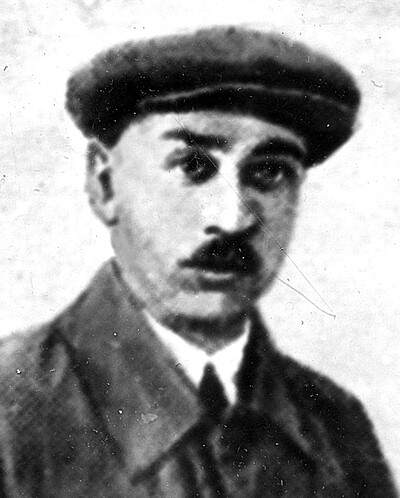
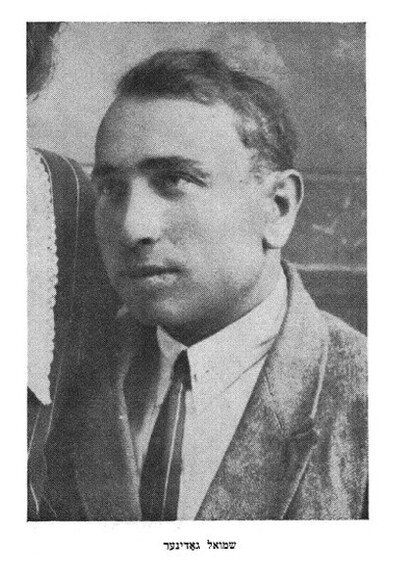
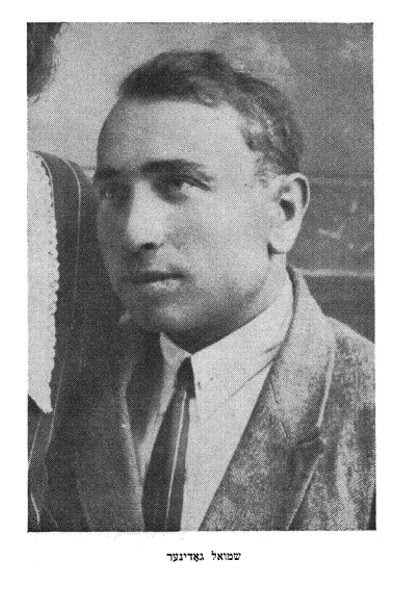
Godiner, Shmuel-Nisn
1893–1942
He was prose author and playwright, born in Telekhan (Tsyelyakhany), Minsk region (later Polesia), Byelorussia. His father, Yisroel-Dovid, was religious man, engaged in scholarship, and for a time a tenant innkeeper in the village of Vyado. Godiner received a traditional education, studying Jewish subjects with his father, and later under the influence of illegal socialist literature, he was captivated by the revolutionary movement and was one of the founders of the youth movement dubbed the Kleyner Bund (Little Bund). In 1908, he and his parents moved to Warsaw, where he became an apprentice in a locksmith’s workshop. At age seventeen he began to work in a metal factory. At the same time, he devoted himself to acquiring an education on his own. He read great quantities of the Russian, Polish, and German literature. In Warsaw he made his first attempts at composing poetry and stories, and he showed his writings to I. L. Peretz who encouraged him to write more. At the end of 1912, he was drafted into the Tsarist army, served in the Caucasus, participated in the first fighting of WWI, and in 1914 he was wounded while traversing the Carpathian Mountains on the battle front. In early 1918 he was captured by the Austrians, but he was soon successful in escaping from their camp to Warsaw, and from there he returned to Russia. He remained for a short time in the army, and when the Russian civil war started, he joined the Red Army; he later joined the Communist Party. In 1921 he came to Moscow as a student and entered the Valery Bryusov Institute for Literature and studied there for two years. He initially wrote poetry (never published), but from 1921 he wrote only prose. At first, he wrote mainly about the war themes and Russian civil war, and in a distinctive symbolist style. His first story, entitled “Reges” (Moments), was published in Emes (Truth) in Moscow in 1921, and later published work in Shtern (Star) in Minsk, Der shtrom (The stream) in Moscow, and other magazines and newspapers. He became recognized as one of the groundwork-layers of Soviet Yiddish prose. He also wrote dramatic works, translated many books from Russian, and compiled a literary anthology. Gordiner went to Birobidzhan on two occasions, and there he helped found Yiddish schools and libraries, and to strengthen cultural work. He penned a long story, “Birobidzhaner” (A man from Birobidzhan), among the first immigrants there. In 1934 he was seated on the presidium with the most prominent Yiddish authors—Perets Markish, Dovid Hofshteyn, Izi Kharik, and Yekhezkl Dobrushin—at the first conference of the councils in the Jewish Autonomous Region. He demonstrated great mastery in his chef d’oeuvre, Der mentsh mit der biks (The man with the rifle), in which he described the events in WWI and the civil war. Soon after the Nazi invasion of the Soviet Union in the June of 1941, he volunteered to fight at the front. He fought there together with the partisans. He died there in 1942.
Among his books are the following: Tog antkegn (Toward the day) (Moscow: Der emes, Kultur-Lige, 1924), 127 pp.; Der mentsh mit der biks, a novel in two volumes (Moscow: Shul un Bukh, 1928, 1933), several reprint editions; Figurn afn rand, dertseylungen (Figures on the edge, stories) (Kiev: Kultur-Lige, 1929), 251 pp.; Oys religye zamlung fun literatur (Out with religion! Literature collection) (Moscow: Bezbozhnik, 1929), 56 pp., with A. Vevyorke; Dzhim kuperkop (Jim Kuperkop), a dramatic pamphlet in eleven scenes (Moscow-Kharkov-Minsk: FSSR Publ., 1930), 131 pp. (staged by Artef [Communist-inspired Yiddish theater] in New York); Kavkom hersh, dertseylung (Kavkom Hersh, a story) (Kharkov: State Publishers of National Minorities, 1933), 15 pp.; Verk, ershter band, dertseylungen (Works, vol. 1: stories) (Moscow: Emes, 1933), 378 pp.; Muterland, roman (Motherland, a novel) (Moscow: Emes, 1935), 480 pp.; Di akore fun rohatshev (The fortress of Rogachov), a story (Moscow: Emes, 1936), 16 pp.; Di gliklekhe muter elke (Elke, the happy mother), a story (Moscow: Emes, 1936), 48 pp.; Yudke komunareytshikl (Yudke, the little communard), a story (Moscow: Emes, 1936), 48 pp.; Di heylike shklover levone (The heavenly Shklov [Szkłów, Škłoŭ] moon) (1936); Der ershter (The first) (Moscow, 1938), 12 pp.; A nakht bam tseyln (A night counting), a story (Moscow: Emes, 1938), 11 pp.; Zaveler trakt (Zavel highway), a story (Moscow: Emes, 1938), 190 pp. (New York: IKUF, 1950), 247 pp.; Linitisher yatn (Linitish guys), a story (Moscow: Emes, 1939), 17 pp.; Der yontef fun frayndshaft (The festival of friendship) (Moscow: Emes, 1939), 46 pp.; Andere mentshn (Other people), stories (Moscow: Emes, 1940), 288 pp. His work was included in: Deklamater fun der sovetisher yidisher literatur (Reciter of Soviet Yiddish literature) (Moscow: Emes, 1934); Der arbeter in der yidisher literatur, fargesene lider (The worker in Yiddish literature, forgotten poems) (Moscow, 1939); the anthology Birebidzhan (Birobidzhan) (Moscow, 1936); Far der bine: dertseylungen, pyeses, lider (For the stage: stories, plays, poems), with musical notation (together with Yekhezkl Dobrushin and Elye Gordon) (Moscow: Central People’s Publ., 1929); Bafrayte brider, literarishe zamlung (Liberated brethren, literary anthology) (Minsk” State Publishers of Byelorussia, 1939); Farn heymland in shlakht! (For the homeland in battle!) (Moscow: Emes, 1941); Komyug, literarish-kinstlerisher zamlbukh ([Jewish] Communist Youth, literary-artistic anthology) (Moscow: Emes, 1938); and Osher shvartsman, zamlung gevidmet dem tsvantsik yortog fun zayn heldishn toyt (Osher Shvartsman, collection dedicated to the twentieth anniversary of his heroic death) (Moscow: Emes, 1940). His translations include: Lidiya Seifullina’s Erd-zaft (Juice of the earth) (Moscow: Shul un Bukh, 1924), 158 pp., and her Virinyeya (original: Virineya) (Moscow: Emes, 1925), 146 pp.; Fedor Gladkov, Tsement (Cement [original: Zement]) (Moscow: Shul un Bukh, 1927), 334 pp.; Mikhail Rozanov, Kostya ryabtsevs togbukh (Kostya Ryabtsev’s diary) (Moscow, 1928), 222 pp.; Yuri Oliosha, Kine (Envy) (Warsaw: Literarishe Bleter, 1934), 137 pp.; Maksim Gorki’s Klim sangins lebn (The life of Klim Samgin [original: Zhizn’ Klima Samgina]) (Moscow, 1937). Godiner also compiled (together with Yisroel Rabinovitsh) Af barikadn, revolyutsyonere shlakhtn in der opshpiglung fun der kinstlerisher literatur (At the barricades, revolutionary battles in the lens of artistic literature) (Kharkov: Central Publ., 1930), 300 pp.
Sources: M. Mizheritski, in Royte velt (Kharkov) (September-October 1931); M. Kashtshevatski, in Royte velt (August 1931); Y. Bronshteyn, Atake (Attack) (Minsk, 1931), pp. 194-218; A. Vevyorke, Der stil fun der proletarisher literatur (The style of proletarian literature) (Kharkov, 1932), p. 28; D. Manyevitsh, in Morgn-Frayhayt (New York) (May 2, 1932); Shmuel Niger, in Tog (New York) (December 16, 1934); A. Abtshuk, Etyudn un materialn tsu der geshikhte fun der yidisher literatur bavegung in FSRR (Studies and material for the history of the Yiddish literature movement in the Soviet Union) (Kharkov, 1934), pp. 27-29, 50, 51, 61; M. Natovitsh, in Eynikeyt (Moscow) (February 24, 1945); N. Y. Gotlib, Sovetishe Shrayber (Soviet writers) (Montreal, 1945), pp. 88, 92; Ester (Godiner) Miler, preface to Shmuel Godiner’s novel Zaveler trakt (New York, 1950), pp. 9-13; David Knaani and Arye Shamri, translators, Lo amut ki eḥye (I will not die, but live on) (Merḥavia, 1957). Zaynvil Diamant and Aleksander Pomerants [Additional information from: Berl Kagan, comp., Leksikon fun yidish-shraybers (Biographical dictionary of Yiddish writers) (New York, 1986), col. 123; and Chaim Beider, Leksikon fun yidishe shrayber in ratn-farband (Biographical dictionary of Yiddish writers in the Soviet Union), ed. Boris Sandler and Gennady Estraikh (New York: Congress for Jewish Culture, Inc., 2011), pp. 65-66.]
Олеша Юрий Карлович (1899-1960) Olesha Yuri
יורי אלעשא
Sh. Godiner translated into Yiddish Nikolay Virta's (real name is Karelsky) Eynzamkayt :roman (Loneliness).- Moskve: Farlag Emes, 1937.- 308, [3] pp.
אײנזאמקײט: ראמאנ
נ. װירטא; יידיש - ש. גאדינער
Sh. Godiner translated into Yiddish Vladimir Stavsky's (real name is Kirpichnikov) Der iberbrokh (Run-up/Running start).- Moskve: Farlag Emes, 1932.- 284,[4] pp.
דער איבערבראך
װ. סטאװסקי; יידיש - ש. גאדינער
Sh. Godiner wrote Kavkom Hersh (Кавком Герш)
Kharkov ;Kiev: Melukhe farlag far di natsionale minderhaytn in USRR, 1933.- 15, [1] pp.
קאװקאמ הערש
ש. גאדינער
כארקאװ; קיעװ
מעלוכע-פארלאג פאר די נאציאנאלע מינדערהײטנ אינ אוסרר
Di akore fun Rohatshov (Бездетница из Рогачева meaning A childless woman from Rohatshov), a story (Moscow: Emes, 1936), 38, [1] pp.
די אקארע פונ ראהאטשאװ
Sh. Godiner wrote a collection of stories Maysters fun feld un vayngortn (Masters of the fields and vineyards) (Moscow: Emes, 1940), 168,[4] pp.
מײסטערס פונ פעלד אונ װײנגארטנ
N. Ognev is a pen name of M. Rozanov
Sh. Godiner wrote Dertseylt in freydn (Told in Joy) (Moscow: Emes, 1939),35, [1] pp.
דערצײלט אינ פרײדנ
Sh. Godiner translated N. Ognev's Kostya Ryabtsev’s diary
Kostye Ryabtsevs tog-bukh :
dos lernyor 1923-1924; lebnsbilder fun der shul fun der tsveyter shtupe
N. Ognyev; yidish - Sh. Godiner
Moskve: farlag "Shul un bukh", 1928.- 222, [1] pp
קאסטיע ריאבצעװס טאג-בוך
דאס לערניאר 1924-1923; לעבנסבילדער פון דער צװײטער שטופע
נ. אגניעװ; יידיש - ש. גאדינער
The author of Kostya Ryabtsev’s diary is Nikolay Ognev (1888-1938)