
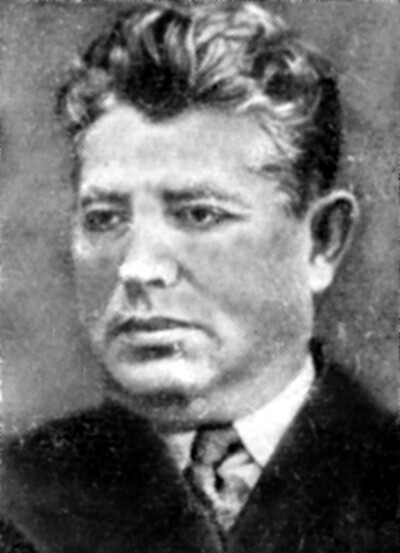
Reznik, Yankev
April 1892–June 25, 1952
The younger brother of the poet, prose author, and dramatist Lipe Reznik, he was a teacher, journalist, and doctor of educational science, born in Chernobyl, Kiev district, into the family of a teacher. He signed his given name as Yashe. Until age fourteen he studied Jewish subject matter, and in 1913-1914 he was studying to be a pharmacist at Kiev University, from which he graduated in 1916. He was at this point already interested in educational matters, and he later turned completely to pedagogical work.
Over the years 1912-1914, he participated in the building of a Jewish public school in Chernobyl, the second in the Russian empire with Yiddish as the language of instruction. After the Revolution, he worked his entire life as a teacher and devoted himself to research in education. In 1921 he founded in Kiev the first Jewish pedagogical technical school (which he directed until 1929) and the senior elementary school in Kiev, and he directed a model children’s home.
In 1927 he went on a scientific mission to Germany, studying teaching practices in local schools there, and in 1928 became a professor of pedagogy in the Jewish division of the Odessa institute for public education. For many years he served as director of the pedagogical section in the Kiev institute for Jewish culture. In later years, at the time of the “struggle against cosmopolitanism,” he was expelled from the Communist Party and removed from all of his positions. He was barely able to gain a position in a Ukrainian teachers’ institute in the secluded provincial city of Starobil's'k, Lugansk (Luhansk) district, Ukraine—and soon thereafter he died there.
From 1917 he was contributing work to general periodicals, such as Komfon (Communist Banner) and Shtern (Star), but in the main he wrote for pedagogical journals. Reznik’s more important pedagogical articles were concerned with “Complex method” and new school programs, published in: Kiev’s Pedagogisher Byuletin (Pedagogical Bulletin) (1922-1923); Af di vegn tsu der Nayer Shul (On the Path to the New School) (Moscow: Kultur-Lige, 1924-1928); Pedagogishe Khrestomatye (Pedagogical Reader) (Kiev: Kultur-Lige, 1926); the anthology Tsu Hilf dem Shtetldikn Lerer (Aid to the Teacher in Town) (Kiev: Kultur-Lige, 1927); Kamf af Tsvey Frontn in der Pedagogik (Battle on Two Fronts in Pedagogy) (Kiev: Institute for Jewish Proletarian Culture, 1932).
He co-edited: Ratnbildung (Soviet Education) (Kiev-Kharkov, 1928-1937?); Yunger Shlogler (Young Hard Worker) (Kiev-Kharkov, 1931-1932). He edited: Di Lernarbet in Shul (Educational Work in School) (Kharkov-Kiev: Ukrainian State Publishers for National Minorities, 1933), 210 pp.
In book form:
Hantbikhl, Tsol Yedies fun Farsheydene Gebitn fun Lebn (Hand Booklet, Numerical Information for Various Realms of Life) (Kiev: n.d., 1923?), 36 pp.;
Matematik, fun Lebn Farn Tsveytn, Dritn, Fertn Lernyor (Mathematics of Life for the Second, Third, Fourth School Year) (Kiev: Kultur-Lige, 1923, 1924, 1925, resp.), 94 pp., 27 pp., 154 pp.;
Tsu der Nayer Shul, fun Pruv-Arbet in a Kinder-Hoyz (To the New School, from Tentative Work in a Children’s Home) (Kiev: Kultur-Lige, 1924), 106 pp.;
Arbetbukh af Matematik, Farn Tsveytn Lernyor (Workbook for Mathematics, for the Second School Year) (Moscow: Shul un Bukh, 1927), 128 pp.;
Programen fun der Eynheytlekher Arbet-Shul (Programs for the Uniform Labor School) (Moscow: Central People’s Publishers, USSR, 1928), 88 pp.;
Di Politekhnishe Shul Loyt Marks-Engels-Lenin (The Polytechnic School According to Marx, Engels, [and] Lenin), with G. Gorokhov (Kharkov-Kiev: Ukrainian State Publishers for National Minorities, 1932), 196 pp.;
Heymfargebungen (Homework), with H. Safyan and Ester Shnayderman (Minsk: Institute for Jewish Proletarian Culture, 1935), 109 pp.;
Teorye un Praktik fun der Lernarbet in Shul (Theory and Practice of Educational Work in School), part 1 (Moscow: Emes, 1935), 253 pp.;
Oysbildung fun Rikhtike Forshtelungen un Bagrifn Ba di Kinder (Education in Proper Conceptions and Concepts with Children) (Kiev, 1938), 80 pp.;
Interes un Ufmerkzamkeyt inem Unterrikht (Interest and Consideration in Instruction) (Kiev, 1938), 54 pp.;
Heym-Fargebungen (Homework) (Kiev, 1938), 38 pp.;
Lektsye un Shmues Als Metod fun Unterikht (Lecture and Conversation as a Method of Instruction) (Kiev, 1938), 90 pp.;
Metodik fun Farfestikn dem Lern-Materyal (Method for Strengthening Teaching Material) (Kiev, 1938), 76 pp.;
Dertsiung un Bildung in der Sovetisher Shul (Upbringing and Education in the Soviet School) (Kiev-Lvov, 1940), 323 pp.;
He also contributed to Ukrainian pedagogical periodicals and published in Ukrainian two textbooks (1927, 1929).
Sources: Zalmen Reyzen, Leksikon, vol. 4; Chone Shmeruk, comp., Pirsumim yehudiim babrit-hamoatsot, 1917-1961 (Jewish Publications in the Soviet Union, 1917-1961) (Jerusalem, 1962), see index; A. Pomerants, Di Sovetishe Haruge Malkhes, Tsu Zeyer 10-Tn Yortsayt, vegn dem Tragishn Goyrl fun di Yidishe Shraybers un der Yidisher Literatur in Sovetnland (The [Jewish writers] Murdered by the Soviet Government, on Their Tenth Anniversary of Their Deaths, Concerning the Tragic Fate of the Yiddish Writers and Yiddish Literature in the Soviet Union) (Buenos Aires: YIVO, 1962), pp. 55-56; Yeshurin archive, YIVO (New York).