
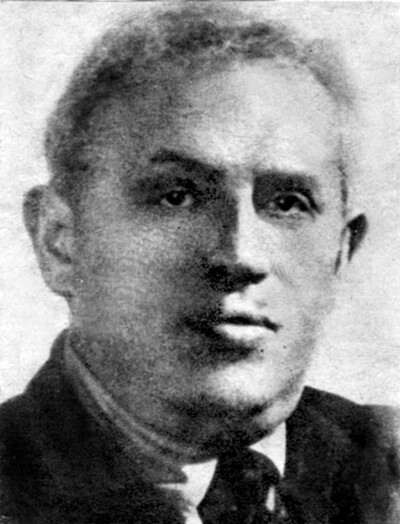
Reznik, Lipe
August 15, 1890–April 5, 1944
The author of poetry, stories, and plays, he was a teacher and translator as well, born in Chernobyl, Kiev district, Ukraine, the elder brother of Yankev Reznik. His father was a schoolteacher and cantor. He studied in religious elementary school and yeshiva, and at age fourteen he went to work. In 1910 he moved to Kiev and entered an art school. Over the years 1912-1914, he was an auditor at a pedagogical course of study in Grodno. Until 1917, he worked as a teacher in private Jewish schools.
After the Revolution he worked as an administrator in a Jewish school in Kiev. He then passed the examinations for an external (auditor) student and entered the physics and mathematics department of Kiev University. In 1920 he was living in Moscow and working as a teacher in the Malakhovo Jewish Children’s Colony, before returning to Kiev in 1921 where he worked in children’s homes and schools.
Until 1929 he taught Yiddish language and literature and edited Pedagogisher Byuletin (Pedagogical Bulletin) in Kiev. After completing his student research position in the philology section at the Institute for Jewish Culture, he worked as an administrator of the linguistics department and lecturer on social education at the Pedagogical Institute.
His literary work began with a reworking of the children’s book Der Alter Seyfer, a Mayse (The Old Religious Text, a Story) (Kiev: Kunst-Farlag, 1914), 18 pp. After a lengthy break, he made his debut with poetry in the collection Oyfgang (Arise) (Kiev: Kultur-Lige, 1919). From that point, he contributed poems, stories, and plays, as well as articles on Yiddish language and pedagogy to: the collection Eygns (One’s Own) 2 (Kiev, 1920); Shtrom (Current) in Moscow; Di Royte Velt (The Red World) and Yunge Gvardye (Young Guard) in Kharkov; Di Yidish Shprakh (The Yiddish Language) in Kiev; Ukrayine (Ukraine), Farmest (Challenge), Forpost (Outpost), Sovetish (Soviet), Sovetishe Literatur (Soviet Literature), and other Soviet publications; the anthology Sambatyen (Sambation) in Riga (Arbeterheym, 1922); the collection Khalyastre (Gang) in Warsaw; and Hamer (Hammer) and Frayhayt (Freedom) in New York; among others.
As a pedagogue, he also wrote for Tsu Hilf dem Shtetldikn Lerer (Aid to the Teacher in Town) (Kiev: Kultur-Lige, 1927) and Zhurnal far Praktish Yidish Shprakhvisn (Journal for Practical Yiddish Linguistics) (1927), in which he published such essays as: “Vegn der Prepozitsye fun” (On the Preposition fun), “Vegn der Predikativer Grupe” (On the Predicative Group), and “Vegn Stil un Shprakh fun Itsik Kipnis” (On the Style and Language of Itsik Kipnis).
He edited or co-edited: Sholem-Aleichem, Mayses (Stories) (Kiev: Kultur-Lige, 1925), 47 pp.; Sholem-Aleykhem, Zayne Kindershe un Inglshe Yorn, Kapitlen fun Sholem-Aleykhems Avtobyografye (Sholem-Aleichem, his Childhood and Youth, Chapters from Sholem-Aleichem’s Autobiography), with Shimen Dobin (Kiev: Kultur-Lige, 1926), 96 pp.; and the children’s magazine Freyd (Joy).
His poetry appeared in: Yugnt (Youth) in Kharkov (1922); Ezra Korman’s Brenendike Brikn In der Nayer Yidisher Dikhtung fun Ukraine (Burning Bridges in Modern Yiddish Poetry from Ukraine) (Berlin: Idisher Literarisher Farlag, 1923); Shlakhtn, Fuftsn Yor Oktyabr in der Kinstlerishe Literatur (Battles, Fifteen Years Since October in Artstic Literature) (Kharkov-Kiev: Ukrainian State Publishers for National Minorities, 1932); Tsum Zig (Toward Victory) (Moscow: Emes, 1944); and Af Naye vegn (Along New Pathways).
His own work would include (in addition to what has been mentioned above):
In Bleykhe Oyfgangen (In Ghostly Apparitions), poetry (Kiev: Kultur-Lige, 1921), 30 pp.;
Samet (Velvet), poetry (Kiev: Kultur-Lige, 1922), 36 pp.;
Oyfshtand, Pyese in Dray Aktn (Resistance, a Play in Three Acts) (Kiev: Kultur-Lige, 1928), 78 pp.;
Heym (Home) (Kharkov: Ukrainian Central Publishers, 1929), 143 pp.;
Azoy iz Geven, Rekrut, Pyese in Fir Aktn (11 Bilder) Loyt Aksenfeldn (As it Was, Recruit, a Play in Four Acts, Eleven Scenes, Following [Yisroel] Aksenfeld) (Kiev-Kharkov: Ukrainian State Publishers for National Minorities, 1935), 104 pp.;
Gantsfri (Early Morning), poetry (Moscow: Emes, 1935), 112 pp.;
Sheve (Sheve), a story (Kiev-Kharkov: Ukrainian State Publishers for National Minorities, 1935), 15 pp.;
Donye (Donye) (Kiev, 1939), 87 pp.; Rum (Glory), poetry (Kiev, 1939), 26 pp.;
In Yene Teg (In Those Days), a play (Kiev: Ukrainian State Publishers for National Minorities, 1940), 123 pp.
Reznik also had several unpublished, but staged, plays: Di Letste Shvartse Geto (The Last Black Ghetto), following Eugene O’Neill; Shvester (Sister), following Y. L. Perets; and Khasene Gehat (Married).
For a time he was editor of the School and Pioneer Library for the Kiev publishing house Kultur-Lige (Culture League). And, for this publisher, he translated a series of works:
Maxim Gorky, Naynter Yanvar (January 9th) (1926, 1930), 45 pp.;
Nikolai Tikhonov, Sami (Sami);
Vladimir Korolenko, Kinder fun Keler (Underground Children [original: Deti Podzemel’ia]) (Kiev: Kultur-Lige, 1927), 39 pp.;
Leon Trotsky, Ahin un Tsurik (Here and Back) (Kiev: Kultur-Lige, 1926), 92 pp.;
H. G. Wells, Ug-Lomi, a Mayse fun Shteyn Tkufe (Ugh-Lomi, a Story from the Stone Age) (1927), 87 pp.;
A. S. Novikov-Priboi, Afn Grunt fun Yam (At the Bottom of the Sea) (Kiev: Kultur-Lige, 1927), 78 pp.; and
Jack London, Dertseylungen (Stories) (Kiev: Kultur-Lige, 1925, 1930), 62 pp.; among others.
Translations with other publishers include:
the Finnish epic Kalevala;
Aleksandr Pushkin, “Boris Godunov” (Boris Godunov), in Dramatishe Verk (Dramatic Works) (Kiev: Ukrainian State Publishers for National Minorities, 1937);
poems by Taras Shevchenko;
stories by Anton Chekhov; and more.
A special place in his translations was assumed by a series of Hebrew poems from the Spanish era by Yehuda Halevi, Ibn Gavirol, Avraham Ibn-Ezra, and others. It is worth mentioning in this context that, in one of Reznik’s first books (Samet), he included in a poetic cycle the poetic reworking of the holiday service in the Temple—something which at that time provoked mockery and fury among Soviet critics. In later years, he also published an array of stories, among them: “DI Vayse Shtub” (The White House), “In Shkhenesdikn Tsimer” (In the Neighboring Room), and “Valye” (Frill).
He died in Kostanay, Kazakhstan, whence he had been evacuated during the war.
“Reznik is one of the most important representatives,” noted Zalmen Reyzen, “of the young Soviet Yiddish lyrical poets [cofounder of the ‘Kiev group’]. Beginning as a symbolist, he later freed himself from the external signs of symbolism…. He excels with an evolving sense of the culture of the word, and he has given interesting indications of a move on to prose.”
“Lipe Reznik (following Perets Markish),” wrote Y. Gontar, “is one of the founders of Soviet Yiddish poetry,…and Reznik is more than a poet. He is the founder of Soviet Yiddish drama. The fact that Reznik based a number of his dramatic works on the writings of Yisroel Aksenfeld and Y. L. Perets shows that [he] remains true to the Yiddish classical authors. His writings excelled in their cultured quality and his multisided talent.”
Berl Cohen
Sources: Zalmen Reyzen, Leksikon, vol. 4; Chone Shmeruk, comp., Pirsumim yehudiim babrit-hamoatsot, 1917-1961 (Jewish Publications in the Soviet Union, 1917-1961) (Jerusalem, 1962), see index; Prolit (Kharkov) 1 (1928); Khatskl Dunets, In Shlakhtn (In Battle) (Moscow, 1931); Yashe Bronshteyn, Atake, Literarishe-Kritishe Artiklen (Attack, Literary Critical Articles) (Moscow, 1930); Y. Gontar, in Yidishe Kultur (New York) 6-7 (1944), p. 92; Hersh Smolyar, in Yidishe Shriftn (Warsaw) 7-8 (1965); Arn Vergelis, in Sovetish Heymland (Moscow) 7 (1970); Mortkhe Altshuler, Yahadut berit-hamoatsot baaspaklarya shel itonut yidish bepolin, bibliyografya 1945-1970 (The Jews of the Soviet Union from the Perspective of the Yiddish Press in Poland, Bibliography) (Jerusalem, 1975), p. 170; Yidisher Teater in Eyrope Tsvishn Beyde Velt-Milkhomes (Yiddish Theater in Europe Between the Two World Wars), vol. 2 (New York, 1971), pp. 366, 378; Yeshurin archive, YIVO (New York).
Lipe Reznik translated J. London's story "Farshtraykt" (orig. "The apostate")
פארשטרײקט
דזשעק לאנדאנ; יידיש - ל. רעזניק
קיעװ : קאאפעראטיװער פארלאג קולטור-ליגע
1927.- 31, [1] pp.
Farshtraykt
Dzshek London; Yiddish - L. Reznik
KievKooperativer farlag Kultur-Lige
פארשטרײקט
דזשעק לאנדאנ; יידיש - ל. רעזניק
קיעװ :מעלוכע פארלאג פאר די נאציאנאלע מינדערהײטנ אינ אוססר
1937.- 43, [1] pp.
Farshtraykt
Dzshek London; Yiddish - L. Reznik
Kiev : Melukhe farlag far di natsionale minderhaytn in USSR
Lipe Reznik translated into Yiddish an Arabic fairy tale "Sindbad der yamforer :an arabish maysele" ("Sindbad the sailor")
סינדבאד דער יאמפארער
אנ אראביש מײסעלע
יידיש - ל. רעזניק
קיעװ : מעלוכע פארלאג פאר די נאציאנאלע מינדערהײטנ אינ אוססר
1937.- 78, [2] pp.
Sindbad der yamforer :an arabish maysele
Yiddish - L. Reznik
Kiev : Melukhe farlag far di natsionale minderhaytn in USSR
Lipe Reznik was a compiler of "Literarishe khrestomatie :farn 9 klas fun der mitl-shul" (Reading book for 9th class)
ליטערארישע כרעסטאמאטיע
פארנ 9 קלאס פונ דער מיטל-שול
צונױפגעשטעלט - ל. רעזניק
קיעװ : מעלוכע פארלאג פאר די נאציאנאלע מינדערהײטנ אינ אוססר
1939. - 239, [1] pp.
Literarishe khrestomatie :farn 9 klas fun der mitl-shul
tsunoyfgeshtelt - L. Reznik
Kiev : Melukhe farlag far di natsionale minderhaytn in USSR
Lipe Reznik translated from Russian into Yiddish A.S. Pushkin's "Di geshikhte fun dem dorf Goryukhino" ("The story of the village Goryukhino", orig "История села Горюхина")
די געשיכטע פונ דעמ דארפ גאריוכינא
א. ס. פושקין; ײדיש - ל. רעזניק
קיעװ : מעלוכע-פארלאג פאר די נאציאנאלע מינדערהײטנ אינ אוססר
1937.- 38, [2] pp.
Di geshikhte fun dem dorf Goryukhino
A.S. Pushkin; yiddish - L. Reznik
Kiev : Melukhe farlag far di natsionale minderhaytn in USSR
Lipe Reznik contributed his translations among other translators from Ukranian into Yiddish to the collection of poety by Pavlo Tytshina (Павло Тычина) "Di Partay firt" (The Party is leading", orig. "Партия ведёт")
די פארטײ פירט
פאװלא טיטשינא; צונױפגעשטעלט די זאמלונג: ל. קװיטקא; איבערזעצ.: ד. האפשטײן, מ. כאשטשעװאצקי, כאנע לעװינע, איציק פעפער, ע. פינינבערג, ל. קװיטקא, ל. רעזניק, מ. טאלאלאיעװסקי
כארקאװ ; קיעװ: מעלוכישער ליטערארישער פארלאג
1936. - 57, [3] pp.
Di Partay firt
Pavlo Titshina; Tsunoyfgeshtelt di zamlung: L. Kvitko; Iberzets.: D.Hofshteyn, M. Khatschevatsky, Hane Levine, Yitsik Fefer, E. Fininberg, L. Kvitko, L. Reznik, M. Talalaevsky
Kharkov; Kiev : Melukhisher Literarisher farlag
Lipe Reznik translated Maxim Gorky's story "Di Muter" ("Mother", orig. "Mать") in the collection of 4 stories. Other 3 stories were translated by Perets Markish
דערצײלונגען
מ. גארקי; יידיש - ל. רעזניק, פ. מארקיש
קיעװ : קאאפעראטיװער פארלאג קולטור-ליגע
1928. - 57, [2] pp.
Dertseylungen
M. Gorki; yiddish - L. Reznik, P. Markish
Kiev : Kooperativer farlag Kultur-Lige