


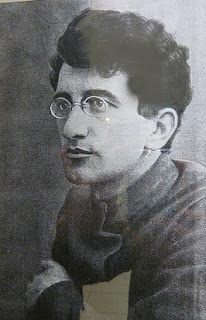
Kharik, Izi
November 17, 1898–October 29, 1937
He was a poet, born in Zembin (Zyembin), Borisov (Horad Barysaw) district, Byelorussia. He was the son of a cobbler and the grandson (on his mother’s side) of Leyzer Sheynman, the well-known wedding entertainer from Zembin. Until age twelve he studied in religious primary school and a Russian public school in Zembin; he later worked in Minsk, Borisov, Homel, and Vitebsk, as an unskilled laborer in a bakery and an assistant to a druggist. From 1917 until 1919, he was the administrator of a school, a leader in the trade union movement, and a librarian in Minsk.
In 1919 he became a Communist, volunteered to join the Red Army, and took part in battles against the White Guard in Byelorussia and against the Poles. He spent the years 1921-1923 studying at the V. I. Briusov Institute for Literature and Art in Moscow, and in Moscow he graduated from a senior literary school in 1924. He subsequently returned to Minsk (1928 to the summer of 1937), where he graduated from the philological institute and took up leading positions in the general and Jewish life of Byelorussia.
He became editor-in-chief of the literary-artistic and sociopolitical journal Shtern (Star), served as one of the directors of the People’s Commissariat for Education in Byelorussia, and stood at the head of all Yiddish cultural work in Byelorussia until the end of his life. He was selected as a corresponding member of the Byelorussian Academy of Sciences, and he was a member of the presidium of the central executive committee of the Byelorussian Communist Party. He was also a delegate and one of the main speakers at the All-Soviet Writers’ Conference. Kharik distinguished himself in Yiddish literature in Soviet Russia as the poet of “Minsker blotes” (Minsk mud).
He began writing poetry in his early years, but due to his reticence he sent them nowhere to be published. By chance, two of his poems reached Shmuel Agurski who was then editor of the Moscow-based, Yiddish-language, Bolshevik newspaper Di Komunistishe Velt (The Communist World), and he published these two poems—“Mir un Zey” (Us and Them) and “In Shturm” (In the Storm)—under the name A. Z. Zembin in issue 14-15 (April 1920). From that point he published his poetry, both originals and translations from Russian poetry, in: Di Komunistishe Velt, Der Emes (The Truth), Nayerd (New Earth), Yungvald (Young Forest), Pyoner (Pioneer), and Sovetishe Literatur (Soviet Literature) in Yiddish, and Krasnaia Nov (Red Soil), Tribuna (Tribune), Pravda (Truth), and Ogonyok (Light) in Russian—all in Moscow; Oktyabr (October), Yunger Leninyets (Young Leninist), Yunger Pyoner (Young Pioneer), Atake (Attack), Shtrom (Current), Shtern, Ruf (Call), Tsaytshrift (Periodical) in which he published in its very first number (1925) a piece about his grandfather, Leyzer Sheynman, and Sovetishe Vaysrusland (Soviet Byelorussia)—in Minsk; Farmest (Challenge), Shtern, and Di Royte Velt (The Red World)—in Kharkov; Prolit (Proletarian Literature) and Afn Shprakh-Front (On the Language Front), among others, in Kiev; Khvalyes (Waves) in Vitebsk; and Der Odeser Arbeter (The Odessa Worker) in Odessa; among others.
Abroad he contributed work to: Der Hamer (The Hammer), Morgn-Frayhayt (Morning Freedom), Signal (Signal), Yung Kuzhnye (Young Smithy), Yugnt (Youth), Studyo (Studio), Ikor (Yidishe Kolonizatsye Organizatsye in Rusland [Jewish Colonization Organization in Russia]), Yidishe Kultur (Jewish Culture), and Zamlungen (Collections)—in New York; Kultur (Culture) in Chicago; Literarishe Bleter (Literary Newspaper), Arbeter-Tsaytung (Workers’ Newspaper), Fraye Yugnt (Free Youth), Yidishe Shriftn (Yiddish Writings), and Folks-Shtime (Voice of the People) in Warsaw; Literarishe Tribune (Literary Tribune) and Parizer Tsaytshrift (Parisian Periodical) in Paris; Erd un Arbet (Land and Labor) in Kishinev; Di Prese (The Press) and Idishe Tsaytung (Jewish Newspaper) in Buenos Aires.
Kharik was one of the people who laid the groundwork for Soviet Yiddish literature. One finds in his work artistically laid out the foundational stages and significant phenomena that transpired in Jewish life in the Soviet Union, especially in Byelorussia, at a time when the process of industrialization and collectivization were running at full blast there. Creative intelligence was “attached” to industrial undertakings and collective farms, provided that one created work in which “the enthusiasm of workers and peasants” played its part. Kharik was “attached” to the greatest construction at that time in Byelorussia: the electrical station “Osintorf,” located deep in Polesia (where were immense reserves of peat, which had to serve as heating for the station). Kharik stayed there for a considerable period of time, and it appears as such in his poem “Kaylekhdike Vokhn” (Circular Weeks). It was promptly included in the teaching programs for Jewish schools, and extracts from it were read aloud in literary evenings in clubs and recited at conferences. The poem was, in truth, a significant event in Yiddish literature. Kharik’s poetry—“Minsker Blotes,” “Mit Layb un Lebn” (Body and Soul), “Kaylekhdike Vokhn,” and “Af a Fremde Khasene” (At a Strange Wedding), among others—were popular and beloved by Yiddish readers. His poetry excelled with its fine craftsmanship, with flaming revolutionary pathos, and with authentic spirit of the people. An innovative poet and a master of modern creativity, he forged new paths for the subsequent generations of Soviet Yiddish poets. His contemporaries explained that young writers from Minsk were simply in love with him, a word from him was holy in their eyes.
It was an unexpected blow and puzzle for everyone when in June 1937 he was arrested in Minsk. No one could understand what crimes could be laid before this prominent activist for Yiddish culture and fiery patriot. Shortly before this event, with great enthusiasm the fifteen-year anniversary of his literary activity was celebrated. At this jubilee the Byelorussian Academy of Sciences published a collection of articles by the best-known authorities of Yiddish literary criticism. The central Moscow newspaper Der Emes had dedicated an entire page to the honoree on November 15, 1935 with warm, praiseworthy articles and a large portrait of the poet, painted by the famous artist M. Rabitshev. That year a special plenum of the Byelorussian Writers’ Association dealt with the question of “On the nationalist and Trotskyist contraband in Byelorussian and Yiddish literature.” Kharik’s name was mentioned only in passing—just the editor of the journal Shtern, who did not realize the “actual face” of a series of writers and critics and who willingly published their work.
In late May-early June 1937, a series of writers’ conferences took place in Minsk, at which was raised the then widespread issue of the “struggle against Trotskyist Averbakhist diversion in literature,” and Kharik was directly accused of the “idiotic illness of carefreeness” embodied in his publishing the work of the “long unmasked enemies of the people, of the counter-revolutionary bandits”—men like Khatskl Dunets, Yashe Bronshteyn, Ziskind Lev, Arn Yudelson, and others (they had all by then been purged). But they had, in fact, “discovered” guilt—for he had ostensibly taken part “in the attack on Kirov and was in the group which prepared an attempted assassination on the then People’s Commissar for Defense Voroshilov.” He was dragged through a number of Russian prisons, where they ferociously tortured him. He went insane and was brought in September to the labor camp at Sukhobenzvodny in northern Russia. On October 28, 1937 he was brought to court for a trial that lasted fifteen minutes. He was sentenced to the highest punishment, and the next morning the sentence of the court was carried out: he was shot. That same day the poet Moyshe Kulbak and the literary critics Yashe Bronshteyn and Khatskl Dunets were also shot.
“His was a profoundly ethnic form, as he drew his poetic nourishment from popular Jewish sources,” wrote Moyshe Litvakov.
“His landscape,” noted Leyb Tsart, “was Byelorussian Jewish folklore.”
“He was the heart of the company of Yiddish writers in Byelorussia,” wrote Uri Finkl, “…while his Af a Fremder Khasene is rife with an artistic sense of completion and his figure of the wedding entertainer is a protesting Lamedvovnik, through whom the simple man of the people speaks.”
Kharik was one of the Soviet Yiddish writers who were murdered by the brutal sword of Stalin and who would not be “rehabilitated” (i.e., exonerated) for many years. In the new edition of the Great Soviet Encyclopedia (1957), it simply states that he “died in 1937,” and in the literary biographical dictionary of Soviet writers from Byelorussia (Minsk, 1957), it states: “He died somewhere in 1937.” It would be some time before his poems appeared again in the Soviet Union. His poems in Byelorussian (Minsk, 1958) and in Russian—with an introduction by Arn Vergelis (Moscow, 1958)—were all that appeared. Of his literary heritage, a few poems have been preserved, and they were published in Folks-Shtime in Warsaw (April 13, 1957) and in Parizer Tsaytshrift 15 (1957).
Although he has never been fully exonerated, things began to change slowly in the early 1960s with the following publications: Dovid Hofshteyn, Izi Kharik, Itsik Fefer, Oysgeklibene Shriftn (Dovid Hofshteyn, Izi Kharik, Itsik Fefer, Selected Writings), ed. Shmuel Rozhanski (Buenos Aires: Lifshits Fund, 1962); and Mit Layb un Lebn (Moscow: Sovetski Pisatel, 1970), 286 pp. Several volumes of his work in Russian and Byelorussian have also appeared in print.
Kharik published in book form:
Tsiter (Shiver), poems from his early period (Minsk: Kultur-Lige, 1922), 64 pp.;
Af der Erd (On the Ground), including as well his poem about the Civil War in Byelorussia, Minsker Blotes (Moscow: Shul un Bukh, 1926), 112 pp.;
Mit Layb un Lebn, a poem about the heroic work of young Soviet teachers in rebuilding Jewish towns (Minsk: Byelorussian State Publishers, 1928), 79 pp., rpt. 1970;
Lider un Poemes (Poetry) (Kiev: Kultur-Lige, 1930), 206 pp., second printing (Minsk, 1930);
Broyt (Bread), a poem (Minsk, 1930), 16 pp.;
Kaylekhdike Vokhn (Minsk: Byelorussian State Publishers, 1932), 157 pp., newer edition (Moscow: Emes, 1935), also appearing in an abbreviated form for the Jewish school (Minsk, 1933), 50 pp.;
Fun Polyus tsu Polyus (From Pole to Pole), youth and children’s poetry (Minsk: M.F.V. Yungsektor, 1934), 61 pp., which won an award in the All-Russian Competition for Youth Literature in Moscow, 1934;
Undzer Munterkeyt, Lider un Poemes (Our Cheerfulness, Poetry) (Kharkov: Molodoy bolshevik, 1935), 130 pp., second edition (Moscow, 1936);
Finf Poemes (Five Poems) (Minsk: Byelorussian State Publishers, 1936), 260 pp.;
Af a Fremder Khasene (Minsk: M.F.V., 1936), 117 pp., in which he depicts in a nostalgic tenor the life of his grandfather, the old Zembin wedding entertainer, who devoted his career to strangers’ weddings.
He coedited: Atake in Minsk (Byelorussian State Publishers, 1934); Pyonerishe Lider (Pioneering Poetry) in Minsk (1934); and the literary almanac Sovetishe Vaysrusland (Soviet Byelorussia) in Minsk (Byelorussian State Publishers, 1935).
His work was also represented in: Birebidzhan (Birobidzhan), anthology (Moscow, 1936); Shlakhtn, Fuftsn Yor Oktyaber in der Kinstlerisher Literatur (Battles, Fifteen Years of October in Artistic Literature), compiled together with Hershl Orland and B. Kahan (Kharkov-Kiev: Ukrainian State Publishers for National Minorities, 1932); Af Barikadn, Revolyutsyonere Shlakhtn in der Opshpiglung fun der Kinstlerisher Literatur (At the Barricades, Revolutionary Battles in the Lens of Artistic Literature) (Kharkov: Central Publishers, 1930); Far der Bine: Dertseylungen, Pyeses, Lider (For the Stage: Stories, Plays, Poems), with musical notation (together with Yekhezkl Dobrushin and Elye Gordon) (Moscow: Central People’s Publishers, 1929); Der Arbeter in der Yidisher Literatur, Fargesene Lider (The Worker in Yiddish Literature, Forgotten Poems) (Moscow: Emes, 1939); Deklamater fun der sOvetisher Yidisher Literatur (Reciter of Soviet Yiddish Literature) (Moscow: Emes, 1934). Two poems—“Mir un Zey” (Us and Them) and “In Shturm” (In the Storm)—under the name A. Z. Zembin also appeared in Izi Kharik, tsu zayn 15-Yorikn Dikhterishn Veg (Izi Kharik, for his Fifteen-Year Poetic Path).- Minsk: Farlag fun der Vaysrusisher Visnshaft-Akademie, 1936.- 136 [3] pp., portr. Also, he contributed a piece from a poem "Minsker Blotes" to the collection Royte Armey (Red Army) (Minsk: State Publ., 1932), 120 pp. compiled by N. Vaynhoyz. His work appears in A Shpigl af a Shteyn: Poezye un Proze fun Tsvelf Farshnitene Yidishe Shraybers in Ratn-Farband (A Mirror on a Stone : Poetry and Prose from Twelve Murdered Jewish Writers in the Soviet Union) (Tel Aviv: Di Goldene Keyt, 1964; Jerusalem: Hebrew University, 1987), including biography and bibliography pp. 751-756.
He compiled: the poetry collection Ruf in Minsk (Byelorussian State Publishers, 1935), with Yasha Bronshteyn; a play based on Sholem-Aleykhem’s A Yontef in Kasrilovke (A Holiday in Kasrilovke), with Yekhezkl Dobrushin, staged at the Moscow Yiddish state theater with Kharik’s poetry in the text.
Among other items, he translated into Yiddish the poem Di Kretshme (The Tavern) by Moris Tsharat. In 1936 there was published in Minsk: Izi Kharik, tsu zayn 15-Yorikn Dikhterishn Veg (Izi Kharik, for his Fifteen-Year Poetic Path) (Moscow?: USSR Academy of Sciences, 136 pp., with appreciations and critical articles by Shmuel Agurski, Eli Osherovitsh, Moyshe Litvakov, Yashe Bronshteyn, Meyer Viner, Aleksander Khashin, Uri Finkl, Leyb Tsart, and Yisroel Serebryani.
Sources: Information concerning his death from M. Lubling (Tel Aviv-Jaffa); Bolshaia Sovietskaia Entsiklopediya (Great Soviet Encyclopedia), vol. 46 (Moscow, 1957), p. 74; Pis’menniki Savetskai Belarusi (Writers of Soviet Byelorussia) (Minsk, 1959), pp. 437-38; H. Leivick, Afn Rand (On the Edge) (Kiev, 1925); Leivick, in Zamlbikher 8 (New York, 1952), pp. 27-50; Leivick, in Tog-Morgn-Zhurnal (New York) (October 6, 1954); A. Vevyorke, in Oktraber-Zamlbukh (Moscow) 1 (1925), p. 72; Vevyorke, Der Stiln-Kamf fun der Proletarisher Literatur (The Struggle Over Style in Proletarian Literature) (Kharkov, 1932), pp. 17-18; N. Mayzil, Noente un Vayte (Near and Far), vol. 2 (Warsaw, 1926), pp. 252-59; Mayzil, Dos Yidishe Shafn un der Yidisher Arbeter in Sovetn-Farband (Jewish Creation and the Jewish Worker in the Soviet Union) (New York, 1959), see index; A. Kushnirov, in Yungvald (Moscow) 4 (1926); M. Litvakov, in Umru (Disquiet), vol. 2 (Moscow, 1926), pp. 189-219; Y. Bronshteyn, in Shtern (Minsk) 6 (1926); Bronshteyn, in Der Hamer (New York) (1929), pp. 60-64; Bronshteyn, in Atake (Moscow-Minsk) (1930), pp. 112-35; Bronshteyn, Sheferishe Problemen fun der Yidisher Sovetisher Poezye (Creative Problems in Soviet Yiddish Poetry) (Minsk, 1935); D. Tsharni (Daniel Charney), in Literarishe Bleter (Warsaw) (January 21, 1927); Charney, in Der Veker (New York) (November 1, 1954); Y. Dobrushin, in Di Royte Velt (Kharkov) 7-8 (1926), pp. 130-40; Dobrushin, In Iberboy, Literarish-Kritishe Artiklen (Under Reconstruction, Literary-Critical Articles) (Moscow, 1932), pp. 13-38, 125, 139; Avrom Reyzen, in Oyfkum (New York) (May 1929), p. 11; H. D. Nomberg, Mentsh un Verk, Yidishe Shrayber (Man and Work, Yiddish Writers) (Warsaw, 1930), pp. 237-40; B. Orshanski, di Yidishe Literatur in Vaysrusland Nokh der Revolutsye, Pruvn fun an Oysforshung (Yiddish Literature in Byelorussia After the Revolution, Attempt at an Inquiry) (Minsk, 1931), see index; G. Yabrov, in Tsaytshrift (Minsk) 5 (1931), p. 3; Yankev Leshtshinski, in Forverts (new York) (March 9, 1931); Kh. Dunyets, Far Magnitboyen in der Literatur (For the Great Works of Literature) (Minsk, 1932), pp. 18-19; Dunyets, Fir Tezisn vegn Kaylevdike Vokhn (Four Theses on Circular Weeks) (Minsk, 1933), pp. 3-9; Sh. Klitenik, in Emes (Moscow) 207 (1932); B. Y. Byalostotski, Eseyen (Essays) (New York, 1932), pp. 126-28; M. Viner, Problemes fun Kritik (Problems of Criticism), co-authored with A. Gurshteyn (Moscow, 1933), p. 183; A. Abtshuk, Etyudn (Studies) (Kharkov, 1934), pp. 36, 67; Leyzer Grinberg, in Studyo (New York) (October-December 1934); N. Y. Gotlib, in Montreal 6 (1934); Y. Rapoport, in Tsukunft (New York) (February 1935); Rapoport, Tsvishn Yo un Neyn (Between Yes and No) (Warsaw, 1937), pp. 176-202; Y. Nusinov, in Yidn in FSSR (Jewish in the USSR) (Moscow, 1935), pp. 138, 142, 147; Itsik Manger, in Folkstsaytung (Warsaw) (September 11, 1936); E. Korman, in Heft (Montreal) (January-February 1936; May-June 1936); Shmuel Niger, in Der Tog (New York) (October 24, 1937); Y. Glants, in Der Veg (Mexico City) (October 16, 1937); B. Glazman, in Idishe Kemfer (New York) (October 4, 1940); Leo Finkelshteyn, in Yidishe Shriftn (Lodz) (January 1947); Dr. A. Mukdoni, in Morgn-Zhurnal (New York) (January 24, 1949); H. Vaynraykh, in Forverts (January 2, 1949); Vaynraykh, Blut af der Zun (Blood on the Sun) (New York, 1950), pp. 48-65; Y. Botoshanski, Mame Yidish (Mother Yiddish) (Buenos Aires, 1949), p. 212; A. Tabatshnik, in Davke (Buenos Aires) (July-September 1951); Elye Shulman, in Fraye Arbeter Shtime (New York) (July 18, 1952); Shulman, in Unzer Tsayt (November 1953; September 1956); Dr. L. Zhitnitski, a Halb Yorhundert Idishe Literatur (A Half Century of Yiddish Literature), vol. 1 (Buenos Aires, 1952), p. 53; A. Leyeles, in Tog-Morgn-Zhurnal (September 26, 1953); Yankev Pat, in Der Veker (October 1, 1954); Khayim Leyb Fuks, in Der Veker (November 15, 1954); H. Berger, in Oystralishe Yidishe Nayes (Melbourne) (July 6, 1956); Al. Pomerants, in Tsukunft (July-August 1956); A. Zak, in Idishe Tsaytung (Buenos Aires) (August 19, 1957); M. Shlyar, in Folksshtime (November 7, 1957); Dr. Shloyme Bikl, Shrayber fun Mayn Dor (Writers of my Generation) (New York, 1958), pp. 287-304; Y. Gilboa, Al ḥorvot hatarbut hayehudit biverit hamoatsot (On the Destruction of Jewish Culture in the Soviet Union) (Tel Aviv, 1959), pp. 125-26; P. Shteynvaks, in Keneder Adler (Montreal) (December 31, 1959); A. Vergelis, in Morgn-Frayhayt (New York) (March 24, 1960); G. Aronson, in Forverts (July 31, 1960); N. Mayzil, preface to Z. Akselrod, Lider Zamlung (Poetry Collection) (New York, 1961), pp. 8, 9, 11, 18, 20, 24, 34; Pervyi Bsesoyuznyi C״ezd Sovetskikh Pisatelei (First all-Soviet Congress of Soviet Writers) (Moscow, 1934), p. 690; Joseph Milbauer, comp., Poètes Yiddish D’Aujourhui (Contemporary Yiddish Poets) (Paris, 1936); Joseph Leftwich, The Golden Peacock: An Anthology of Yiddish Poetry (Cambridge, Mass., 1939).
Two poems—“Mir un zey” (Us and them) and “In shturm” (In the storm)—under the name A. Z. Zembin also appeared in Izi kharik, tsu zayn 15-yorikn dikhterishn veg (Izi Kharik, for his fifteen-year poetic path).- Minsk: farlag fun der Vaysrusisher visnshaft-akademie, 1936.- 136 [3] pp., portr.
REPLY FROM LEXICON: Thank you. We have updated the biography accordingly./sry
Kharik, Izi contributed a piece from a poem "Minsker blotes" to the collection Royte armey (Red Army) (Minsk: State Publ., 1932), 120 pp. compiled by N. Vaynhoyz.
REPLY FROM LEXICON: Thank you. We have updated the biography accordingly./sry