

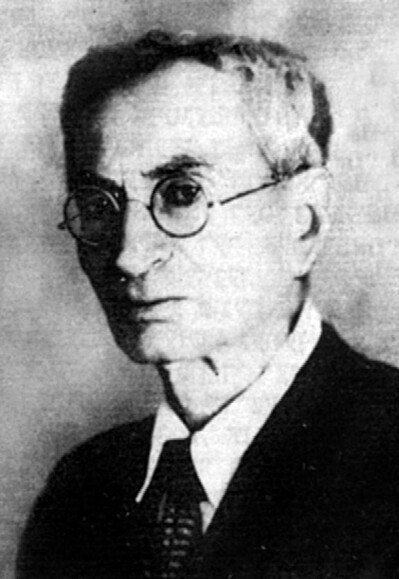
Slutski, Dov-Ber
June 26, 1877–July 13, 1955
He was a philologist, prose author, journalist, and bibliographer, born on an estate near the town of Horodishche (Gorodishche), Kiev district, Ukraine. When he was nine years old, his father and the entire family were expelled from the village and then began a time of great poverty for them. He attended religious elementary school in Horodishche but had no possibility to continue his studies, and thus he continued his studies independently.
He later survived the 1905 pogrom in Kiev. He lived thereafter in Odessa, where Ḥaim Naḥman Bialik befriended him and encouraged him to write.
He debuted in literature with a sketch entitled
“Lifne hasaar” (Before the Storm) in Luaḥ aḥiasef (1903),
later publishing several sketches in
Hashiloaḥ (The Shiloah),
where from 1910 he published such stories as
“Miriam” and “Bair” (In the City), among others.
He contributed as well to other Hebrew-language periodicals, in particular
Hazman (The Times).
His literary activities in Yiddish began in
issue 25 of Der Fraynd (The Friend) in St. Petersburg (1905),
in which he published (in the form of a letter to the editor, using the pen name D. Ber) his article
“Yidish” (Yiddish),
a call to erect public schools in the Yiddish language. At the time the article caused a stir—according to Khayim-Shloyme Kazdan, Shloyme-Fayvish Gilinski, Y. Levin, M. Birnboym, and others, it helped create the Jewish School in Warsaw in 1912.
Slutski later published stories, feature pieces, and articles in:
Der Fraynd;
Folks-Shtime (Voice of the People) in Vilna; and
Haynt (Today) in Warsaw.
As the correspondent from Haynt, he visited Kavkaz before WWI, later settling in Kiev.
His cycle of works,
“Mazepkevker Bilder” (Images of Mazepevka), published during WWI, offered a full-fledged view of Jewish life in the Pale of Settlement.
After the revolution in 1917, he worked for the daily newspaper
Di Naye Tsayt (The New Time) in Kiev and for
Komunistishe Fon (Communist Banner),
as well as other Soviet Yiddish newspapers and journals.
His main interests were literature, language, and sociology. He visited the Jewish colonies in southern Russia as a correspondent for
Shtern (Star) and Emes (Truth).
He wrote (also under the pseudonym B. Marinski) letters from Kiev to
Frayhayt (Freedom) in New York and
Di Prese (The Press) in Buenos Aires.
He translated into Yiddish fictional works by European, Hebrew, and Russian writers.
He accomplished a great deal in the field of Yiddish philology. In 1919 he published in the Kiev journal
Shul un Lebn (School and Life)
a Yiddish terminology for watchmaking—assembled with the help of his brother, a watchmaker. In the Minsk-based
Tsaytshrift (Periodical),
he published:
“Der Leksikon fun Mener-Shnayderay” (Lexicon of Men’s Tailoring);
“Yidishe Badkhonim, Shoyshpiler” (Jewish Wedding Entertainers, Actors) 1 (1926); and
“Dergantsungen tsu der Leksikon…” (Additions to the Lexicon) 2-3 (1928).
A man with encyclopedic knowledge, he was compiler of
Leksikon fun Politishe un Fremd-Verter (Lexicon of Political and Foreign Words), edited by Y. Liberman and H. Kozakevitsh, with a foreword by Y. Liberman (Kiev: Kultur-Lige, 1929), 1010 pp.
In this lexicon, one finds
“Opnoygn fun der Partey-Linye” (Deviations from the Party Line), and
in the July 14, 1919 edition of Emes, the editorial board noted the observation: “Inasmuch as it may appear that the ‘Lexicon’ is full of errors in all manner of fields, the publisher has decided not to distribute it, until it—the Lexicon—is fundamentally improved.”
He authored dozens of linguistic works and translations from other languages.
With the conversion of a cathedral in Kiev to an institute for Yiddish scholarly research, Slutski became a contributor to the philology section run by Nokhum Shtif. In the organ of the section,
Di Yidishe Shprakh (The Yiddish Language) 7 (1928),
he published a work entitled
“Vegn Mendelen dem Iberzetser” (On Mendele the Translator).
In 1931 a collection of his poetry and stories appeared in print as
Af Reshtovanyes (On the Scaffolding) in Kharkov (247 pp.).
In 1935 the second collection of the Kiev journal
Afn Shprakhfront (On the Language Front) published his piece “Der Veg Funem Kh’ N. Shtif” (The Way of Comrade N. Shtif), and
in its collection 3-4 appeared his essay “Tsu der Geshikhte fun der Terminologisher Arbet inem Sovetishn Yidish” (On the History of the Terminological Work in Soviet Yiddish).
In 1937 he compiled in Kiev (Ukrainian State Publishers for National Minorities) the anthology
Vos Geven un Vos Gevorn (What Was and What Became), 214 pp.
In 1940 he published his research
“Vegn di Varyantn fun Sholem-Aleykhems Funem Yarid” (On the Variant Editions of Sholem Aleichem’s From the Fair) in the anthology Sholem-Aleykhem, Zamlung fun Kritishe Artiklen un Materyaln (Sholem Aleichem, Collection of Critical Articles and Materials) (Kiev: Ukrainian State Publishers for National Minorities).
When in 1941 the Nazis invaded the Soviet Union, he and other Kiev writers were evacuated to Kazakhstan, where his wife died and he was left with a daughter from her first marriage. He worked there as a correspondent for Eynikeyt (Unity). In 1946 he settled in Birobidzhan, where he became the director of the Jewish division in the central museum of the region.
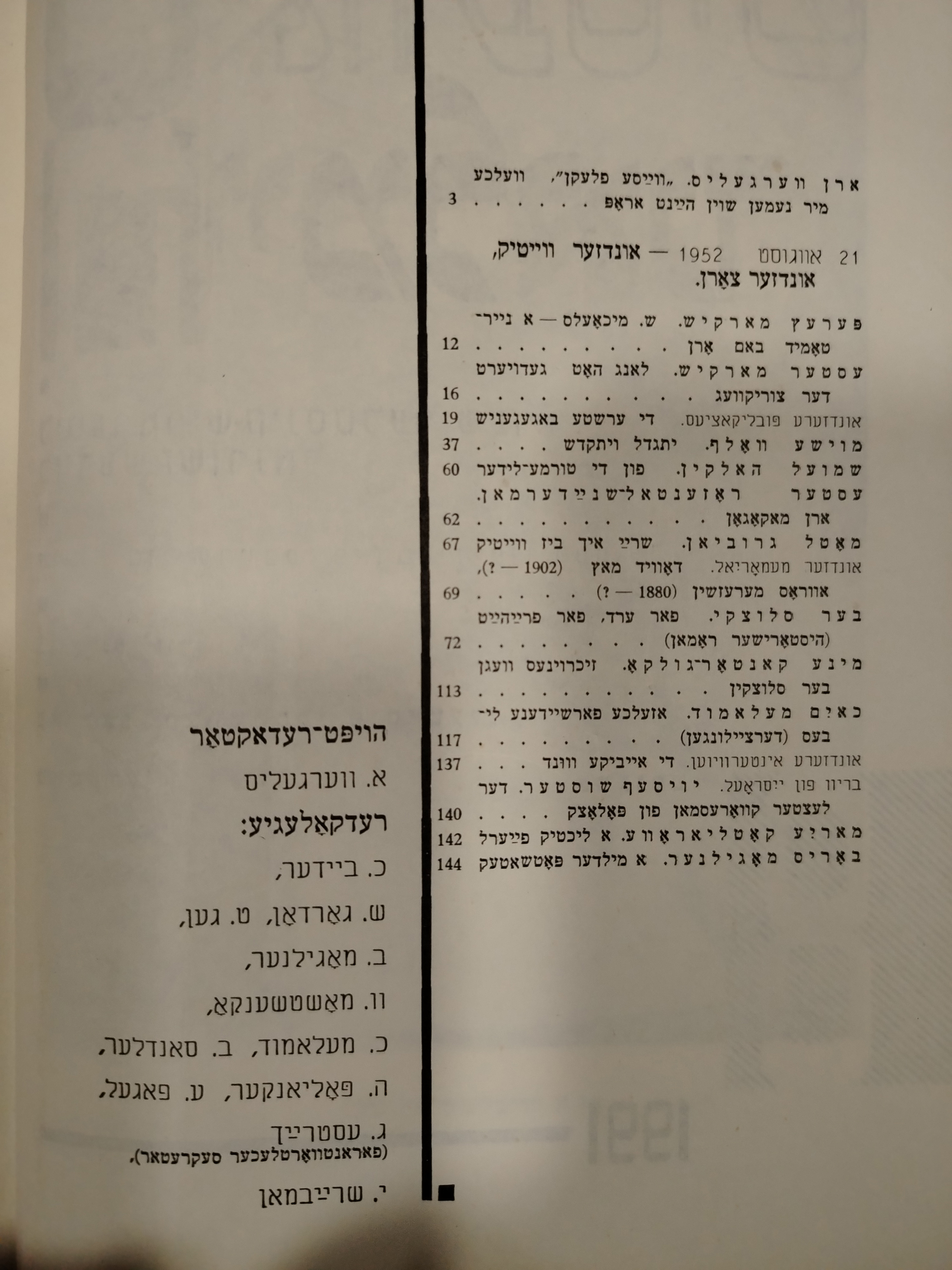
At the same time, he was working on the last chapters of a historical novel from the era of Bar Kokhba, entitled
Far Erd, far Frayhayt (For Land, for Freedom). The manuscript of this historical novel was fortuitously preserved, and the journal Sovetish Heymland (Soviet Homeland) published it in the last months of its existence (August-September 1991):
On the occasion of his seventieth birthday in 1947, praiseworthy articles appeared in the Birobidzhan press, as well as in Moscow’s Eynikeyt, but at the beginning of 1949, when the liquidation of Yiddish culture in Soviet Russia arrived, he was arrested in Birobidzhan—together with other Yiddish writers in the area. According to Yisroel Emyot (Israel Emiot), Slutski was sentenced to ten years in prison—he was placed in the Aleksandrovke, an infamously mournful Siberian prison, sixty kilometers from Irkutsk. Slutski’s stepdaughter in 1956 told Emyot that he died in prison in 1955.
Slutski’s translations include:
Mordecai Zeev Feuerberg, Baynakht (At Night [original: Baerev]), from Hebrew (Kiev, 1918), 23 pp. (there was an earlier, shortened version—Minsk, 1905);
Jonathan Swift, Guliver in Liliputn-Land (Gulliver in the Land of Liliput), free adaptation from Gulliver’s Travels (Kiev, 1919), 86 pp.;
Alphonse Daudet, Dos Vayse Tsigele (The Little White Goat [original: La Chèvre de M. Seguin (?)]), from French (Kiev, 1919);
Mayselekh far Kleyne Kinder (Stories for Small Children), by Turgenev and others, edited by Nokhum Shtif (Kiev, 1919), 45 pp.;
Ivan Turgenev, Bezhener Lonke (Bezhin Meadow [original: Bezhin Lug]) (Kiev and St. Petersburg: Jewish People’s Press, 1920), 23 pp.;
Anton Chekhov, Der Antlofener (The Runaway [original: Beglets]) (Kiev: Kultur-Lige, 1920), 18 pp.;
new edition of Turgenev, Mumu un Andere Dertseylungen (Mumu and Other Stories) (Berlin: Yidisher Literarisher Farlag, 1922), 123 pp.;
Yosef-Ḥaim Brener, Arum a Pintele, Roman (Around the Point, a Novel [original: Misaviv lenekuda]), from Hebrew (Berlin: Yidisher Literarisher Farlag, 1923), 203 pp.;
P. M. Kerzhnetsev, Leninizm, Araynfir Tsum Shtudirn Leninizm (Leninism, an Introduction to the Study of Leninism) (Kiev: Kultur-Lige, 1926), 296 pp.;
G. Grinat, Mit der Volge (With the Volga) (Kiev, 1930), 102 pp.;
Nik Karintsev, N. M. Przhevalski, Lebn un Rayzes (N. M. Przheval'skii, Life and Travels [original: N. M. Przheval'skii, Zhizn' i Puteshestvii︠a︡]) (Moscow: Emes, 1938), 170 pp.;
V. M. Garshin, Fir Teg (Four Days [original: Chetyre Dnia]) (Kiev: Ukrainian State Publishers for National Minorities, 1938), 27 pp.;
L. N. Tolstoy, Ana Karenina, Roman in Akht Teyln (Anna Karenina, a Novel in Eight Parts) (Kiev: Ukrainian State Publishers for National Minorities, 1939); and
works by Vladimir Korolenko, Chekhov, Konstantin Staniukovich, Nikolai Gogol, and others.
Sources: Zalmen Reyzen, Leksikon, vol. 2; N. Lurye, in Shul un Lebn (Kiev) 1 (1918), pp. 63-64, 4-5 (1919?), p. 92; Kh. Sh. Kazdan, in Bikher-Velt (Kiev) 2-3 (1919), pp. 53, 67-69, 74, 75; Kazdan, Fun Kheyder un Shkoles biz Tsisho (From Religious and Secular Primary Schools to Tsisho) (Mexico City, 1956), see index; Shmuel Niger, in Literarishe Bleter (Warsaw) (April 29, 1927); H. Gurni (Herman Gold), in Unzer bukh (New York) (July-August 1927); A. Gurshteyn, in Visnshaftlekher Yorbikher (Moscow) 1 (1929); M. Altshuler, in Emes (Moscow) (July 14, 1929); Elye Spivak, in Afn Shprakhfront (Kiev) 3-4 (1935); D. Tsharni (Daniel Charney), in Di Tsukunft (New York) (October 1935); “Yidishe Shraybers in Kazakhstan” (Yiddish Writers in Kazakhstan), Eynikeyt (Moscow) (April 15, 1943); “Sheferishe Plener fun di Shraybers” (Creative Planners Among the Writers), Eynikeyt (May 17, 1947); Sh. Shneyfal, in Eynikeyt (June 26, 1947); H. Vaynraykh, Blut af der Zun (Blood on the Sun) (New York, 1950), p. 196; Y. Emyot, in Forverts (new York) (February 28, 1959); Emyot, Der Birobidzhaner Inyen (Khronik fun a Groyliker Tsayt) (The Birobidzhan Affair, Chronicle of an Appalling Time) (New York, 1960), pp. 68-71; Elya (Elias) Shulman, in Der Veker (New York) (August 1, 1961); Chone Shmeruk, comp., Pirsumim yehudiim babrit-hamoatsot, 1917-1961 (Jewish Publications in the Soviet Union, 1917-1961) (Jerusalem, 1961), see index; Al. Pomerants, Di Sovetishe Haruge Malkhes (The [Jewish writers] Murdered by the Soviet Government) (Buenos Aires, 1962), pp. 44, 47; Evreiskaia Entsiklopediya, vol. 14.
Among his translations into Yiddish is a story for children by Aleksey Tolstoy Gelkhn (orig.: Желтухин = Yellowish [A nickname of a starling with a yellow spot around its beak].- Kiev: Melukhe farlag far di natsionale minderhaytn in USSR, 1937.- 15, [1] pp., ill.
געלכנ
א. טאלסטאי ; פון רוסיש - ב. סלוצקי
Among his translations into Yiddish is a story for children by V. Korolenko Makars kholem (orig.: Сон Макара = Makar's dream).- Kiev: Melukhe farlag far di natsionale minderhaytn in USSR, 1937.- 63, [1] pp.
מאקארס כאלעמ
װ. קאראלענקא ; יידיש ב. - סלוצקי
Among his translations into Yiddish is a book for children
Der royter bushl (Red stork)
A. Boym; yidish - B. Slutski.- Kiev: Melukhe farlag far di natsionale minderhaytn in USSR, 1937.- 14, [1] pp.
דער רױטער בושל
א. בױמ; יידיש - ב. סלוצקי