

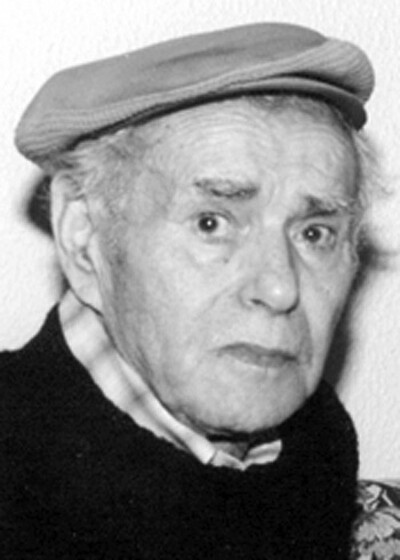


Kerler, Yoysef
April 7, 1918–2000
He was a poet, prose writer, and journalist, born in Haysin (Haysyn), Vinitse (Vinnytsa) region, Ukraine. He studied in a Russian public school. In 1930 he moved with his parents to the newly established Jewish settlements in northern Crimea. He worked on a collective farm and studied in a middle school. Over the years 1934-1937, he attended the Odessa Jewish machine-building technical school. This was also the period in which his literary activities began with his first published poem in 1935 for Odeser Arbeter (Odessa Worker).
From 1937 to 1941, he was a student in the theater studio of the Moscow Yiddish State Theater. He volunteered during WWII, fought at the front, and was wounded three times before being demobilized in 1944.
That same year he published his first collection which consisted primarily of work devoted to the war. He moved to Birobidzhan in 1947 but returned to Moscow the next year, and there in April 1950 he was arrested and exiled for ten years to the Vorkuta labor camp. Later freed and “rehabilitated” (i.e., exonerated), in 1955 he returned to Moscow, working for variety theaters, writing miniatures, sketches, and one-act plays.
In 1957 a Russian translation of his collection Mayn Tatns Vayngortn (My Father's Vineyard) was published (Vinogradnik moego ottsa), and in 1965 of his Ikh Vil zayn a Guter (I’d Like to Be a Good One), also in Russian (Khochu byt' Dobrym). When the journal Sovetish Heymland (Soviet Homeland) started appearing in print in Moscow, Kerler placed poems and essays in it, and in the very first issue he published: “Vos iz Mayn Farmegn, oyb ir Vet Mikh Fregn? Lider Dray iz Mayn Farmegn….” (What Do I Own? Should You Ask Me, It’s Three Poems….).
In one of his autobiographies, he explained: “Professions possess very little—I’ve been a coal miner, a journalist, a stoker, an actor, a railway worker, a farmer, and, of course, at a present I’m forever writing poetry.” Indeed, he was always composing poems, and everywhere, in the most frightful conditions, he wrote, not enumerating every favor, every wage, or every immediate publication. “Who says that one pays for Yiddish poetry? Has he written a single poem? It’s terribly expensive, just imagine, for a poem that disperses like wine in stages? How much they cost, how expensive the poems, with ardent persistence strengthened in its own fire, immersed in its own blood…and reborn and again they fly through pain and lament…. Who pays for Yiddish poems? Naturally, it’s the poet alone.” He wrote and wrote, but he was unable to have his work published with Soviet publishers, and so he commenced a battle to leave for Israel. After a six-year battle with the organs of authority, he was given permission in 1971, and that year he made aliya and settled in Jerusalem.
This began what was to be the final and the most fruitful years of his poetic life. That first year of his arrival in Israel, he brought the book Dos Gezang Tsvishn Tseyn (The Song Between [clenched] Teeth), and it was followed by many other prose, poetry. and journalistic works. Together with his son, Dov-Ber Kerler (Boris Karlov), in 1978 he published Shpigl-Ksav, Getseylte Lider (Words in a Mirror, a Few Poems).
Yoysef Kerler was the initiator of numerous exploits, among them Yerusholaimer Almanakh (Jerusalem Almanac) which he edited from 1973 and which was an important tribune for dozens of writers, poets, literary scholars, and journalists. His poetry has been translated into many languages.
Over the course of his career, in addition to the serials mentioned above, he published poems, notes, and translations in: Emes (Truth), Eynikeyt (Unity), Heymland (Homeland) in 1943, Kiev’s Shtern (Star), Folks-Shtime (Voice of the People), and Yidishe Shriftn (Yiddish writing) in Warsaw.
In Israel, he wrote for: Bay Zikh (On One’s Own), Di Goldene Keyt (The Golden Chain), Yidishe Tsaytung (Jewish Newspaper), Yisroel Shtime (Voice of Israel), and Folksblat (People’s Newspaper), among others.
He co-edited: Atseret-Am, Folks-Akademye (People’s Assembly, People’s Academy), commemorating the twentieth anniversary o f the murder of the Soviet Yiddish writers (Tel Aviv, 1971), 29 pp.
His work also appeared in: Farn Heymland, in Shlakht! Zamlung (For the Homeland, in Battle! Anthology) (Moscow: Emes, 1941.- 63, [1] pp); Af Naye vegn (Along New Paths) (New York: Yidisher Kultur Farband, 1949); Tsum Zig (To Victory) (Moscow: Emes, 1944); Zinovi Kompanayets’s, Finf Lider fun Yidishe Sovetishe Dikhter (Five Songs from Soviet Yiddish Poets) (Moscow: Muzyka, 1960), including translations into Russian; Azoy Lebn Mir, Dokumentale Noveln, Fartsaykhenungen Reportazh (How We Live: Documented Novellas, Jottings, Reportage Pieces) (Moscow: Sovetski Pisatel, 1964); Horizontn (Horizons) (Moscow: Sovetski Pisatel, 1965); Tsuzamen (Together) (Tel Aviv: Perets Publ., 1974); Khayim Bez, Antologye fun der yIdisher Literatur far Yugnt (Anthology of Yiddish Literature for Young People) (New York: Congress for Jewish Culture, 1976); and in other anthologies in Russian, English, Dutch, and other languages.
He received the Manger Prize and the Atran Prize.
His books include:
Far Mayn Erd (For My Land), poetry (Moscow: Emes, 1944), 45 pp.;
Dos Gezang Tsvishn Tseyn (Tel Aviv: Perets Publ., 1971), 167 pp., Hebrew translation by Yaakov Shofet as Hazemer ben hashinayim (Tel Aviv: Ḥalonot, 200), 159 pp.;
Zet ir Dokh (Despite All Odds), poems (Tel Aviv: Perets Publ., 1972), 220 pp.;
12ter Oygust 1952 (August 12, 1952) (Jerusalem: Eygns, 1978), 224 pp.;
Shpigl-Ksav, Getseylte Lider (Jerusalem, 1978), 80 pp.;
Di Ershte Zibn Yor (The First Twelve Years) (Tel Aviv: Perets Publ., 1979), 138 pp.;
Himlshaft, Bletlekh, Proze, un Lider (Heavens Above, Pages, Prose, and Poetry) (Jerusalem: Yerusholaimer almanakh, 1985/1986), 120 pp.;
Geklibene Proze, Eseyen, Zikhroynes, Dertseylungen (Selected Prose, Essays, Memoirs, Stories) (Jerusalem: Yerusholaimer Almanakh, 1991), 304 pp.;
Abi Gezunt, Lider fun Haynt un fun Nekhtn (As Long as You’re Well, Poems of Today and Yesterday) (Jerusalem: Eygns, 1993), 106 pp.;
Davke Itst—fun di Letste un Andere Lider (Now Is the Time—new and Last Poems) (Jerusalem: Yerusholaimer almanakh, 2005), 127 pp.
“Kerler revealed himself,” noted Dov Sadan, “with his utter distinctiveness as an individual amidst the many…. The truth is indeed his own, but not only his own; his is a truth among a mass.”
“Kerler drew his poetic nourishment…directly,” wrote Yudel Mark, “from the good, old sources, from the immediacy and simplicity of the folk poem, from the elemental forces of the diction of the ‘common’ people.”
He died in Jerusalem.
Sources: M. Gotovitsh, in Sovetish Heymland (Moscow) 2 (1961); Arn Vergelis, in Sovetish Heymland 11 (1970); B. Ts. Goldberg, in Tog-Morgn-Zhurnal (New York) (February 2, 1971; February 4, 1971); M. Tsanin, in Idishe Tsaytung (Buenos Aires) (April 14, 1971); Sh. Shveyter, in Folksblat (Tel Aviv) (June 1971); Y. Yanasovitsh, in Di Prese(Buenos Aires) (September 26, 1971); A. Shpiglblat, in Di Goldene Keyt (Tel Aviv) 75 (1972); Dov Sadan, Heymishe Ksovim, Shrayber, Bikher, Problemen (Familiar Writings, Writers, Books, Issues) (Tel Aviv: Hamenorah, 1972), pp. 157-85; Y. Emyot, in Forverts (New York) (June 24, 1973); Yudel Mark, in Yidisher Bukh Almanakh (New York) 30 (1972/1973), pp. 40-42; Khayim Bez, in Yidisher Bukh Almanakh 33 (1976), p. 28; M. Altshuler, Yahadut berit-hamoatsot baaspaklarya shel itonut yidish bepolin, bibliyografya 1945-1970 (The Jews of the Soviet Union from the Perspective of the Yiddish Press in Poland, Bibliography) (Jerusalem, 1975), pp. 164-65.
Images c/o M. Zavorohina.
Kerler's work also appeared in the collection "Farn heymland, in shlakht! zamlung" (For the homeland in battle!) (Moscow: Emes, 1941.- 63, [1] pp).
פארנ הײמלאנד, אינ שלאכט! זאמלונג