

Rabnitski, Shiye-Khone
September 1859-May 4, 1944
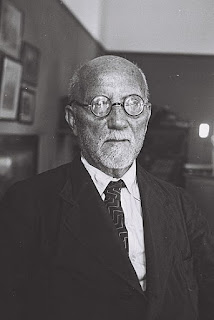
A Hebrew and Yiddish writer, he was born in Odessa, the descendant of a poor family. He studied in religious primary school and yeshiva. Over the years 1877-1887, he lived in the town of Mayak, where he took up general self-education, also studying German and French. He was an active “Ḥovev-tsiyon” (Lover of Zion) and follower of Ahad Ha-Am’s spiritual Zionism. He was a close friend of Sholem-Aleichem and Ḥaim Naḥman Bialik, who were bound to Rabnitski’s life-long joint Hebrew publishing and literary scholarship in such fields as textbooks, such as Haagoda (Jewish folklore) and Sipure hamikra leyeladim (Biblical stories for children). In 1921 he settled in Tel Aviv. He debuted in print in Yiddish with an article “Dos Pintele Yud” (The Quintessential Jew) in the Zionist anthology Der Yudisher Vekker (The Jewish Awakener) (Odessa, 1887, edited by Ts. Z. Frankfeld).
Using the pen name Rabi Katsin, he published a series of critical articles entitled “An Eysek Mit Shmates” (A Matter of Rags) in Baylage tsum Yudishen Folksblat (Supplement to the Jewish People’s Newspaper) (issues 4-5, 13-15, 32-33 in 1888), in which he came out strongly opposed to the works of Shomer (N. M. Shaykevitsh), Bekerman, and A. Y. Bukhbinder. This series gained him a certain notoriety.
Strengthening his position as a critic as well were a series of articles and reviews in Sholem-Aleichem’s Yudishe Folks-Biblyothek (Jewish People’s Library), in which he took charge of some of the bibliographic-critical section.
He edited the first nineteen issues of the biweekly paper Der Yud (The Jew), founded in early 1899, in Warsaw, and it played a major role in the history of Yiddish literature and the press. Rabnitski introduced there a simplified orthography, which was later adopted by other Yiddish publications.
With Bal-Makhshoves, he edited the anthology Kultur (Culture) (Minsk: Kultur, 1905). He later turned much more to Hebrew. He would on occasion contribute something to: Der Yud, Fraynd (Friend), the anthology Hilf (Help), Hoyz-Fraynd (House Friend), and Shmuel Niger’s Pinkes (Records), among other serials, in which he would publish, in addition to journalistic articles, also literary treatments and reviews under pen names such as Bar-Katsin, R., Bas-Kol, Boke, Ruvn Kats, A. Yereykhi, and Tsofnes Paneakh.
In the language struggle, he spoke out against the virulent critics of Yiddish. In one of his articles concerning Yiddish, he wrote (using the pan name Medad): “Our generals, our fanatics for Hebrew, those who write, edit, and publish Hebrew newspapers, they reprimand every single blemish of our poor zhargon [Yiddish]…. [They] do not understand that one can only describe life in the diaspora in the language of the diaspora; one can only depict genuine life in a living language.” (Fraynd, 1903) He wrote on the same matter in the literary collection he edited, Untervegs (Pathways) (Odessa, 1917).
In book form:
Vos Mir Zenen un Vos Vet fun Unz Veren? Iber der Lage fun Unzer Folk un zayn Refue (Who Are We and What Will Become of Us? on the State of Our People and Their Remedy) (Berdichev: Ezra, 1898), 35 pp.;
Di Yudishe Oytsres, Iber Kinder-Ertsihung (The Jewish Treasures, for Children’s Education) (Odessa: Y. Rabnitski and M. Falinkovski, 1903/1904), 64 pp.;
Tsi Zenen Yuden a Folk? Tsi Darfen Yuden a Land? (Are the Jews a People? Should the Jews Have a Country?) (Warsaw: Mizrachi, 1917), 28 pp.;
Di yudishe Agodes, Dertseylungen, Zagn, Legendn, Mesholim, Aforizmen un Shprikhverter, Geklibn fun Talmud un Medroshim Nokhn Hebreyishn Sefer Haagode (The Jewish Tales, Stories, Sagas, Legends, Fables, Aphorisms, and Sayings, Selected from the Talmud and Midrash Following the Hebrew Sefer haagoda) (Odessa: Moriya, 1916-1919), 4 vols., second edition (Berlin, 1921-1922), reprint (New York, 1948), vols. 5 and 6 in manuscript;
Yudish Vitsen (Jewish Jokes) (Berlin, 1922/1923), 264 pp., later edition (New York, 1952), 2 vols.
Together with Mendele and Bialik, he published Funem Khumesh, Sipure Hamikra (From the Pentateuch, Biblical Stories) (Odessa: Moriya, 1912/1913)—only the first part appeared in print, chapters 1-34.
Rabnitski published his memoirs in the collection Tsum Ondenk fun Sholem-Aleykhem (To the Memory of Sholem-Aleichem) (Petrograd, 1918).
Sholem-Aleichem published his novels Stempanyu and Yosele Solovey (Yosele Solovey) under Rabnitski’s auspices, practically under his editorship. From 1892 Rabnitski and Sholem-Aleichem published a joint series of humorous features in Hamelits (The Spectator) under the title “Kevurat soferim” (The Burial of Writers), using the pseudonyms Eldad (Sholem-Aleichem) and Medad (Rabnitski).
In general, Sholem-Aleichem had a high opinion of Rabnitski, “because Bar-Katsin [Rabnitski] adds a little bit of salt from humor and satire into his writing…. If he writes something that isn’t so, it’s sugary sweet, few words, short and sharp, without wit, without preamble, without etiquette.”
Rabnitski, in the words of Zalmen Reyzen, is “one of the first—temporally, speaking—Yiddish critics,… one of the first writers to appreciate Mendele Moykher-Sforim’s work.”
He died in Tel Aviv.
Sources: Zalmen Reyzen, Leksikon, vol. 4; Getzel Kressel, Leksikon hasifrut haivrit (Lexicon of Hebrew Literature), vol. 2 (Merḥavya, 1967); Chone Shmeruk, comp., Pirsumim yehudiim babrit-hamoatsot, 1917-1961 (Jewish Publications in the Soviet Union, 1917-1961) (Jerusalem, 1961), see index; Sholem-Aleykhem Bukh (Volume for Sholem-Aleichem) (New York, 1926); N. Grinblat, Mevakrim besifrutenu (Critics of our Literature) (Tel Aviv, 1944), pp. 140-42; N. B. Minkov, Zeks Yidishe Kritiker (Six Yiddish Critics) (Buenos Aires, 1954), pp. 125-68; Shmuel Niger, Kritik un Kritiker (Criticism and Critic) (Buenos Aires: Argentinian division of the Congress for Jewish Culture, 1959); Yitskhok-Dov Berkovitsh, Undzere Rishoynem, Zikhroynes-Dertseylungen vegn Sholem-Aleykhem un zayn Dor (Our Founding Fathers, Memoirs and Stories of Sholem-Aleichem and his Generation),vol. 5 (Tel Aviv: Hamenorah, 1966), pp. 22-36; Lili Berger, In Gang fun Tsayt (In Step with The Times) (Paris, 1976), pp. 99-106; Yeshurin archive, YIVO (New York).