
Rozental, Leyzer-Dovid
June 23, 1856–1932
A prose author and translator, he was born in Khotin (Khotyn), Bessarabia [now, Ukraine]. He attended religious elementary schools and later a synagogue study chamber on his own. In 1861 he moved with his family to Telenesht (Telenesti), Bessarabia [now, Moldova]. Avraham Mapu’s Ayit tsavoa (The Hypocrite) brought him into the Jewish Enlightenment. On his own he mastered Russian and German. He lived for a lengthy period of time in Belz, Bessarabia [now, Ukraine]. He worked as a teacher, 1918-1919, in the Jewish high school in the town of Teplik (Teplyk), Podolia. He later lived in Odessa in great want, getting by as a translator for the most part.
Rozental was mainly a Hebrew writer. He rarely wrote in Yiddish and with long breaks between such instances. He debuted in print with a story in
Mortkhe Spektor’s Hoyz-Fraynd (House Friend).
He later published stories in:
Yud (Jew),
Dos Leben (The Life [= Fraynd (Friend)] and
Moment (Moment)
— in Warsaw, and
a series of feature pieces entitled “Brif fun a Navenadnik” (Letter from a Wanderer) in Undzer Leben (Our Life) in Odessa.
In 1904 under his editorship there was published a series of five books, 96 pp. each, from the library of Dos Leben, among them:
Yudish (Yiddish), eight stories by Rozental including
“Alte Beys-Medresh” (Old Study Hall),
“Leybke Vatenmakher” (Leybke, the Devil Take Him),and
“Nitshes Talmid” (Nietzsche’s Student);
In der Fremd (Abroad), eight stories by Maxim Gorky, Anton Chekhov, and others, translated by Rozental and Shaye Lerner;
In Kalifornye (In California), stories by Bret Harte, translated by Rozental.
In 1905 he published the story “Di Shlekhte Psure” (The Bad Message) in Di Bihn (The Bee) in Odessa.
In addition to other items, in Hebrew he published considerable material about pogroms in Ukraine and Podolia in the years 1917-1921 under the title
Megilat hatevaḥ (The Scroll of Massacre) (Tel Aviv: Ḥavurah, 1926/1927-1929/1930), 3 vols.
The only item in Yiddish that appeared from his works on the pogroms was
Tetyever Khurbn (The Destruction of Tetiyiv) (New York: Oyfboy, 1922), 56 pp.
He translated:
Lenin’s Natsyonale un Idishe Frage (The National and Jewish Question) (Moscow, 1921), 222 pp.;
Nikolai Pokrovsky’s Rusishe Geshikhte (Russian History) (Moscow: State Publishers, 1924 or 1925); and
N. M. Nikol'sky, Dos Uralte Folk Yisroel (The Ancient People Israel), original: Древний Израиль: популярные очерки по истории евреев в научном освещении (Ancient Israel: Popular Essays on Jewish History from a Scholarly Perspective) (Moscow: Central Jewish Commissariat, 1919), 277 pp.
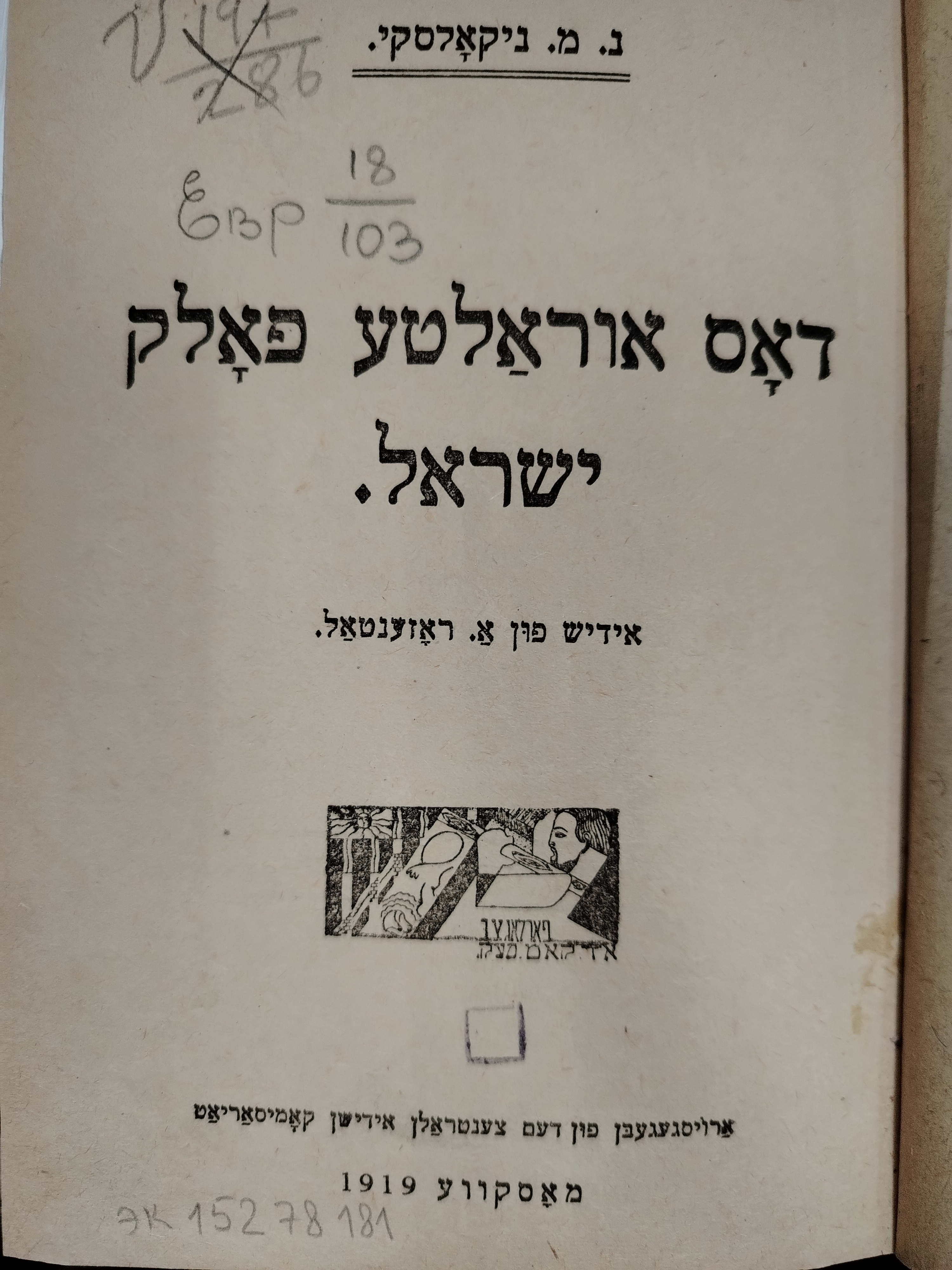
His work appeared in:
Helena Frank, Yiddish Tales (Philadelphia: Jewish Publication Society of America, 1912).
In manuscript he left behind poetic translations of the Psalms and Ecclesiastes, a large reader, and stories.
He died in Odessa.
Sources: Zalmen Reyzen, Leksikon, vol. 4; Getzel Kressel, Leksikon hasifrut haivrit (Lexicon of Hebrew Literature), vol. 2 (Merḥavya, 1967); Yankev Fikhman, Regnboygn, Zikhroynes, Eseyen un Lider (Rainbow, Memoirs, Essays, and Poems) (Buenos Aires, 1953), pp. 79-84; Yeshurin archive, YIVO (New York).
Re: M. N. Nikol'sky
The correct name is N.M. Nikol'ski
Никольский, Николай Михайлович (1877-1959).
The translation into Yiddish was done from "Ancient Israel: the collection of popular essays on the history of the Jews in scientific coverage" (Orig.: Древний Израиль: популярные очерки по истории евреев в научном освещении).
RESPONSE FROM LEXICON: Thank you. Correction made./sry
In the original; many thanks.
I don't know if the error was in the original or in the translation, but the title of the third story in Rozental's Yudish collection was ניטשעס תּלמיד, or Nietzsche's Student.