
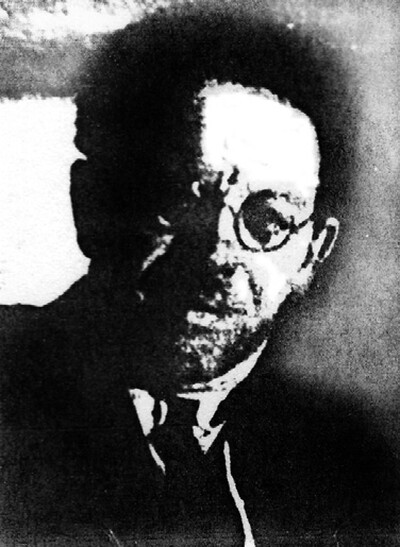
Rafes, Moyshe
November 3, 1883–1942
He was a journalist and community leader, born in Vilna. He studied in religious elementary school, later in a Russian public school, and as an external (auditor) student he passed the examinations at a five-year high school. Until 1917 he was among the active leaders of the Bund and a member of its central committee.
Over the years 1917-1919, he was editor of Folks-Tsaytung (People’s Newspaper) in Kiev, organ of the Bund for southern Russian. He wrote on political and Party themes and research works relating to the history of the Jewish labor movement.
It was said of him that overnight he went from being an extreme anti-Bolshevik to an orthodox Communist. In 1919 he was the central figure in the establishment of the Kombund (Communist Bund) which that year decided to join the Communist Party. He was very active in the Yevsektsye (Jewish section [of the Party]), and in its heated discussions he acquired a name as an ideologue for active assimilation of the Jewish masses. He quickly ascended in his Bolshevik career, assuming important positions and was active as well in the Comintern.
He was purged in May 1938, arrested, and sentenced by a military tribunal of the supreme court of the Soviet Union in June 1940 to ten years in a labor camp. According to certain sources, he was sent to a northern camp in the Komi Autonomous Soviet Socialist Republic. It was there that he wrote the history of Soviet Jewry and died in 1942. Other sources claim that he fell a victim to the mass purges of 1948-1952.
He contributed articles to Bundist publications: Veker (Awakener), later Folks-Tsaytung (1906-1907); Hofnung (Hope) and Morgnshtern (Morning Star) (1907); the anthology Di Naye Tsayt (The New Time) (Vilna: B. A. Kletskin, 1908); Tsayt (Time) and Unzer Tsayt (Our Time) in St. Petersburg (1913-1914); and Unzer Shtime (Our Voice) in Vilna (1919).
He also wrote for: Royte Pinkes (Red Record) in Kiev (1920); the collection Hirsh Lekert (Hirsh Lekert) (Moscow: Biblyotek Yung-Vald, 1922); Arbeter-Kalendar (Workers’ Calendar) for 1924 (Moscow, 1923); Royte Velt (Red World); and Emes (Truth); among others.
He edited: Folks-Tsaytung (Kiev, 1917-1919); Tsayt-Fragen (Issues of the Time), 1 issue appeared (Kiev, 1918); Komunistishe Fon (Communist Banner) (Kiev, 1919-1924, editor only in 1919); Di Royte Fon (The Red Banner) (Vilna, 1920); Avrom Kirzhnits, Der Idisher Arbeter, Khrestomaṭye tsu der Geshikhte fun der Idisher Arbeter, Revolutsyonerer un Sotsyalistisher Bavegung in Rusland (The Jewish Worker, a Reader on the History of the Jewish Labor, Revolutionary, and Socialist Movement in Russia) (Moscow: Central People’s Publishers, USSR, 1925-1928), 4 vols.
He wrote on political, party matters and research work on the history of the Jewish labor and revolutionary movement.
In pamphlet or book form:
Fun vanen bakumen di melukhe ihre hakhnose? (Where does the state get its income from?) (Vilna: Di Velt, 1906), 20 pp.;
Af vos farbroykht di regirung dos gelt fun folk? (On what does the government dispense the people’s money?), using the pen name M. R-s (Vilna: Di Velt, 1906), 24 pp.;
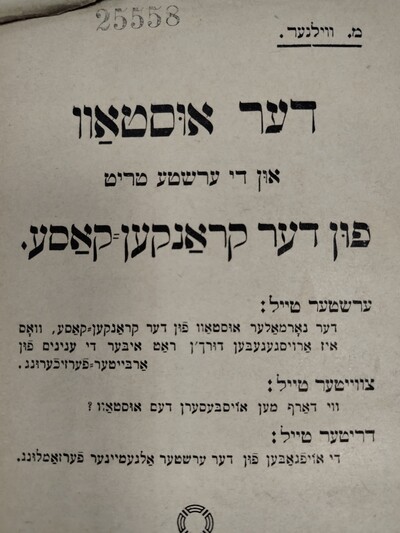
Der Ustav un di Ershte Trit fun di Kranken-Kases (The Law and the First Steps Toward Health Insurance) (Warsaw: Di Velt, 1913), 120 pp. using the pen name/pseudonim M. Vilner.;
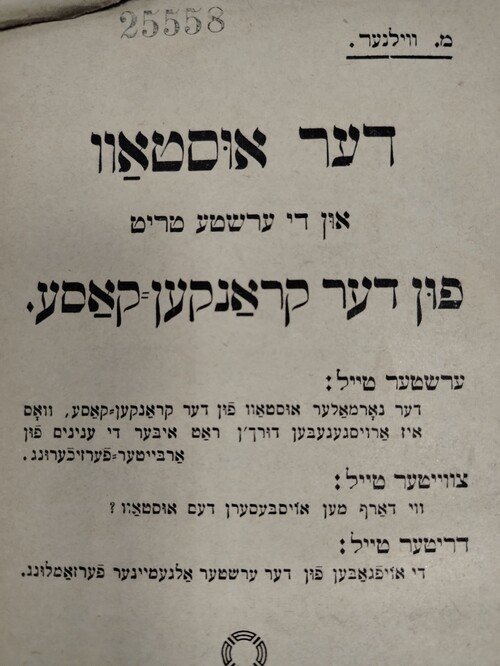
Image courtesy of the Russian State Library (Moscow), Oriental Centre.
Di Kranken-Kases (Health Insurance Companies), translated from Russian by Kh. Ber (pen name of Ber Orshanski) (St. Petersburg, 1913), 16 pp., using the pen name B. Solovyov;
Afn Shvel fun der Konter-Revolutsye, Publikatsyes un Redes (At the Threshold of Counter-Revolution, Publications and Speeches) (Ekaterinoslav: Di Velt, 1918), 141 pp.;
Di Royte Armey (The Red Army) (Kharkov-Kiev: Yunger arbeter, 1924), 66 pp.;
Kapitlen Geshikhte fun Bund (1885-1922) (Chapters in the History of the Bund, 1885-1922) (Kiev: Kultur-Lige, 1929), 278 pp.
He also published pamphlets and books in Russian and wrote for the Russian press. In addition, he wrote under the Party pseudonym of L. Vaysenberg.
Rafes’s brother Mikhail Rafes (b. 1876) was a medical doctor and authored the pamphlet Di Umbarihrbarkeyt fun Perzon (The Inviolability of the Person) (Vilna: Di Velt, 1906), 40 pp.
Sources: Zalmen Reyzen, Leksikon, vol. 4; Chone Shmeruk, comp., Pirsumim yehudiim babrit-hamoatsot, 1917-1961 (Jewish Publications in the Soviet Union, 1917-1961) (Jerusalem, 1961), index; John Mill, Pyonern un Boyer (Pioneers and Builders), vol. 2 (New York: Veker, 1949), see index; Hersh Smolyar, Vu Bistu Khaver Sidorov? (Where Are You, Comrade Sidorov?) (Tel Aviv: Perets Publ., 1975), pp. 138-39; Yeshurin archive, YIVO (New York).