
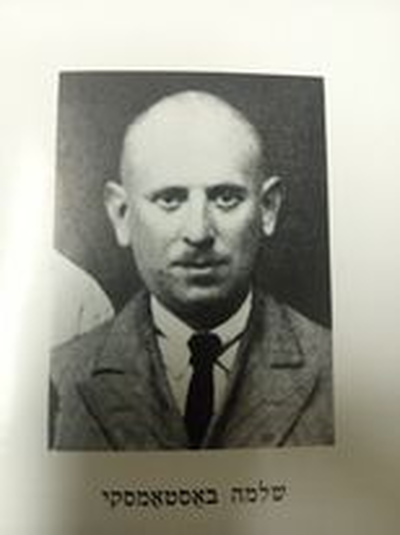
Bastomski, Shloyme
July 1891–March 5, 1941
Born in Vilna into a family of a poor locksmith, he was orphaned at an early age. He studied in Talmud-Torah (free elementary school for the poor), and simultaneously attended a Russian public school for Jewish children. He graduated in 1912 from the Vilna Pedagogical Institute and became a teacher, initially in a Russian Jewish public school in Meretsh (Merech) and later in Devenishok (Dieveniškės, Dziewieniszki), both in the Vilna district. He was a pioneer in running a school in Yiddish. He privately proposed Yiddish-language stories books for his school children, and he began to collect Yiddish folklore. In 1915, after the entrance of the Germans into Vilna, he was invited to be a teacher in the just founded “Folksshul far yinglekh fun der khevre mefitse haskole” (Public school for boys of the Mefitse haskalah [Society for the promotion of enlightenment (among the Jews of Russia)] society), the first boys school in Vilna with Yiddish as the language of instruction. He worked in this school almost until the end of his life. His subsequent communal and literary activities were also tied up with the Yiddish-language school. His first article—concerned with Jewish children’s literature—was published in Vilner vokhnblat (Vilna weekly news) in 1910. Thereafter, he produced several sketches and stories in Karpinovitsh’s Folksblat (People’s news) in 1911 and Litvin’s Lebn un visnshaft (Life and science) in 1912. From 1916, with his own publishing house, “Di naye yidishe folksshul” (The new Yiddish elementary school), he published a series of textbooks, school readers, children’s games, and folklore collections, including: Rekhnbikher (Arithmetic books), five sections, with Yiddish terminology for arithmetic, produced by a special commission; Khrestomstyes (Readers); Dos lebedike vort (The living word), Lebedike klangen (Living sounds), and Naye vort (New word), samples for literary learning, three sections: epic, lyric, drama; a series of thirty-two textbooks for young children with Yiddish originals (for example: Yekele nar [Yekele the fool], Tsvey matones [Two gifts], Der nes [The miracle], Der tsadek [The holy man], Der farshlosener kastn [The locked chest], Di tsvey khakhomim [The two wise men], Der keyser un der tsadek [The Kaiser and the holy man], Bustnay [Bostenai], Di emese kale [The real bride], In der nakht fun bdikes-khomets [On the night of searching for leaven], and the like, as well as adaptations or translations from other writers; a series of twenty-one booklets for older children, travelogues and biographies; children’s games (Der kundes [The prankster], Ilustrirter loto [Illustrated lotto], Retenishn mit bilder [Puzzles with pictures]); children’s plays (Purim plays, Nakhmen der farber [Nachman the painter], Friling kumt [Spring arrives], and the like); a number of folklore collections (Baym kval [At the source], two volumes; Yidishe folkretenishn [Yiddish folk riddles]; Yidishe folk-mayses un legendes [Yiddish folktales and legends], two volumes; Zamlung fun yidishe shprikhverter far shul un familye [Collection of Yiddish proverbs for school and family]; Amol iz geven [The past is past]); several dozen issues of a popular science library, the majority adapted by him alone; a translation of Zola’s The Coalminers. Aside from all of these, he published and edited the popular children’s magazines, Grininke Beymelekh (Little Green Trees) and Der khaver (The Friend), in which he published among numerous other items his own stories: “Vegn khelmer naronim” (On the fools of Chelm), “Vegn hershele ostropolyer” (On Hershele Ostropoler), “Motke khabad” (Motke Chabad), “Yosele kundes” (Yosele the prankster [which also appeared in book form]). He also edited the school publications: Far undzer shul (For our school) (Vilna, 1933); 20 yor dvoyre kupershteyn-shul (Twenty years of the Deborah Kuperstein School) (Vilna, 1934); Kinder vegn d”r tsemakh shabad (Children on Dr. Tsemach Shabad) (Vilna, 1938). He also was on the editorial board of the pedagogical journal, Di naye shul (The new school), in Vilna, and he wrote articles for Vilner Tog (Vilna Day) and Faroys (Forward), the Vilna organ of Fareynikte (United), the Zionist socialist group, with which he was tied ideologically. In the last years before WWII, Bastomski joined the territorialist group Frayland (Freeland). He was member of the folklore commission and the general council of YIVO, as well as on the central educational committee in Vilna. He died in March 1941, prior to the entrance of Hitler’s armies into the city which was then occupied by Soviet troops.
Sources: Zalmen Reyzen, Leksikon, vol. 1, pp. 205-7; Algemayne entsiklopedye (General encyclopedia), vol. 5 (New York, 1944), pp. 162-63; Lerer-zikher-bukh (Remembrance Volume for Teachers) (New York, 1954), pp. 30-33.