
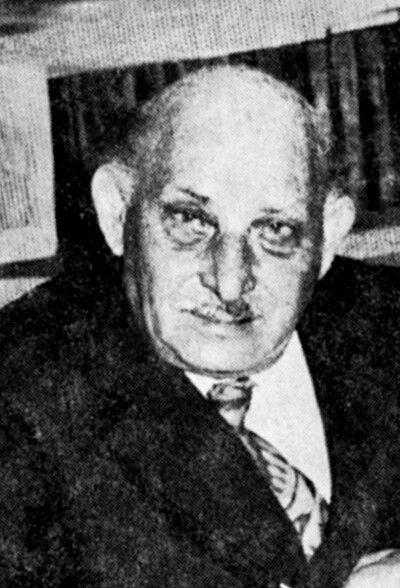
Roytman, Shloyme
February 1, 1913–January 15, 1985
He was a poet, born in Molev (Mohyliv-Podil's'kyy), Ukraine. He attended a Jewish school. Over the years 1934-1938, he was a student in the department of Yiddish language and literature at the Moscow Pedagogical Institute, from which he graduated and received the title of “candidate (Russian equivalent to PhD) in philology.” He went on to be a research student at this institute (1938-1941), defending his dissertation (June 17, 1941) on the lyrical poetry of Heinrich Heine.
During WWII he was evacuated to Central Asia. When his hometown was liberated from enemy occupation in 1944, he returned home. He worked (1944-1945) as a teacher of history and literature in a local Russian middle school.
In September 1945, he received an invitation to work as one of the editors for the publisher Der Emes (The Truth) in Moscow, and until 1948 he oversaw the poetry division. The press was then closed down, and from 1949 he was an instructor in Western European literature at the pedagogical institute in Yoshkar-Ola, Mari Autonomous Soviet Socialist Republic. He later claimed that this appointment saved him during the terror directed at Yiddish culture and its creators. In fact, Yoshkar-Ola was a site of exile from Tsarist times. And there he remained until he departed for Israel. In 1973 he settled in Herzliya.
He debuted with poetry in print in 1931 in Zay Greyt (Get Ready) in Kharkov. He came to Yiddish poetry with his own creative system, with his own innovative poetic style, as a romantic poet and a thinker.
He went on to publish poems in: Yunge Gvardye (Young Guard) and Di Royte Velt (The Red World) in Kharkov; Der Shtern (The Star) in Minsk; Sovetish (Soviet), Heymland (Homeland), Eynikeyt (Unity), and Sovetish Heymland (Soviet Homeland) in Moscow; Birobidzhaner Shtern (Birobidzhan Star); Folks-Shtime (Voice of the People) in Warsaw; Di Goldene Keyt (The Golden Chain), Bay Zikh (On One’s Own), and Letste Nayes (Latest News) in Tel Aviv; Yerusholaimer Almanakh (Jerusalem Almanac); and Tsukunft (Future) and Der Veker (The Awakener) in New York.
His poetry appeared as well in the collections and anthologies: Litkomyug (Literary Communist youth) (Kharkov-Kiev: Ukrainian State Publishers for National Minorities, 1933), Af Naye vegn (Along New Paths) (New York: Yidisher Kultur Farband, 1949), Moshe Basok’s Mivḥar Shirat Yidish (Selection of Yiddish Poetry) (Tel Aviv: Hakibuts hameuḥad, 1963), and Charles Dobzynski, Anthologie de la Poésie Yiddish, le Miroir d’un People (Anthology of Yiddish Poetry, the Mirror of a People) (Paris: Gallimard, 1971).
He received several literary awards, among them the Manger Prize and a prize from the Congress for Jewish Culture. In addition to poetry, he also published essays on literature. With Moyshe Notovitsh, he published a lengthier work “Oktyaber in der Yidisher Sovetisher Literatur” (October in Soviet Yiddish Literature), Heymland 1 (1947).
His works include:
Vayngertner, Lider (Vineyards, Poetry) (Moscow: Emes, 1941), 63 pp.;
Gutmorgn, Zinger! (Good Morning, Singer!) (Moscow: Emes, 1947), 192 pp.;
Der Mames Nign, Lider un Poemen (Mother’s Melody, Poetry) (Moscow: Sovetski Pisatel, 1971), 206 pp.;
Der Lets un der Riter, Lider un Poemen (The Clown and the Knight, Poetry) (Tel Aviv: Perets Publishers, 1975), 198 pp.;
Mayn Yisroeldik Shoyferl, Sonetn un Lider (My Little Israeli Shofar, Sonnets and Songs) (Ramat-Hasharon: Dar, 1976), 91 pp.;
Sonetn (Sonnets) (Ramat-Hasharon: Dar, 1977), 226 pp.;
Hertslyer Strofes (Herzliya Stanzas) (Tel Aviv: Perets Publishers, 1980), 232 pp.;
Folkstimlekhe Lider (Folk Songs) (Tel Aviv: Yidish-Bukh, 1982), 129 pp.;
Lirishe Otem, Tsveyter Band, Sonetn (Lyrical Breath, Vol. 2, Sonnets) (Tel Aviv: Perets Publishers, 1984), 123 pp.;
Ven Zakhn Dervakhn (When Things Awaken) (Tel Aviv: Yisroel-Bukh, 1986), 90 pp.;
Proze (Prose) (Tel Aviv: Perets Publishers, 1988), 273 pp.
In 1964 a collection of Roytman’s poems in Russian translation was published in Moscow: Svet i Teni (Light and Shade).
He died in Herzliya.
“A genuine throwback,” wrote Yankev Glatshteyn, “to the most beautiful sources in the accumulation of our language—and at the same time a modern and individual artist in his modes of expression.”
“An artist of high culture,” noted Hersh Remenik, “…the master of songs,…the singer and celebrator of the life…of [our] national character.”
“He celebrated the familiar Jews of Podolia,” commented Yitskhok Yanasovitsh. “He was also the poet of nature’s elements and landscape…. [And in Israel his poems became] psalms of heart and feeling for Israel.”
One critic pointed out that his creative credo was through and through the embodiment of music, song, and sound. As noted his first book appeared in 1941 and his second in 1947; then, like the great majority of Soviet Yiddish writers, this was followed by a lengthy interruption, before his third collection appeared in Moscow in 1971, and it demonstrated that his poetry remained true to Yiddish sound and song.
Sources: Chone Shmeruk, comp., Pirsumim yehudiim babrit-hamoatsot, 1917-1961 (Jewish Publications in the Soviet Union, 1917-1961) (Jerusalem, 1962), see index; Yekhezkl Dobrushin, in Eynikeyt (Moscow) (September 15, 1945); Yankev Shternberg, in Folks-Shtime (Warsaw) (May 11, 1963); H. Remenik, in Sovetish Heymland (Moscow) (1964), pp. 217-18; B. Grin, in Morgn Frayhayt (New York) (November 19, 1972); Yitskhok Yanasovitsh, in Tsukunft (New York) (November 1973); Mortkhe Tsanin, in Tsukunft (November 12, 1976); Avrom Lis, In der Mekhitse fun Shafer (In the Compartment of Creating) (Tel Aviv, 1978), pp. 174-80; Leyzer Podryatshik, In Profil fun Tsaytn (In Profile of The Times) (Tel Aviv: Perets Publ., 1978), pp. 181-86; Yeshurin archive, YIVO (New York).