
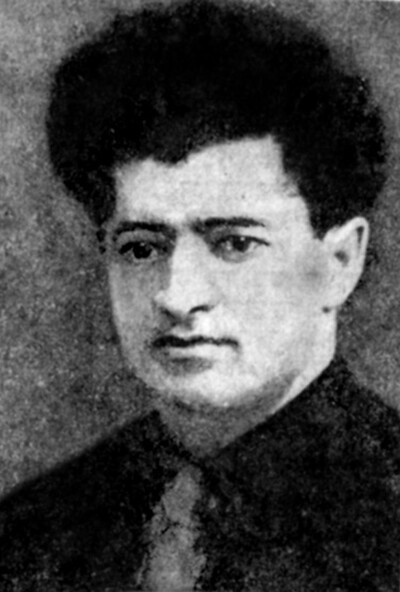
Dunets, Khatskl
1896–1937
He was a Soviet Yiddish literary critic and political writer from Byelorussia. In the mid-1920s, he began writing and, soon after the revolution, he was an important member of the Jewish section of the Byelorussian Academy of Sciences, going on to hold a number of high state positions. In the late 1920s and the first half of the 1930s, he was an active community and state leader and literary critic, and he had a considerable impact on the literary processes of his time, irrespective of the fact that his activity in literature lasted less than a decade.
In book form alone, he brought out a dozen major works. To that one need add dozens of articles in the Yiddish press.
He served as editor of the daily newspaper Oktyabr (October) in Minsk, one of the leading members of the editorial board of the monthly Shtern (Star), an aide to the People’s Commissar for Education in the Byelorussian government, and one of the leaders of the Jewish section in the republic. At the first all-Soviet conference of Soviet Yiddish writers in August 1934, he delivered a public exposé of Yiddish prose, and that same month he received an invitation to the first all-Soviet conference of Soviet writers. Over the course of several years he was the person of authority in Soviet Yiddish literature.
Aside from theoretical works in the field of literary methodology, he published articles on writers and their works, which always aroused intense discussions—about Der Nister’s Fun Mayne Giter (From My Estates), Meyer Alberton’s Birobidzhan, Hershl Orland’s Hreblyes (Dikes), Perets Markish’s Brider (Brothers), Avrom Abtshuk’s Hershl Shamay, Itsik Fefer’s Gefunene Funken (Discovered Sparks), and Shmuel Bregman’s Durkh Krig un Revolutsye (Through War and Revolution), among others.
Dunets’s literary critical treatments carried within them broad generalizations and literary historical parallels. Characteristic in this manner was his major work “Afn Shvel fun 16tn Oktober-Yor” (On the Threshold of October 16th), published in the journal Shtern 10-11 (1932). It is interesting that the critic checked his usual extremism that was ordinarily so distinctive of his attacking-critical fervor.
On February 3, 1935, the office of the Minsk state party committee issued a determination in which was stated that Comrade Dunets, over the course of a series of years, had engaged in counter-revolutionary, Trotskyist-Zinovievist contraband in Yiddish literature, and that he had “furtively passed off theories averse to class.” As such, it was under his editorship, in 1933 there was published Arn Yudlson’s volume of poetry, Grenetsn (Borders), in which was propagandized the anti-Soviet platform that expressed “the lie of the possibility of building socialism in one country, and maliciously accused the Soviet proletariat in ethnic narrow-mindedness.” The NKVD arrested him and “liquidated” him in the same period that the following Yiddish writers met their end: Ziskind Lev, Moyshe Kulbak, and Maks Erik.
After this his subsequent fate remains unknown.
Among his books: Vegn der Masn-Arbet af Yidish (On Mass Labor in Yiddish) (Minsk: State Publ., 1929), 44 pp., with Galbraykh; Dergreykhungen fun der Natsyonaler Politik in f. s. s. r. (Accomplishments in National Politics of the USSR) (Moscow: Central People’s Publishers, 1930), 82 pp.; In Kamf af Tsvey Frontn (In a Struggle on Two Fronts) (Minsk: Byelorussian Academy of Sciences, 1932), 16, 106 pp.; Kegn Sotsyal-Fashistishn “bund” (Against the Social-Fascist Bund) (Minsk: State Publ., 1932), 94 pp.; Far Marksistisher Historiografye (For Marxist Historiography) (Minsk: Byelorussian Academy of Sciences, 1932), 38 pp.; Tezisn Tsum Alfarbandishn Tsuzamenfor fun di Yidishe Proletarishe Shrayber (Theses at the All-Soviet Conference of Proletarian Yiddish Writers) (Minsk, 1932), with Yashe Bronshteyn; In Shlakhtn (In Battle) (Moscow-Kharkov-Minsk: Central People’s Publishers, 1931), 278 pp.; Di Iberdikhtung-Teorye fun Kh. Litvakov (The Poetic Theory of Comrade Litvakov) (Minsk: Byelorussian Academy of Sciences, 1931), 127 pp.; Far Magnitboyen fun der Literatur (On the Great Works of Literature) (Minsk: Byelorussian Academy of Sciences, 1932), 80 pp.; Vegn Shrayber un Verk (On Writers and [their] Works) (Minsk, 1933), 126 pp.; Af Literarishe Temes (On Literary themes) (Minsk: State Publ., 1934), 140 pp.
He also contributed to: Fashizirter Yidishizm un zayn Visnshaft (Fascist Yiddishism and its Scholarship) (Minsk: Byelorussian Academy of Sciences, 1930), 23, 121 pp.
He also translated into Yiddish works by the Byelorussian writer Źmitrok Biadula, among others.
Sources: Kalmen Marmor, in Morgn Frayhayt (New York) (March 16, 1931); Kh. Brogin (Froim Oyerbakh), in Morgn-Zhurnal (New York) (January 13, 1932); M. Damesek and Tsiving, in Shtern (Minsk) (January-February 1932); A. Dameshek, in Shtern 10 (1936); A. Gurshteyn, Problemen fun Kritik (Problems of Criticism) (Moscow, 1933); Shmuel Niger, in Tsukunft (New York) (November 1934); B. Ts. Goldberg, in Tog (New York) (December 30, 1934); A. Mukdoni, in Morgn-Zhurnal (April 3, 1935); Kh. Bernshteyn (A. Glants), in Tog (March 22, 1935); H. Vaynraykh, Blut af der Zun (Blood on the Sun) (New York, 1950), p. 63.