

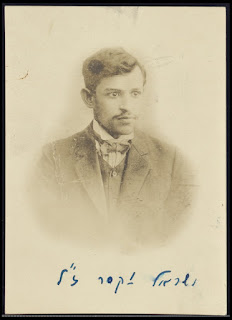
Vakser, Yisroel
1892–May 24, 1919
He was born in Dashev (Dashiv), Kiev district, Ukraine. His father, Rabbi Arye Yehude-Leyb Hakohen, was known by the name Reb Leybush, and in his day was among the progressive rabbis and published treatises in Hapisga (The Summit), Hamelits (The Advocate), and other Hebrew publications. Yisroel Vakser studied Jewish subjects with his father and acquired worldly knowledge his own.
At the time of the outbreak of WWI, he was a teacher in a Hebrew school in Kiev. In 1916 he moved to Baku, in the Caucasus, where he became a teacher in a school for refugee children and was one of the most energetic cultural leaders in the crowded Jewish community.
In 1918, following the dreadful Armenian-Tatar internecine war in the city, he left Baku, spent a period of time in Odessa, and from there departed for the town of Krivoye Ozero, Podolia region, where he took up a teaching position in a recently founded Jewish school.
There, in Krivoye Ozero, he died together with other young Jews defending the Jewish population from attacks by Ukrainian gangs upon the city.
He began writing around 1913-1914. He wrote in both Hebrew and Yiddish, both poetry and prose, mainly poems and stories for children. While he was alive, he only published a short Hebrew sketch in the publication Hamevaser hakavkazi (Herald of the Caucasus) in Baku (Nisan, 1915).
After his death, there was published: “Tsvishn Knekht” (Among Slaves), an allegorical satire, in Frayhayt (Freedom) in Czernowitz (August 1922); the stories “Rokhele un Paraske” (Rokhele and Paraske) and “Shimele” in Tsukunft (Future) in New York (February and July, respectively, 1923); the stories “In Zibn Teg Arum” (Seven Days from Now) and “di Letste Trer” (The Last Tear) in Milgroym (Pomengranate) 3 (1923) in Berlin; a children’s tale “Dos Kluge Feygele” (The Intelligent Little Bird) in Kinder-Zhurnal (Children’s Magazine) and in Oyfgang (Arise) (May 1924).
In book form: Fir Kinder-Mayselekh (Four Children’s Tales), published by Leyzer Shteynbarg (Jassy, 1922).
He left in manuscript (partially with his elder brother in Baku and partially with his younger brother in New York): plays, On Kinder (Without Children), Af Mesires-Nefesh (Out of Devotion), and Bay di Ibergeblibene (With the Survivors); stories, “Naftoli der Soyfer” (Naftoli the Scribe), “a Kindele” (A Little Child), “der Khoyv” (The Debt), and “der Nitsokhn” (Victory); a poem in verse, “Dos Indzele un di Yam-Tekhter” (The Island and the Sea Girls); as well as a whole series of children tales. His story “Der Khoyv” was translated by his brother Menashe Vakser into Hebrew and published in Hadoar (The Mail) in New York (February 1, 1924).
Sources: M. Maidanik, “Beir haharaga” (In the City of Killing), Reshumot 3, p. 276; Kh. N. Bialik, in Milgroym (Berlin) 3 (1923); M. Kamarovski, in Hadoar (New York) 26 (1924); Shmuel Niger, in Tsukunft (New York) (July 1924); Niger, Yidish Shrayber in Sovet-Rusland (Yiddish Writers in Soviet Russia) (New York, 1958), pp. 31-40; E. Shtaynman, Maamarim (Essays) (Tel Aviv, 1926).