

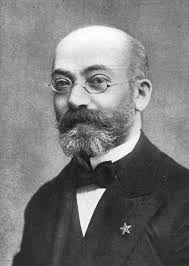
Zamenhof, Lazar
December 15, 1859–April 15, 1917
He was born in Bialystok, then part of Russia, into the home of a language teacher. Until age fifteen he studied in a senior high school, then pursuing medicine at Warsaw and Moscow Universities; for many years thereafter he practiced as an eye doctor.
From his youth he carried around the idea of a universal language which would be able to bring different peoples together, and to that end he initially wanted to make use of “dead” languages, especially Hebrew; he later turned to the Yiddish language which, thanks to its having spread across the entire world, might serve as a basis for an international language. He worked on a Yiddish grammar for three years, but in the end he came to the idea that existing languages could not serve as a foundation for a connecting language among peoples, and in 1878 he worked out an ingenious language on the foundations of the modern Romance and Teutonic languages to which he gave the name Esperanto. The diffusion of his language proved very difficult for him, and only in 1887 did he find a publisher for his first pamphlet which he published under the pseudonym “Doctor Esperanto.”
Thereafter he was recognized as a great philologist, and his language acquired international recognition, as an auxiliary language to given languages of different peoples. Zamenhof translated into Esperanto works from world literature—among them: Shakespeare’s Hamlet and the religious text, Kohelet (Ecclesiastes). The success of his new language pried him loose from his work on Yiddish, and his Yiddish grammar remained incomplete.
For the first time in 1909, he published a small part of this work (using the pen name of Dr. Eks) in A. Litvin’s Lebn un Visnshaft (Life and Science) (Vilna), issues 1, 7, and 9, where he, incidentally, proposed to change the Jewish alphabet into the Roman one.
There is an entire literature devoted to Zamenhof’s accomplishments, and a great number of textbooks to teach Esperanto were created in all the languages of the world. For a time he turned as well to Jewish political issues and was the founder of the youth circle Friends of Zion in Warsaw, but he later left political Zionism and developed the idea of the need to reform Jewry, as in his Russian-language pamphlet Gillelizm (Hillelism) (Warsaw, 1900), 78 pp.
He died in Warsaw.
His brochure of 1887 was republished in 1930 in Warsaw: Esperanto, Moderner Lern-Bukh fun der Internatsyonaler Shprakh: Gramatik, Khrestomatye un Verter-Bukh fun 15000 Verter, Oystsulerner Zikh Aleyn on der Hilf fun a Lerer in 15 Teg (Esperanto, Modern Textbook of the International Language: Grammar, Reader, and Dictionary of 15,000 Words, to Master on One’s Own Without the Help of a Teacher in Fifteen Days), 110 pp.
Sources: Zalmen Reyzen, Leksikon, vol. 1; Dr. Chaim Zhitlowsky, in Tsukunft (New York) (January 1927); Z. Kuper (Y. Y. Zinger), in Forverts (New York) (September 6, 1931); R, Brainin, in Der Tog (New York) (January 31, 1932); G. Bublik, in Morgn-Zhurnal (New York) (February 28, 1932); B. Mark, in Dos Naye Lebn (Lodz) (August 16, 1946); A. Sh. Hershberg, in Pinkes Byalistok (New York) 1 (1949), p. 426; Dr. Y. Shatski, Geshikhte fun Yidn in Varshe (History of the Jews in Warsaw), vol. 2 (New York, 1953), p. 386; Arn Tsaytlin, in Tog-Morgn-Zhurnal (New York) (July 11, 1954; November 6, 1959); Yidishe Shprakh (New York) (December 1958; April 1959); Professor Sh. Ayzenshtadt, in Frayhayt (New York) (June 21, 1959); A. Glants, Tog-Morgn-Zhurnal (August 12, 1959); N. Ts. Maymun, in Bitsaron (New York) (Tishrei-Ḥeshvan [= October-December] 1959); Dr. Y. Ribkind, in Hadoar (New York) (Kislev 17 [= December 18], 1959); L. Faynberg, in Tog-Morgn-Zhurnal (December 13, 1959); Y. Shmulevitsh, in Forverts (December 27, 1959).
Полина Пайлис
Ludoviko Zamenhof – la iniciatoro de la lingvo Esperanto [Л. Заменhоф – создатель языка эсперанто]
https://dzen.ru/a/YumzVpTkYWHZO4fU
[Thank you for posting this!]
One more edition of Zamenhof's work translated into Yiddish by Neymanovitsh/Neimanovitch Naftaly Herts (HaNeTs) with an introduction by HaNeTs and a dictionary - Di(a) veltshprakhe : dos iz eyn naye shprakhe, zehr eyn laykhte, vos yeder fershtendiger mentsh, ken zi(a) erlernen in eynige teg, und vet zikh kenen in ihr fershtendigen mit der gantser veltferpast fon doktor Esperanto ; umgearbeytet fir dem yudishen folk fon HaNeTs ; farrede fon HaNeTs (orig.: Международный язык = International Language).- Varsha, 1900.- 64 pp.
דיא װעלטשפראכע :
דאס איז אײן נײע שפראכע, זעהר אײן לײכטע, װאס יעדער פערשטענדיגער מענטש, קען זיא ערלערנען אין אײניגע טעג, אונד װעט זיך קענען אין איהר פערשטענדיגען מיט דער גאנצער װעלט
פערפאסט פאן דאקטאר עספעראנטא ; אומגעארבײטעט פיר דעם יודישען פאלק פאן הנץ ; פאררעדע פאן הנץ
NAFTOLE-HERTS NAYMANOVITS (NAFTALI HERTZ NEIMANOVITCH, HANETS) (February 12, 1843-1898)