
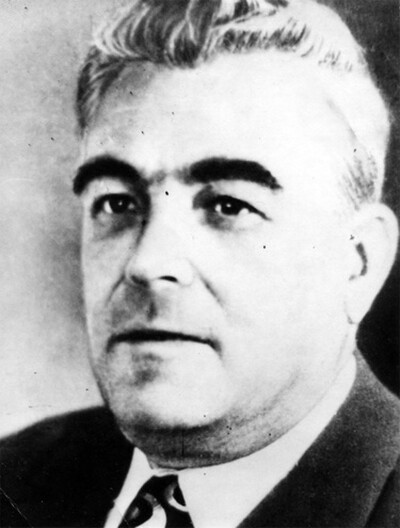
Tabatshnikov, Khaskl
June 26, 1913–1988
e was a prose writer, born in Boslev (Bohuslav), Ukraine, into a laboring family. Orphaned as a youth, he wandered through towns during the years of the civil war, and the environment in which he grew up appears in his autobiographical novel Barshever Motivn (Barshev Motifs) (Moscow: Sovetski Pisatel, 1975), 412 pp.
From his early youth, he was involved in various trades, later working in a factory. He debuted in print with a story—“Tsvishn Barzhes” (Among Barges)—in the sixth issue of the Kharkov journal Yunger Boyklang (Sounds of Construction for Youth), the literary supplement to the newspaper Yunge Gvardye (Young Guard), in 1928. Thereafter he published stories and novellas in Yiddish-language newspapers and other Soviet Yiddish journals.
Prior to WWII, he published four books (see below), mainly stories of ordinary life, in which the protagonists were simple workers, laborers, and youngsters looking for and finding a way forward in life.
He fought at the front during WWII; afterward, there was a sharp disruption in his work, as generally in Yiddish literature, with the Stalinist persecutions. In the early 1960s he returned to writing, and his work appeared in Sovetish Heymland (Soviet Homeland) in Moscow. In the 1970s he published in this journal his novel Barshever Motivn which then appeared as a separate volume. In the early 1980s, he published his stories “Di Shvester Dvorkin” (The Sisters Dvorkin) and “Leyzer Barkus, der Elektriker” (Leyzer Barkus, the Electrician) in this same journal.
His work was included in the anthology In Undzere Teg (In Our Time) (Moscow: Sovetski Pisatel, 1983) 558 pp. edited by Arn Vergelis.
He died in Kiev.
His books include: Afn Front, Dertseylungen (On the Front, Stories) (Kharkov-Kiev: Ukrainian State Publishers for National Minorities, 1932), 138 pp.; Donye (Donye) (Kharkov-Kiev: Ukrainian State Publishers for National Minorities, 1934), 78 pp.; A Shtetl Bam Dnyeper (A Town on the Dnieper), stories (Kharkov-Kiev: Ukrainian State Publishers for National Minorities, 1936), 207 pp.; Der Ershter Shney (The First Snow), stories (Kiev: Ukrainian State Publishers for National Minorities, 1939), 292 pp., also published in Russian translation (in Kiev) in 1939.
He was the translator into Yiddish of Gavrosh (Kiev: Melukhe Farlag far di Natsionale Minderhaytn in USSR, 1937) apparently a reworked version of Victor Hugo's Les Misérables . Gavroche is a fictional character in the original 1862 novel.
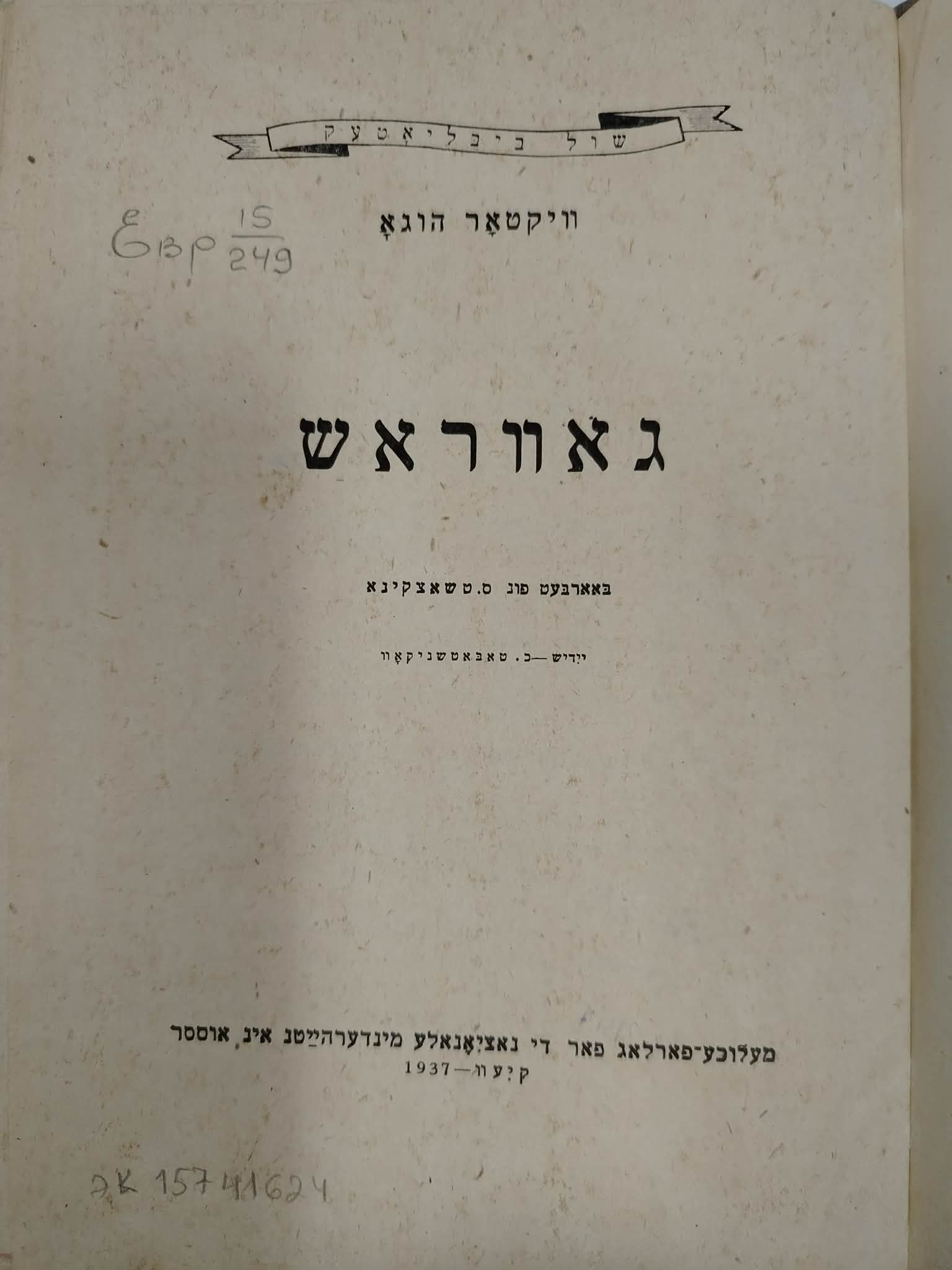
Image courtesy of the Russian State Library (Moscow), Oriental Centre.
Sources: Y. Vorhaft, in Yunger Boyklang (Kharkov) 7 (1928); A. Holdes, in Farmest (Kharkov) (May-June 1934); M. Mizhiritski, in Farmest (October 1934).
Khaskl Tabatshnikov wrote a collection of 5 stories In veg : dertseylungen / red. R. Balyasne.- Kiev: Melukhe-farlag far di natsyonale minderhaytn in USSR, 1941.- 291, [1] pp., portr.
אינ װעג : דערצײלונגענ
כ. טאבאטשניקאװ ; רעד. - ר. באליאסנע
Khaskl Tabatshnikov contributed as a translator (among other translators: I. Fefer, M. Hartsman, P. Sito, A. Kahan, I. Kipnis) to Taras Shevtshenko. 1814-1939 : almanakh fun sovetishe shrayber / red. Sh. Kozinski.- Kiev: Melukhe farlag far di natsyonale minderhaytn in USSR, 1939.- 159, [1] pp., portr.
טאראס שעװטשענקא. 1814-1939: אלמאנאכ פונ סאװעטישע שרײבער / רעד. ש. קאזינסקי
Khaskl Tabatshnikov translared into Yiddish from Russian adaptation, done by S. Tshatskina from French in 1936, Viktor Hugo's Gavrosh.- Kiev: Melukhe farlag far di natsyonale minderhaytn in USSR, 1937.- 61, [2] pp., 10 original ill., taken from French edition by Ollendorf publishing house via Russian edition.
Gavrosh is an extract from "Les miserables" by Victor Marie Hugo (1876—1885)
Author of Russian adaptation from French - Чацкина, Софья Исааковна (1878-1931).