
Yefroykin, Zalmen
April 18, 1895–October 1, 1966
He was born in Vekshne (Viekšniai), Lithuania, the brother of Yisroel Efroykin. At five years of age, he moved with his family to Libave (Liepāja), Latvia. Because of business concerns, his father, a grain merchant, lived far from home, and it was his mother, a woman of rabbinic heritage, who saw to the upbringing of the children, and who, in addition to her traditional piety, also possessed a general education. Yefroykin studied in a “cheder metukan” (improved religious elementary school), as well as with a Talmud teacher, and later he graduated from a senior high school as an external (auditor) student. After WWI he graduated from a Jewish teachers’ seminary in Riga. In his youth he was carried away with the spirit of the 1905 Revolution, and for ten years he was a member of the “Kleyner Bund” (Little Bund), later helping to found illegal workers’ circles in which one taught reading and writing and political economy. He also organized a semi-legal library with Yiddish-language books.
During WWI he studied in Vilna and in St. Petersburg. In late 1918 he returned to Libave, then already part of an independent Latvia, where he played a significant role in rebuilding the local organization of the Bund, was selected onto the Bundist list in the local Jewish community and civil administration, and—together with Yudl and Mendl Mark and A. Elkishek—established the Y. L. Perets Club, a popular center for Jewish culture, and after that a large Jewish school supported by the municipal administration of Libave. At this time Yefroykin made a trip across the new borders of the war’s fronts to Vilna and Warsaw to provide the new school with the necessary textbooks; later, he became a teacher in the school in which Yiddish was the language of instruction for all subjects.
At the end of 1921 he emigrated to the United States, served in New York for a short time as secretary for ORT (Association for the Promotion of Skilled Trades) and then became a teacher in a Workmen’s Circle school and a prominent leader in the Workmen’s Circle. Over the course of many years thereafter, he served as director of the Workmen’s Circle Middle School, the Workmen’s Circle summer camp for children, as well as Workmen’s Circle teachers’ courses. From 1953 he was educational director of the Workmen’s Circle.
He began writing in his youth, publishing articles in the local Russian-language Libavskii Vestnik (Libave Herald) and the German-language Libausche Zeitung (Libave Newspaper), in Fraynd (Friend) in St. Petersburg, and in the Russian-Jewish Novyi Voskhod (New East), among others. In 1919 he edited the weekly Di Shtim (The Voice), organ of the Bundist committee in Libave. He would later publish in: Forverts (Forward), Der Veker (The Awakener), and Fraynd, among others, in New York.
In Shul-Almanakh (School Almanac) (Philadelphia, 1935), he contributed: “Der Ideisher Veg fun di Arbeter-Ring-Shuln” (The Ideological Path of Workmen Circle Schools) and “Di Idish-Veltlekhe Shul in Letland” (The Secular Jewish School in Latvia). For the volume Yidn h’ (Jews 5) of the Algemeyne Yidisher Entsiklopedye (General Jewish Encyclopedia), he wrote a chapter entitled “Yidishe Dertsiung in Amerike” (Jewish Education in America), and for volume 1 of The Jewish People, Past and Present he penned the article “Yiddish Secular Schools in the United States.” For a time he published articles in the English-language journal of the Workmen’s Circle, The Call.
For many years he served as co-editor of Kultur un Dertsiung (Culture and Education), which commenced publication in 1930, and of Kinder-Tsaytung (Children’s Newspaper), which did the same in 1934—both in New York.
In book form: Unzer Vort, Literatur-Gezelshaftlekhe Khrestomatye (Our Word, Literary-Social Reader) (New York, 1933), 408 pp., with Kh. Bez (Hyman Bass), second improved edition (New York, 1935), 424 pp.; Mayn Shprakhbukh, Arbet un Leyen-Bukh far Yidish (My Language Book, a Workbook and Reader for Yiddish) (New York, 1938), 192 pp., with Kh. Bez, second edition (New York, 1945); Mayn Shprakhbukh, part 2 (New York, 1942), 256 pp., second edition (New York, 1946);
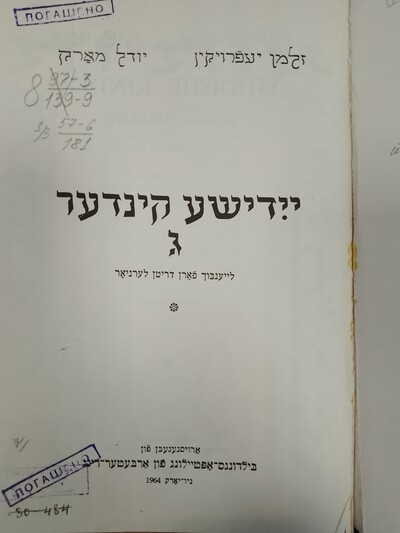
There is one more part (Part III) of Yidishe kinder, leyenbukh farn dritn lernyor (Jewish children, textbook for the third year of study) (New York, 1964), 271 pp., ill., with Yudl Mark. It was illustrated by Y. Shlos, Tsirl Groblya-Valetski, F. Sharon, Shoyrlin Knaring, Yosef Khromov, Hershl Danilevitsh, Yoel Levit, Ignatsi Vits, Maks Band. (See Image)
Dos Yidishe Vort (The Yiddish Word) (New York, 1947), 320 pp., with Kh Bez; Baym Kval, Literarishe Zamlung far der Yidisher Shul (At the Source, a Literary Collection for the Jewish School) (New York, 1948), 110 pp., with Kh. Sh. Kazdan; Fun Peretses Oytser, Perets Antologye (From Perets’s Treasures, an Perets Anthology) (New York, 1952), 264 pp.; A Trit Foroys, Nokhn Ershtn Leyenbikhl (A Step Forward, After the First Textbook) (New York, 1953), 31 pp., with Yudl Mark; Dos Lebedike Vort, Leyenbukh far dem Dritn Lernyor (The Living Word, Textbook for the Third Year of Study) (New York, 1954), 256 pp., with Kh Bez; Yidishe Kinder, Leyenbukh Farn Tsvaytn Lernyor (Jewish Children, Textbook for the Second Year of Study) (New York, 1955), 224 pp., with Yudl Mark; Yidn Gibn Zikh nit Unter (Jews Do Not Surrender) (New York: Workmen’s Circle, 1966), 245 pp.
In 1961 he began to publish a series of travel narratives concerned with general and Jewish life in Soviet Russia, later published as: A Bazukh in Sovet-Rusland (A Visit to Soviet Russia) (New York: Workmen’s Circle, 1962), 109 pp.
He died in New York.
Sources: Shmuel Niger, in Tog (New York) (January 8, 1933; May 15, 1938; April 19, 1947); Niger, In Kamf far a Nayer Dertsiung (In the Struggle for a New Education) (New York, 1940), pp. 74, 89, 95ff; Ts. Hirshkan, in Morgn-Frayhayt (New York) (December 15, 1934); Kh. Sh. Kazdan, in Unzer Shul (Our School) (Warsaw, 1934); Avrom Reyzen, in Di Feder (New York) (1949); Y. Mlotek, in Khavershaft (New York) (1953); Yankev Glatshteyn, in Idisher Kemfer (New York) (August 28, 1953); Y. Mark, in Kultur un Dertsiung (New York) (February 1956); Y. Shmulevitsh, in Forverts (New York) (February 25, 1956); Sh. Saymon, in Kultur un Dertsiung (March 1959); Sh. D. Zinger, Dikhter un Prozaiker, Eseyen vegn Shrayber un Bikher (Poets and Prose Writers, Essays on Writers and Books) (New York, 1959), pp. 332-36.
One more part (Part III)
There is one more part (Part III) of Yidishe kinder, leyenbukh farn dritn lernyor (Jewish children, textbook for the third year of study) (New York, 1964), 271 pp., ill., with Yudl Mark.
[It was] ilustrirt fun Y. Shlos, Tsirl Groblya-Valetski, F. Sharon, Shoyrlin Knaring, Yosef Khromov, Hershl Danilevitsh, Yoel Levit, Ignatsi Vits, Maks Band