
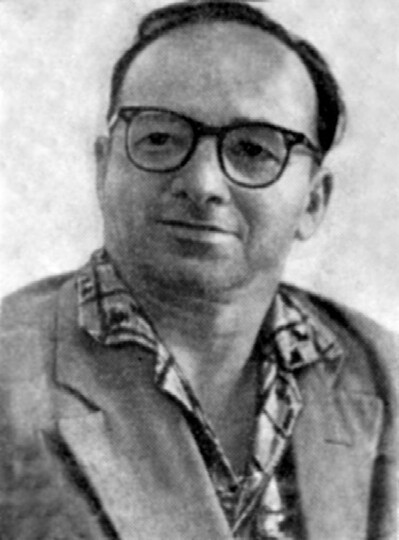
Maltinski, Khaim
August 8, 1910–February 16, 1986
He was a poet and current events author, born in Ponevezh (Panevėžys), Lithuania. From 1915 he was living in Vitebsk, before moving to Minsk. He attended religious elementary school and Soviet Jewish educational institutions in Minsk; he later graduated from the pedagogical institute in Kiev.
He early on joined a Communist youth group, and for a time he was an instructor in Communist youth organizations in Byelorussia, later working as a tractor driver at a state farm in Ukraine.
He debuted in print in 1927 with poems in the Minsk magazine Der Yunger Arbeter (The Young Worker). He went on to publish in: Oktyabr (October) and Shtern (Star) in Minsk; Yungvald (Young Forest) in Moscow; and other Soviet Yiddish publications in Russia.
He also published translations from Russian and Byelorussian writers.
In one of his autobiographical poems, he explained with a smile how his career as a poet began: “With my little bundle and twenty years of age, humble and meager, with crooked little feet in torn, dusty boots, and with a curly mop of hair on my head and under my shiny-greasy soldier’s cap, I arrived in the great city of the poets…. Everyone in the great city looked at my attire and my step…. Who could possibly surmise that in the little bundle in my hand—wrapped up, sown up, and twisted up—were my poems with a loaf of bread?” This poem was marked with the year 1930, and one year later he brought out his first poetry collection; he went on to publish one collection after the next, as he became one of the most popular Yiddish poets, especially in Byelorussia.
Shortly after the outbreak of the Nazi-Soviet war in 1941, Maltinski volunteered to join the Red Army, and he remained at the front throughout the entire war, participating in the battles for Berlin, in which a mine blew off one of his feet. He received the highest military decorations. After the war he returned to Minsk, where the Nazis had murdered his wife, his seven-year-old son, and his entire family in the Minsk ghetto. He lived thereafter for a time in Moscow.
He wrote a series of war-related poems for Eynikeyt (Unity) there. In 1947 he moved to Birobidzhan, where he contributed to local Yiddish publications and where he was selected to edit the almanac Birobidzhan. In 1948 the Soviet Yiddish press wrote a great deal about his war poem Dvore (Deborah), which he published in Birobidzhan.
Unable to evade the Stalinist repression of Yiddish culture, he was arrested and sent to a camp in the North. After rehabilitation (exoneration) he returned once again to Minsk.
From the early 1960s, he was a member of editorial board of the journal Sovetish Heymland (Soviet Homeland), in which he placed poems and essays. He published a great number of poetic works in Warsaw’s Folks-Shtime (Voice of the People) and Yidishe Shriftn (Yiddish Writings), and a cycle of poems in the Moscow magazine Horizontn (Horizons) in 1965.
He made aliya to Israel in 1974, and there he found a new zest for creative activity which lasted over ten years. He died in Tel Aviv.
His prewar books include:
Vi dos Lebn Tayer (As Precious as Life), poetry (Kharkov-Kiev: Central Publishers, 1931), 55 pp.;
Unzer Khor (Our Chorus) (Minsk: Byelorussian State Publishers, 1933), 42 pp.;
Kinder (Children), children’s stories (Minsk: State Publ., 1933), 69 pp.;
Yunger Leninyets (Young Leninist) (Minsk: State Publ., 1934), 36 pp.;
Af der Vishke, Kinder Pyese in Fir Stsenkes (At the Reins, a Children’s Play in Four Scenes) (Minsk: State Publ., 1934), 39 pp.;
Faran a Forpost, Pyese in Finf Stsenkes (There Is an Outpost, a Play in Five Scenes) (Minsk: State Publ., 1935), 26 pp.;
On a Shotn, Lider (Without a Shadow, Poetry) (Minsk: State Publ., 1936), 82 pp.;
Geyn zol zikh Gring (Going Should Be Easy), poetry (Minsk: State Publ., 1936), 52 pp.;
Yorn, Yorn Mayne (Year, My Years) (Moscow: Sovetski Pisatel, 1973), 278 pp.;
Di Erd Farshteyt (The Soil Understands) (Tel Aviv: Perets Publ., 1976), 202 pp.;
Mayn Mames Onblik (My Mother’s Appearance) (Tel Aviv: Perets Publ., 1977), 176 pp.;
Mayn Dimyen-Brik (Bridge of My Imagination), poetry (Tel Aviv: Nay-lebn, 1978), 179 pp.;
Frishe Vintn (Fresh Winds) (Tel Aviv: Eygns, 1980), 188 pp.;
Der Moskver Mishpet Iber di Birobidzhaner (The Moscow Judgment Over the Birobidzhaners) (Tel Aviv: Nay-lebn, 1981), 245 pp.;
In Zibn Zunen (In Seven Suns) (Tel Aviv: Gerangl, 1983), 302 pp.; and
several volumes in Russian.
Shortly before his death, a book of prose by him was published: Der Droysn-Mentsh (The Outdoors Man) (Tel Aviv: Gerangl, 1986), 370 pp.
His work also appeared in Atake, Almanakh fun Roytarmeyishn Landshuts-Literatur (Attack, Almanac of the Red Army’s National Defense Literature) (Minsk: State Publ., 1934); Sovetishe Vaysrusland, Literarishe Zamlung (Soviet Byelorussia, Literary Collection) (Minsk: State Publ., 1935); Komyug, Literarish-Kinstlerisher Zamlbukh ([Jewish] Communist Youth, Literary-Artistic Anthology) (Moscow: Emes, 1938); Lomir Zingen (Let’s Sing) (Moscow: Emes, 1940); Lenin un di Kinder (Lenin and Children) (Kharkov-Kiev: Ukrainian State Publishers for National Minorities, 1934); and 10 Pyonerishe Lider (Ten Pioneering Poems) (Minsk, 1934). A small volume of his poetry in Byelorussian translation appeared in 1963: Poplech z Synami Usimi (Shoulder to Shoulder with All the Sons) (Minsk: State Publ.), 175 pp.
Sources: Y. Nusinov, in Eynikeyt (Moscow) (August 5, 1942); A. Kushnirov, in Naye Prese (Paris) (July 27, 1945); I. Kipnis, in Eynikeyt (September 25, 1945); M. Notovitsh, in Eynikeyt (March 15, 1947); “Vegn der Poeme ‘dvore’ fun Khayim Maltinski” (On the poem “Dvore” by Khaim Maltinski), Dos Naye Lebn (Warsaw) 80 (June 1948); B. Ts. Goldberg, in Tog-Morgn-Zhurnal (New York) (January 9, 1962); Biblyografye fun Yidishe Bikher vegn Khurbn un Gvure (Bibliography of Yiddish Books Concerning the Holocaust and Heroism) (New York, 1962).
א װײסרוסישע מײסעלע
א. אלעקסאנדראװיטש; איבערזעצט - כ. מאלטינסקי; מאלערײ - קינסטלער אנאטאלי װאלקאװ
מינסק: מעלוכע-פארלאג פון װײסרוסלאנד. נאצסעקטער
1935.- 14 pp.
A vaysrusishe maysele
A. Aleksandrovitsh; iberzetst - Kh. Maltinski; moleray - kinstler Anatoly Volkov
Minsk: Melukhe-farlag fun Vaysrusland. Natssekter
.דילא, א. דער דרײסטער יורקע / א. דילא; מאלערײ א. י. שאכאר; איבערזעצט כ
מאלטינסקי. - מינסק: מפװ. נאצסעקטער, 1934.- 15 ז
Khaim Maltinski translated "Der dreyster Yurke" by A. Dilo.
:מיט פעסטענ טראט :ליטערארישער זאמלבוכ/ רעדאקטער כ. מאלטינסקי . - מינסק מעלוכע-פארלאג פונ װססר, 1947.- 175.ז
This book (Mit festn trot : literarisher zamlbukh), edited by Khaim Maltinski also includes 19 poems by Kh. Maltinski.