
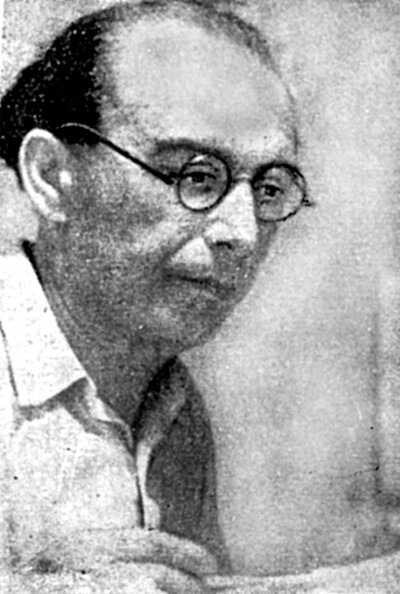
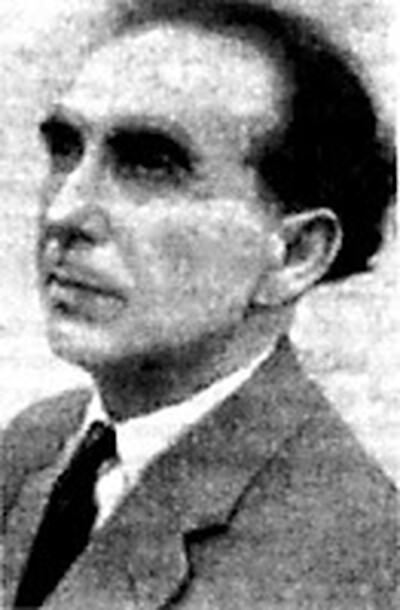
Saktsier, Motl
January 11, 1907–1987
He was a poet, prose author, and playwright, born in Leove (Leova), southern Bessarabia (now, Moldova). He descended from generations of tailors, but his father, Mortkhe Saktsier, who was a Jewish community leader and vice-mayor of the town, sent him to religious elementary school, a state public school, and a public high school as well. In the mid-1920s he moved to Bucharest, and in 1928 he was studying in the Vienna pedagogical seminary; a year later he was living in Paris where he worked in a factory, before returning to Romania in 1931.
He was part of the group Yung-Romenye (Young Romania) associated with the journal
Shoybn (Glass panes) in Czernowitz,
under the editorship of Yankev Shternberg, in which he published poetry and elegies. In 1934 he worked as secretary for
Di Vokh (The Week),
and he contributed poems, notes, and stories to it and
Inzl (Island)
— in Bucharest;
Tshernovitser Bleter (Czernowitz Newspaper) and
Oyfgang (Arise),
— among others, in Romania;
Literarishe Bleter (Literary Newspaper) in Warsaw; and
in Yiddish publications out of Soviet Russia.
In late 1936 he left for the Soviet Union, where he taught and worked on building the underground rail line in Moscow. At the time of 1936-1937 show trials, he was purged, arrested, and exiled to the gulag. Freed in 1940, he returned to Bessarabia and took part in the creation of the Yiddish State Theater in Belz, for which he served as literary director and for which he composed the play
Royte Pomerantsn (Red Oranges).
In 1941 when the forces of Hitler invaded the Soviet Union, he was evacuated with the theater to Uzbekistan. There he was mobilized into the Red Army and assigned to a construction battalion for one year. Following demobilization, he lived in Alma-Ata and Samarkand and worked in the theater ensemble of Sidi Tal and wrote plays and other stage pieces for it. In 1947 he returned to Bessarabia and was living in Kishinev and later Czernowitz, where he was involved in Jewish cultural work and the Yiddish theater.
In 1948 he was charged and convicted of “Jewish nationalism” and sentenced once again in 1949 to deportation to Siberia, this time for ten years. In 1955 (after Stalin’s death), he returned from exile “rehabilitated” (i.e., exonerated), lived briefly in Moscow, and then settled in Czernowitz and Kishinev, where he returned to literary and theatrical work. In 1972 he made aliya to Israel.
His literary activities began with poems in the journal
Yidish (Yiddish) in Bucharest (1928) and
other Yiddish periodicals in Romania.
In 1939, in the anthology
Byalistoker Lebn (Bialystok Life),
he published the poem “Bay Velkhe Taykhn” (By Which Rivers),
and in the journal Sovetish (Soviet) and
the almanac Heymland (Homeland) in Moscow, and
in IKUF-Bleter (Pages from IKUF [Jewish Cultural Association]) in Bucharest,
among other serials.
From 1953 he was writing for:
Yidishe Shriftn (Yiddish Writings) and
Folks-Shtime (Voice of the People)
— in Warsaw;
Yidish Kultur (Jewish Culture),
Zamlungen (Collections), and
Morgn-Frayhayt (Morning Freedom)
— in New York; and
Fray Yisroel (Free Israel) in Tel Aviv;
among others.
He became a regular contributor to
Sovetish Heymland (Soviet Homeland) in Moscow.
In Israel, he placed work in:
Di Goldene Keyt (The Golden Chain),
Bay Zikh (On One’s Own),
Yisroel-Shtime (Voice of Israel),
Folksblat (People’s Newspaper),
Letste Nayes (Latest News), and
Yidish-Velt (Yiddish World).
He devoted many years to writing plays, including:
Di Sonim af tsu Lehakhes (Enemies Out of Spite) (1945);
Lakhn iz Gezunt (Laughter Is Healthy) (1947);
and others.
His musical comedies:
In a Guter Sho (At a Good Time) (1959), a comedy in two acts, which was staged in Yiddish theaters in Romania by Sidi Tal’s troupe;
Abi men Zet Zikh (As Long as it Can Be Seen) (1963); and
Gliklekhe Bagegenishn (Happy Encounters).
He also composed poetry, one-act plays, sketches, and folk images, which were produced by Yiddish stage ensembles in the Soviet Union.
In book form:
Derfar, Lid un Elegye (Therefore, a Poem and Elegy) (Bucharest: Shoybn, 1936), 96 pp.;
Mit Farbotenem Blayer (With a Forbidden Pencil), a poetry collection (Tel Aviv: Perets Publ., 1977), 200 pp.;
Der Shayter Baym Veg (The Bonfire by the Road) (Tel Aviv: Nay lebn, 1978), 230 pp.;
Toybn af Antene (Pigeons on the Antenna) (Tel Aviv: Leivick Publ., 1982), 224 pp.
His novel
Yidishe Shnayders (Jewish Tailors), about his grandfathers in his hometown of Leova,
was lost in the years of his banishment.
“His volume of poetry, Derfar,” wrote Y. Kara, “bore Leivick’s stamp of ethical-social struggles.”
“Characteristic of him and his work,” noted Yitskhok Yanasovitsh, “is the fact that not only the individual experience of the poet takes place in his poems, but also the experiences of his generation. He is consequently, in a major sense, the spokesman of his generation.”
Sources: B. Shnobl, in Oyfgang (Sighet-Marmației) (May-June 1934); Literarishe Bleter (Warsaw) (October 16, 1936); Y. Yakir, in Literarishe Bleter (January 22, 1937); B. Alkvit, Inzikh (New York) 32 (1937); N. Kh., in Eynikeyt (Moscow) (December 2, 1943); Heymland (Moscow) 7 (1948); Y. Yanasovitsh, in Di Naye Tsayt (Buenos Aires) (January 28, 1954); Dr. Shloyme Bikl, in Naye Literarishe Bleter (Buenos Aires) (March-April 1954); Bikl, in Tog-Morgn-Zhurnal (New York) (June 14, 1958; July 6, 1958; October 12, 1958); Bikl, in Rumenye (Romania) (Buenos Aires, 1961), pp. 286-90; N. Mayzil, Dos Yidishe Shafn un der Yidisher Shrayber in Sovetnfarband (Jewish Creation and the Jewish Writer in the Soviet Union) (New York, 1959), pp. 63, 132; Y. Kara, in IKUF-Almanakh (IKUF Almanac) (New York, 1961), p. 166; Yankev Glatshteyn, in Idisher Kemfer (New York) (September 29, 1961); Sholem Shtern, in Yidishe Kultur (New York) (December 1961); Y. Lyubomirski, in Yidishe Kultur (March-April 1962).