
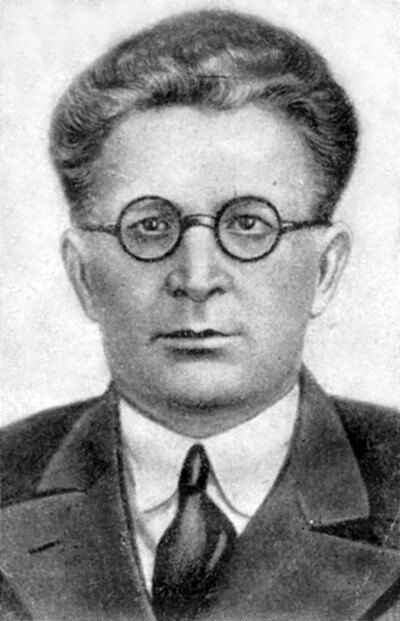
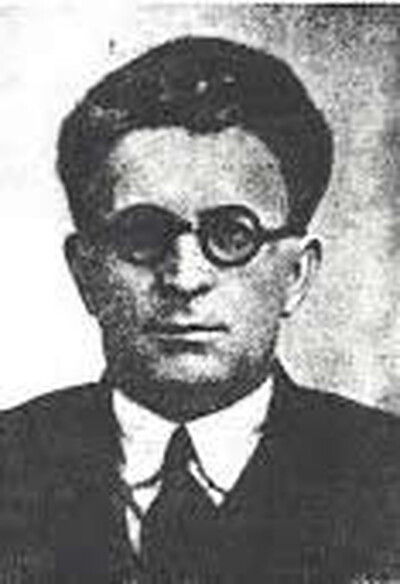
Persov, Shmuel
1890– late November 1950
He was a prose author, born in the town of Pochap, Chernigov (Chernihiv) district, Ukraine. Until age thirteen he studied in yeshiva and went to work at a very early age. He was active in the Bund (1905-1906) after the Revolution of 1905. Around 1907 he emigrated to the United States and worked in a sweatshop.
He began writing in America and debuted in print in 1909 with a story in the weekly Fraye Arbeter-Shtime (Free Voice of Labor) in New York. In 1910 he returned to Russia and worked at a government post in Ukraine. He came to the realization over the next decade that his true calling was literature, and in the first issue of the journal Kultur un Bildung (Culture and Education) in 1918, he placed his story “Der Shvayger” (The Quiet Person) which carried the subtitle “A Folks-Mayse” (A Folktale). Aside from articles on economic problems in the Russian press, he published folktales, sketches, and stories in: Der Yidisher Komunist (The Jewish Communist), Di Komunistishe Velt (The Communist World), Emes (Truth), and Kharkover Tsaytung (Kharkov Newspaper), among others; and together with Moyshe Taytsh and Khayim Gildin, he organized the Moscow Yiddish literary group of proletarian writers. He participated at that time in the literary evening begun by the journal Shtrom (Current).
In 1922 he published his first booklet of prose work: Sherblekh (Shards). He aimed higher with his second prose book, Takhles (Purpose) of 1927, and then his third book the next year, Kornbroyt (Rye Bread). After the poor reception of his 1931 novel Kontraktsye (Counteraction), he sensed the artistic failure of the work and switched over to documentary prose writing, his true métier. In 1935 he published Mentshn fun Metro (People of the [Moscow] Subway). Just then, Maxim Gorky was launching a project on the history of the factory, and Persov undertook to write for this projected series a volume on a metallurgy factory in the Urals.
His book, Di Geshikhte fun Lisve (The History of Lisve) did not have the good fortune to see the light of day. Mass arrests of “enemies of the people” began, and many of the people involved in his documentary work were purged. His book Yankev Moshkovski (Yankev Moshkovski) was dedicated to that heroic aviator and later was qualified as a “nationalistic deviation,” because Moshkovski was a Jew. In 1941 his book Yankev Smushkevitsh, der Doplter Held fun Ratnfarband (Yankev Smushkevitsh, the Twofold hero of the Soviet Union) appeared in print, and that same year the “hero” of the book was executed as an “enemy of the people.”
Persov was arrested on January 18, 1949. He was tried twice: the first time on February 10, 1950 for spying and anti-Soviet, nationalistic activities and sentenced to twenty-five years in an “improvement colony”; the second time on November 22, 1950, he was sentenced to death. The judgment of the second trial was carried out and he was shot.
His published books include: Sherblekh, stories (Moscow, 1922), 17 pp., (Jerusalem rpt.: Hebrew University, 1983), 27 pp.; Kornbroyt, Dertseylungen (Rye Bread, Stories) (Moscow: Shul un Bukh, 1928), 143 pp.; Kontraktatsye, Roman (Counteraction, a Novel) (Moscow: Shul un Bukh, 1931), 267 pp.; Tog un Nakht, Dertseylungen (Day and Night, Stories) (Moscow, Emes, 1933), 209 pp.; Mentshn fun Metro, portraits (Moscow: Emes, 1935), 82 pp.; Viva Stalin! Dertseylung (Long Live, Stalin!, a Story) (Moscow: Emes, 1938), 18 pp.; Alfolkisher Yontev (Holiday for All Peoples) (Moscow: Emes, 1938), 11 pp.; Oytsres, Dertseylungen (Treasures, Stories) (Moscow: Emes, 1939), 126 pp.; Yankev Moshkovski (Moscow: Emes, 1940), 55 pp.; Yankev Smushukevitsh, der Doplter Held fun Ratnfarband (Moscow: Emes, 1941), 99 pp.; Dayn Nomen iz Folk, Fartseykhenungen vegn Yidn Partizaner (Your Name Is the People, Notes Concerning Jewish Partisans) (Moscow: Emes, 1944), 122 pp.; Moyshe Khokhlov, der Held fun Sovetnfarband (Moyshe Khokhlov, Hero of the Soviet Union) (Moscow: Emes, 1946), 30 pp.; and Izbrannoe (Selected [writings]) (Moscow: Sovetsii Pisatel', 1957), 400 pp.
His work was also represented in the anthology, A Shpigl af a Shteyn, Antologye, Poezye un Proze fun TsVelf FarshniTene Yidishe Shraybers in Ratn-Farband (A Mirror on a Stone, Anthology, Poetry and Prose from Twelve Murdered Jewish Writers in the Soviet Union), including a biography (Tel Aviv: Di Goldene Keyt, 1964; Jerusalem: Hebrew University, 1987), 812 pp.; and
he translated: Di Letste Teg (The Last Days) (Kharkov, 1932), 176 pp.; and Sedovs Marsh (Sedov’s March) (Kharkov, 1932), 93 pp., about Georgy Sedov’s expedition to Frantz Josef Land in 1929 [original: Boris Gromov, Pochod “Sedova”: Ekspeditsiya “Sedova” na Zemlyu Frantsa-Iosifa v 1929 Godu].
Sources: Zalmen Reyzen, Leksikon, vol. 2; A. Dameshek, in Literarishe Bleter (Warsaw) (June 22, 1928); Y. Bronshteyn, in Di Royte Velt (Kharkov) (October 1928); Bronshteyn, in Atake, Almanakh fun Roytarmeyishn Landshuts-Literatur (Attack, Almanac of the Red Army’s National Defense Literature) (Moscow-Kharkov-Minsk, 1931); A. Abtshuk, Etyudn un Materialn tsu der Geshikhte fun der Yidisher Literatur Bavegung in FSRR (Studies and Material for the History of the Yiddish Literature Movement in the Soviet Union) (Kharkov, 1934); V. Vitkin, in Shtern (Minsk) (February 1935); B. Glazman, in Idisher Kemfer (New York) (October 4, 1940); N. Mayzil, Dos Yidishe Shafn un der Yidisher Arbeter in Sovetn-Farband (Jewish Creation and the Jewish Worker in the Soviet Union) (New York, 1959); Chone Shmeruk, comp., Pirsumim yehudiim babrit-hamoatsot, 1917-1961 (Jewish Publications in the Soviet Union, 1917-1961) (Jerusalem, 1961), see index; A. Pomerants, Di Sovetishe Haruge Malkhes (The [Jewish writers] Murdered by the Soviet Government) (Buenos Aires, 1962), pp. 176-81; Stefan Podoinitsin, in Sovetish Heymland (Moscow) 6 (1964); D. Krivitski, in Kultur un Dertsiung (New York) (March 1966); A Shpigl af a Shteyn, Antologye, Poezye un Proze fun Tsvelf Farshnitene Yidishe Shraybers in Ratn-Farband (A Mirror on a Stone, Anthology, Poetry and Prose from Twelve Murdered Jewish Writers in the Soviet Union), including a biography (Tel Aviv, 1964; Jerusalem: Hebrew University, 1987), pp. 744-45.