
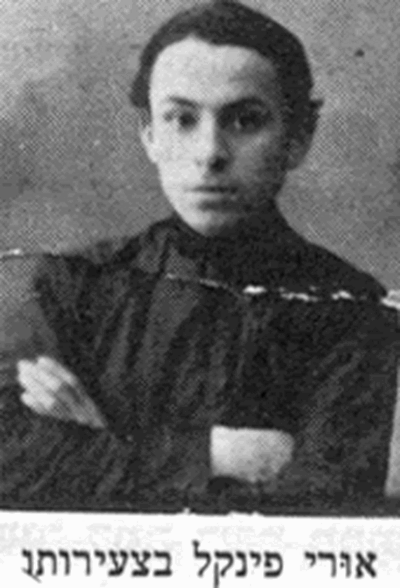

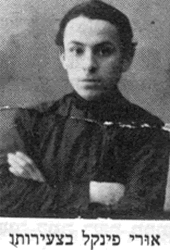
Finkel, Uri
1896–December 5, 1957
He was a literary scholar, prose author, and journalist, born in the town of Rakov (Rakaw), Minsk district, Byelorussia, to a father (Hirsh-Shloyme) who worked as a rabbi and ritual slaughterer and who dreamt that his son would become a rabbi. He received a traditional Jewish education, and until age seventeen he studied Talmud as well as general subject matter. In 1916 he was studying in a polytechnic school in Kharkov, later at the University of Minsk in the department of linguistics, and he remained separated for many years from his family, for in 1920 his hometown was annexed into Poland, while he was in Minsk, and he was for this reason unable to contact his family. It was even impossible for him to write to his parents, because it was forbidden to have ties to “bourgeois abroad.”
He began his literary work with an article entitled “Di Revolutsye un di Yidishe Literatur” (The Revolution and Yiddish Literature) which appeared in the collection Kunst-Ring (Art Circle) (Kharkov) 2 (1918). That same year he contributed to the journal Narodnoie Delo (People’s Affairs), run by the bibliographic division.
During the Soviet Civil War, he volunteered to fight at the front. Commissioned by the political administration, he organized a Yiddish propaganda organ, Okna Rosta (Window for ROSTA [Russian Telegraphic Agency]); and in 1920 he edited (together with H. Botvinik) the only Red Army daily newspaper in Yiddish, Di Komune (The Commune) in Minsk. Together with Nokhum Oyslender, he compiled the volume Avrom Goldfadn, Materyaln far a Byografye (Avrom Goldfaden, Materials for a Biography) (Minsk: Institute for Byelorussian Culture, 1936), 104 pp. The authors systematized in the book all the materials on the life and activities of the founder of the Yiddish theater and made use of a series of new material, striving mainly to elucidate the period of Goldfaden’s activities until 1883—namely, until Yiddish theater was banned in Russia.
He published a second work, “Di Sotsyale Figurn in Goldfadens Verk” (The Social Figures in Goldfaden’s Work), in Tsaytshrift (Periodical) (Minsk) 1 (1927).
In 1927 he was appointed as a research student to the department of literature in the Byelorussian Academy of Sciences in Minsk. The previous year he became a regular contributor to the Minsk-based Der Veker (The Awakener), and later to Oktyabr (October), in which among other items he published articles on Sholem-Aleichem, Hersh-Dovid. Nomberg, Bal-Makhshoves, and Y. L. Perets, as well as Russian authors.
In June 1941 Finkel, his wife, and their son and younger daughter were all evacuated from Minsk, while his two older daughters, who had traveled to Rakaw just before the war broke out to visit their grandfather, were immolated in the town synagogue on February 23, 1942 together with all the other Rakaw Jews. When Nazi Germany invaded Soviet Russia, for a time Finkel lived in Samarkand, Uzbekistan, but he soon volunteered to serve in the Soviet Army. In 1946 he received an award “for valorous work in the war years.”
He also published articles in Moscow’s Eynikeyt (Unity). He was able to preserve the Jewish community records of Rakaw (1810-1913), which his father rescued from destruction and which are now housed in the State of Israel.
He died in Minsk.
Original works in book form:
Mendele moykher-sforim, kindheyt un yugnt (Mendele Moykher-Sforim, childhood and youth), part 1 (Minsk: Byelorussian State Publishers, 1937), 220 pp., second improved edition (Minsk: Byelorussian State Publishers, 1939), 203 pp., third edition (Moscow: Emes, 1948), 152 pp.;
Sholem-aleykhem (Sholem-Aleichem) (Moscow: Emes, 1939), 308 pp., second edition (Warsaw: Yidish Bukh, 1959), 332 pp.
— both of these works were also translated into Russian and Byelorussian and aroused considerable interest.
Translations in book form:
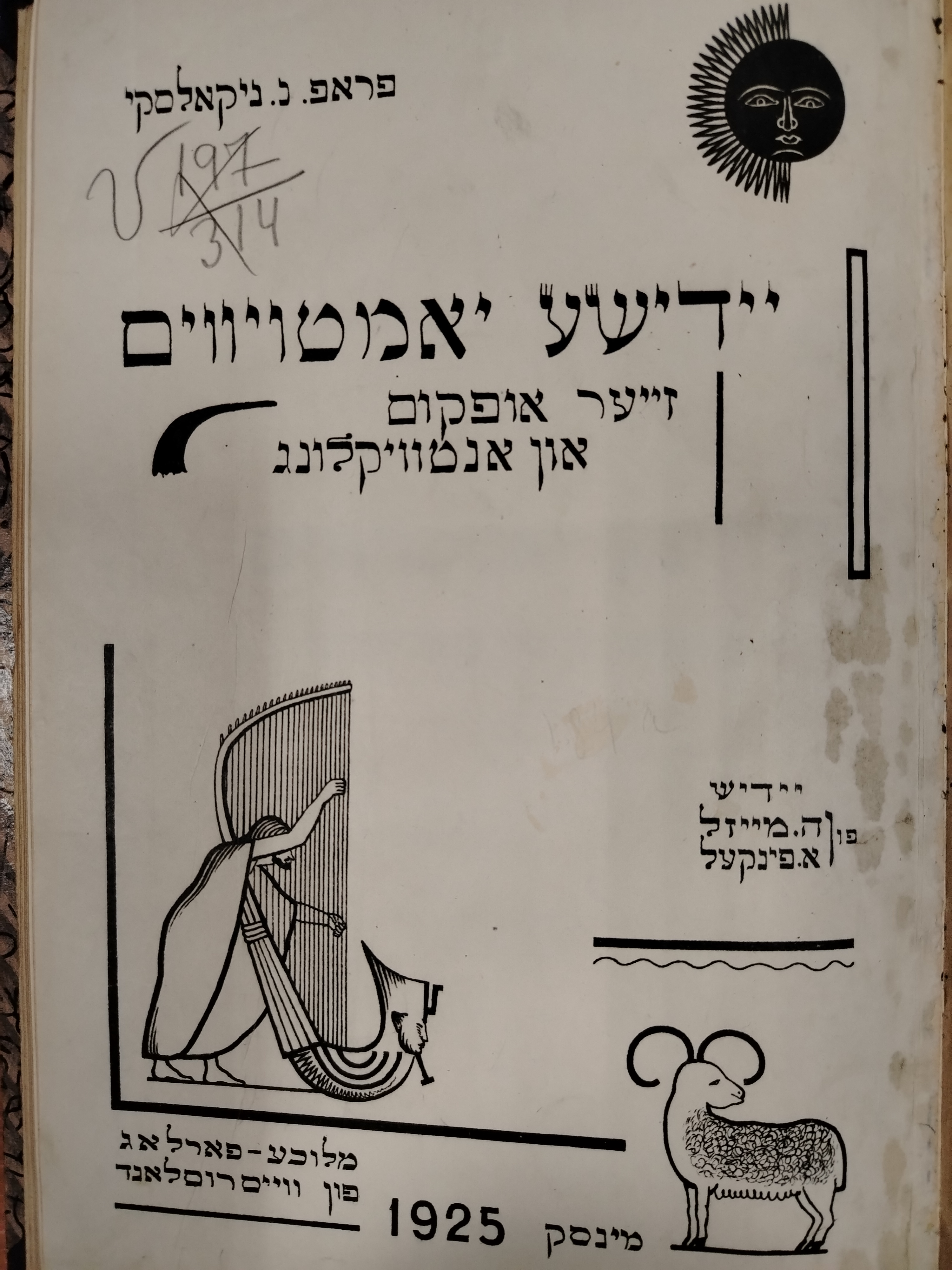
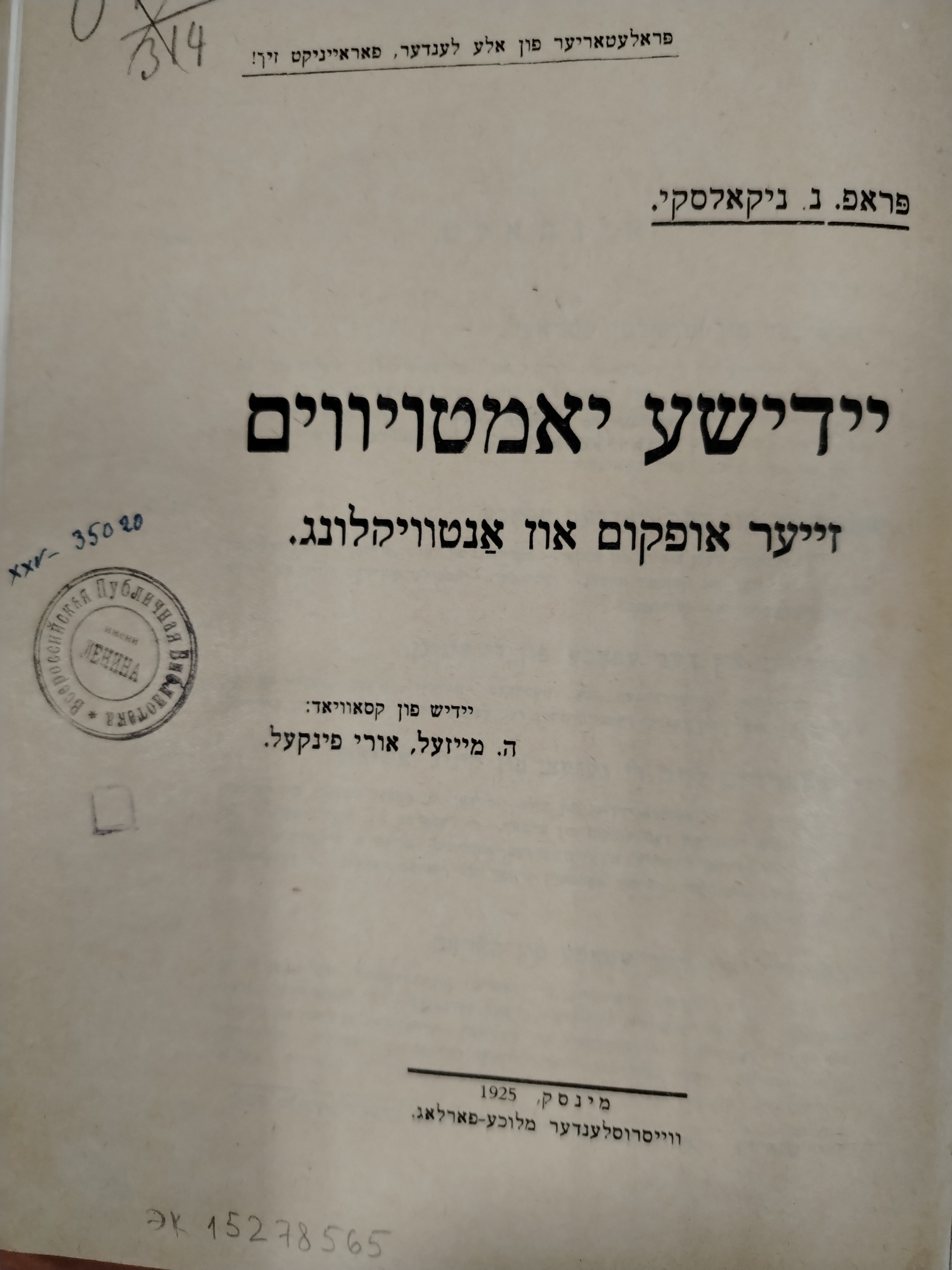
N. M. Nikol'skii, Yidishe Yontoyvim, Zeyer Oyfkum un Antviklung (Jewish Holidays, Their Origin and Development), with H. Mayzel (Minsk: Byelorussian State Pubishers, 1925), 254 pp.;

N. M. Nikol'skii, Geshikhte, di Farklasndike Gezelshaft der Uralter Mizrekh di Antike Velt, Lernbukh far der Mitl-Shul 5ter Lernyor (History, Pre-Class Society of the Ancient East in the Ancient World, Textbook for the Fifth School Year of Middle School [original: Istoriia Doklassovoe Obshchestvo Drevnii Vostok Antichnyi Mir, Uchebnik Dlia Srednei Shkoly 5-I God Obucheniia]) (Moscow: Emes, 1934), 249 pp.
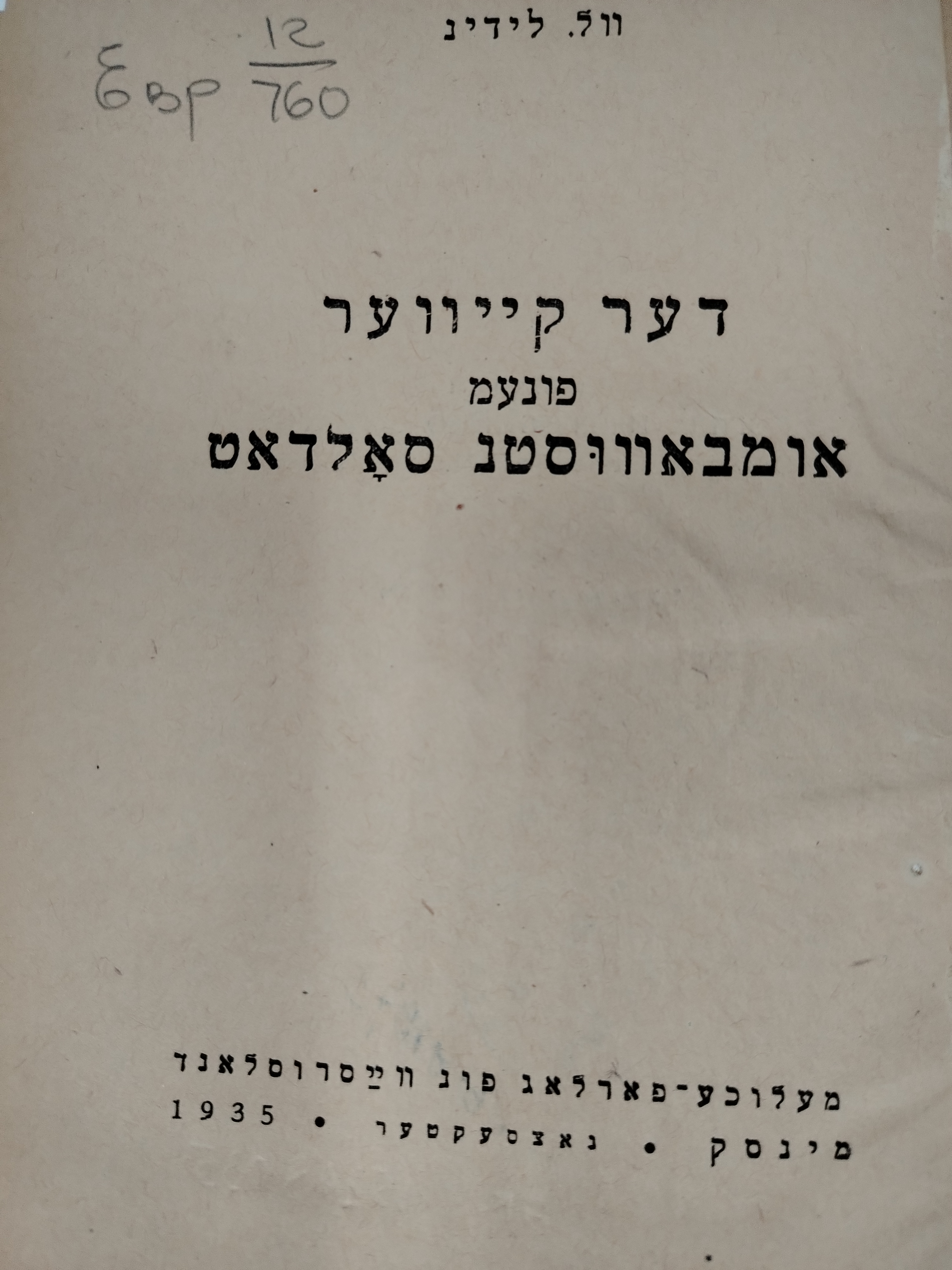
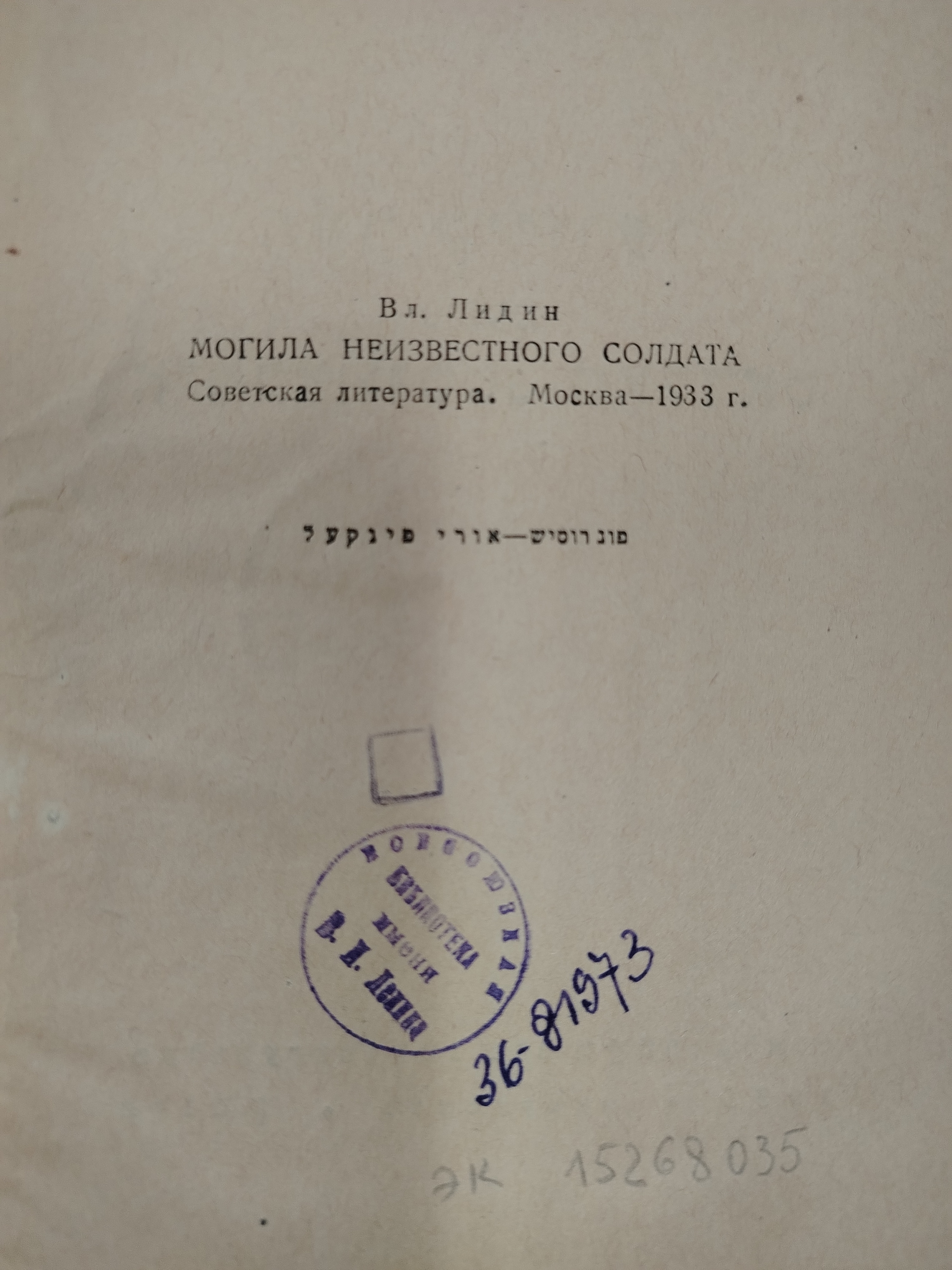
Der Keyver funem Umbavustn Soldat (The Grave of the Unknown Soldier) by Vl. Lidin, originally in Russian (Minsk: Melukhe Farlag fun Vaysrusland, 1935).

Sources: Zalmen Reyzen, Leksikon, vol. 3; Y. Shatski, Arkhiv tsu der Geshikhte fun Yidishn Teater un Drame (Archive for the History of Yiddish Theater and Drama) (Vilna-New York, 1930); Y. Bronshteyn, in Tsaytshrift (Minsk) 5 (1931); A. Gurshteyn, in Forpost (Birobidzhan) 2 (1937); B. Slutski, in Sovetishe Literatur (Kiev) (September 1940); Elye (Elias) Shulman, in Veker (New York) (November 1955); Y. Katsenelson, in Morgn-Frayhayt (New York) (March 11, 1956); obituary notice in Folksshtime (Warsaw) (December 24, 1957); Chone Shmeruk, comp., Pirsumim yehudiim babrit-hamoatsot, 1917-1961 (Jewish Publications in the Soviet Union, 1917-1961) (Jerusalem, 1962), see index; Sh. Belis, Portretn un Problemen (Portraits and Problems) (Warsaw, 1964); Yefim Yeshurin, 100 Yor Moderne Yidishe Literatur, Biblyografisher Tsushteyer (100 Years of Modern Yiddish Literature, Bibliographical Contribution) (New York, 1966), p. 192.
There were 2 editions of Geshikhte, di farklasndike gezelshaft, der uralter mizrekh, di antike velt : lernbukh far der mitlshul 5-ter lernyor / Akad. N.M. Nikolski ; red. - M. Litvakov ; ibergezetst - U. Finkel.- Moskve: Farlag Emes.
1933.- 263, [5] pp., ill., maps, tab.
Tsveyte oysgebeserte uflage:
1934.- 249, [6] pp., ill., maps, tab.
Uri Finkel contributed to the collection of articles devoted to "Izi Kharik: tsu zayn 15-yorikn dikhterishn veg/ redakter - Sh. (S.) Agurski".- Minsk: farlag fun der Vaysrusisher visnshaft-akademye, 1936.- 136 [3] pp., portr.
איזי כאריק :צו זײנ 15-יאריקנ דיכטערישנ װעג/ רעדאקטער - ש.( ס.) אגורסקי
Uri Finkel wrote about Izi Kharik's first poem "Mir un Zey" (We and they).
"מיר אונ זײ"
אורי פינקעל
Uri Finkel translated from Russian into Yiddish Vl. Lidin's roman Der keyver funem umbavustn soldat (orig.: Могила неизвестного солдата = The Tomb of the Unknown Soldier). - Minsk: Melukhe-farlag fun Vaysrusland. Natssekter, 1935.- 261, [1] pp.
דער קײװער פונעמ אומבאװוסטנ סאלדאט
װל. לידינ ; פונ רוסיש - אורי פינקעל
Author : Лидин, Владимир Германович (1894-1979). real name - Gomberg