
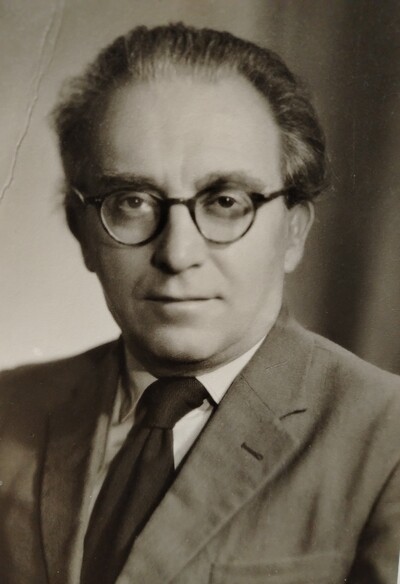
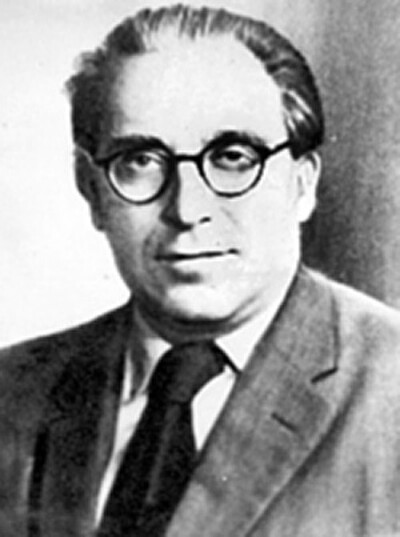
Kahan, Avrom
January 9, 1901–December 12, 1965
He was a prose writer, poet, and playwright, born in Berdichev into a Hassidic family. He studied in religious elementary school and later graduated from a Jewish crown school and at age nineteen from a business school. He went on to study at Kiev University. Until 1925 he was a teacher in Jewish schools in Berdichev and Kharkov. For a certain period of time, he worked with a wandering Yiddish theatrical troupe.
He debuted in print in 1921 with poetry in Komunistishe Fon (Communist Banner) in Kiev, and in subsequent years he primarily wrote prose. His first collection, Karbn (Nicks), was published in 1923 by “Vidervuks” (New Growth), a group of young Yiddish poets of which he was a member. His first long story appeared in print in 1927.
In later years he was one of the most productive authors of Soviet Yiddish literature, primarily of prose work and dramas, as well as poems, stories, novels, essays, and translations from Russian and Ukrainian poets in: Di Royte Velt (The Red World), the anthology Ukraine (Ukraine), Kharkov’s Stern (Star), Minsk’s Tsaytshrift (Periodical) on Y. M. Lifshits, Yunger Boy-Klang (Young Sound of Construction) in Kharkov, Almanakh (Almanac) on Soviet Yiddish writers (1934), Farmest (Competition), Heymland (Homeland) (1934, 1948); Prolit (Proletarian literature), Sovetishe Literatur (Soviet Literature), and Atake, Almanakh fun Roytarmeyishn Landshuts-Literatur (Attack, Almanac of the Red Army’s National Defense Literature) (Moscow-Kharkov-Minsk: Byelorussian State Publishers, 1931).
He evinced a marked interest in the genre of the historical novel and biographies. He was one of the first writers of historical novels in Soviet Yiddish literature—such as
Arn Liberman (Arn Liberman),
Bam Taykh Gnilopyatke (By the Gnilopyatke River),
Sholem-Aleykhem (Sholem-Aleichem), and
Farbrekhn un Gevisn (Crime and Conscience).
Sovetish Heymland (Soviet Homeland) published Kahan’s stories and two of his novels in installments: Farbrekhn un Gevisn, about the Beilis trial, issues 9-11 (1965); and Sholem-Aleykhem, issues 1-2 (1974).
His work also appeared in: Froyen, Literarishe Zamlung (Women, Literary Collection) (Moscow: Central Publishers, 1928); Shlakhtn (Battles) in Kharkov (1932); Tsum Zig (To Victory) (1944); Dertseylungen fun Yidishe Sovetishe Shrayber (Stories by Soviet Yiddish Writers) (Moscow: Sovetski Pisatel, 1969).
He edited: Komyugishe Zamlung (Communist Youth Anthology) (Kharkov: State Publishers, 1926). Co-edited: Yunger Shlogler (Young Shock Troop) (Kharkov: People’s Commissariat for Education, 1931-1932); and Onheyb (Beginning) (Kiev: Ukrainian State Publishers for National Minorities, 1940).
He wrote down the texts for the songs in Avrom Goldfaden’s Tsvey Kunilemels (The two Kunilemels) for the Yiddish State Theater of Ukraine (late 1925).
He served in the Red Army during WWII, published work in Eynikeyt (Unity) at that time, and received a medal for heroism. Over the years 1945-1948, he was its special correspondent in Kiev.
In 1949, he was purged, arrested along with other Yiddish writers, and deported to a camp. After being “rehabilitated” (i.e., exonerated) and freed from the Gulag in 1956, he returned and settled in Kiev, where he published his memoirs and other material in the newspaper Folks-Shtime (Voice of the People) in Warsaw, and later in Sovetish Heymland.
He died in Kiev.
According to Yisroel Serebriani, Kahan describes “the problems of the Soviet way of life, of the new Soviet man,…socialist reconstruction, and at the same time the historical themes therein…. He was one of the first writers of the historical novel in Soviet Yiddish literature…. He possesses a rich, colorful Volhynian language. His style is light, rhythmic, and singing. He often gives a flash of irony and humor.” In the words of Khayim Loytsker, Kahan’s “work is in character…realistic…. His aspiration maximally to reach a depiction of an authentic, necessary, synthetic, artistic assortment brings the writer at times to naturalistic photography. Kahan is a master of the ordinary detail. Nor is he bad at painting portraits, and all this makes the descriptions in his best writings vivid and colorful.”
His works include:
Karbn, 1921-1923 (Nicks, 1921-1923), poetry (Kiev: Vidervuks, 1923), 32 pp.;
Mentshn fun Alker, Dertseylung (People in an Alcove, a Story) (Moscow: Central Publishers, 1927), 112 pp.;
A Khazer, Novele (A Pig, a Novella) (Kharkov: Gezkult, 1928), 30 pp.;
Brokhshtiker (Fractured Pieces), Stories (Kharkov: Central Publishers, 1930), 216 pp.;
Khalemendritshkes Durkhfal (Khalemendritshke’s Failure) (Moscow: Central Publishers, 1931), 20 pp.;
Avangard (Avant-Garde), a story (Moscow: Central Publishers., 1931), 51 pp.;
Inzhenern, Roman (Engineers, a Novel) (Kharkov-Kiev: Ukrainian State Publishers for National Minorities, 1932), 242 pp.;
Energye (Energy), a play (Kharkov-Kiev, 1933), 80 pp.;
Dertseylungen (Stories) (Kharkov: Literatur un kunst, 1934), 172 pp.;
Tripolye, Poeme (Tripoli, a Poem) (Kharkov: Molodoi Bolshevik, 1934), 47 pp.;
Arn Liberman, Historisher Roman (Arn Liberman, a Historical Novel), vol. 1 (Kiev-Kharkov: State Literary Publishers, 1935), 254 pp., for political reasons it was left unfinished;
Di Goldene Rote, Epizodn fun an Amolikn Shul-Lebn (The Golden Company, Episodes from School Life of Bygone Times) (Kiev: Ukrainian State Publishers for National Minorities, 1935), 122 pp.;
Dos Beste Hitl (The Best Cap), a story (Kharkov-Odessa: Children’s Publishers, 1937), 32 pp.;
Bam Taykh Gnilopyatke, an Epizod fun Mendele Moykher-Sforims Lebn (By the Gnilopyatke River, an Episode from the Life of Mendele Moykher-Sforim) (Kiev: Ukrainian State Publishers for National Minorities, 1937), 193 pp., new edition (Kiev: Ukrainian State Publishers for National Minorities, 1940), 140 pp.;
Eygene un Noente, Geshikhtes un Noveles (One’s Own and Close By, Stories and Novellas) (Kiev: Ukrainian State Publishers for National Minorities, 1939), 284 pp.;
Tsvey Dertseylungen (Two Stories) (Kiev: Ukrainian State Publishers for National Minorities, 1939), 20 pp.;
Mayses far Kinder (Stories for Children) (Kiev: Ukrainian State Publishers for National Minorities, 1939), 28 pp.;
Af Undzer Erd, Roman (On Our Ground, a Novel) (Moscow: Emes, 1944), 135 pp.
His play Der Broder Zinger (The Broder Singers) was dedicated to the folk poet Berl Broder, published in Sovetish Heymland 3 (1973), and staged after his death by the Yiddish Folk Theater.
His translations include:
Petro Panch, Mukhe Makar (Mukha Makar) (Kharkov: Ukrainian State Publishers for National Minorities, 1932), 28 pp.; and
Semen Skliarenko, Mikola Shtshors (Mikola Shchors) (Kiev: Ukrainian State Publishers for National Minorities, 1940), 549 pp.; among others.
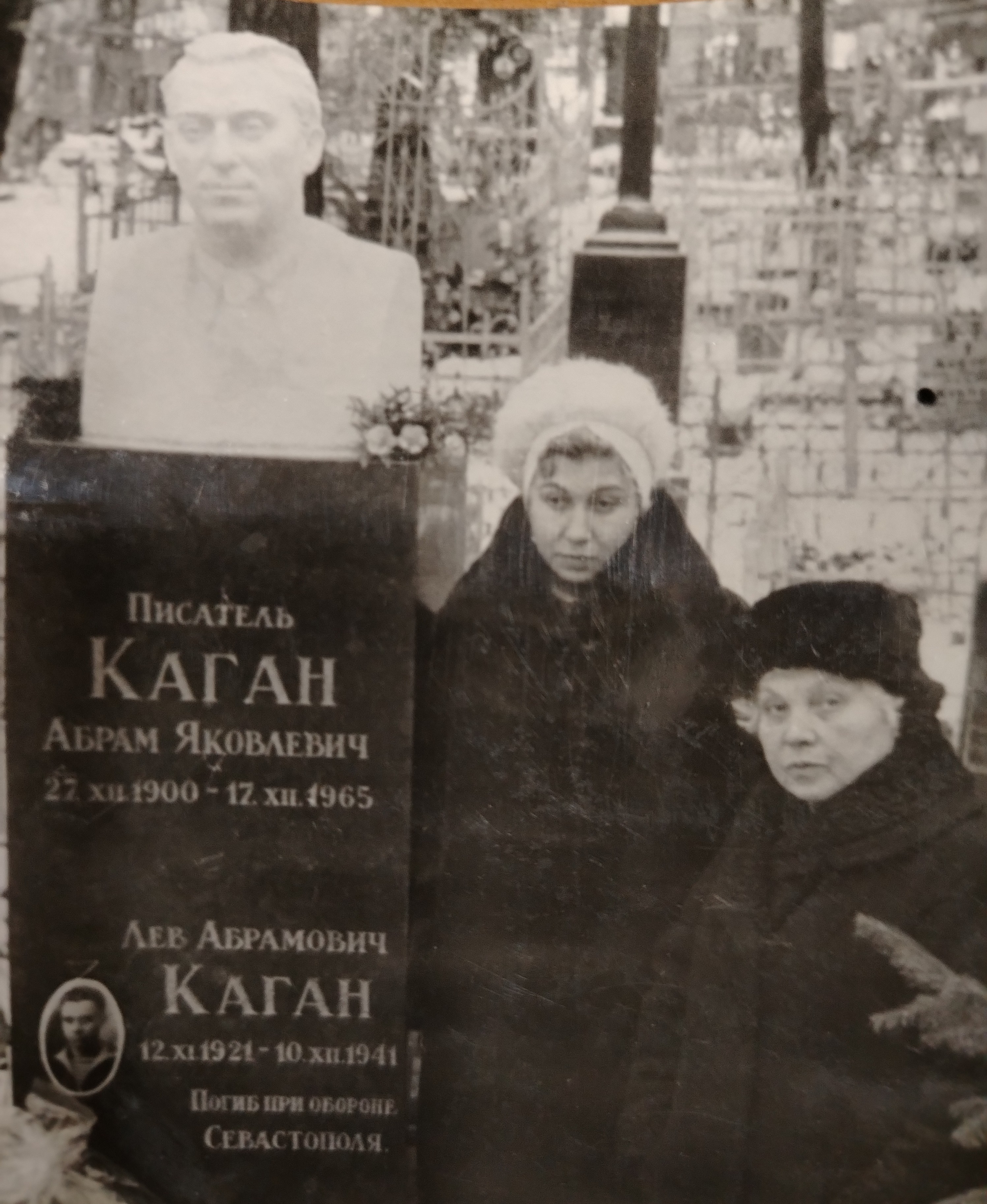
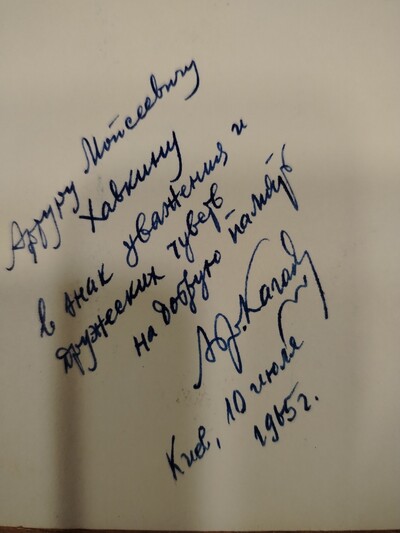
Image courtesy of the library of Knizhniki printing house, Moscow, from the archive of Artur Khavkin.
Sources: Zalmen Reyzen, Leksikon, vol. 3; Chone Shmeruk, comp., Pirsumim yehudiim babrit-hamoatsot, 1917-1961 (Jewish Publications in the Soviet Union, 1917-1961) (Jerusalem, 1962), see index; Shmuel Niger, in Tsukunft (New York) (February 1930); Khatskl Dunets, Far marksistisher historiyografye (For Marxist historiography) (Minsk: Byelorussian Academy of Sciences, 1932), p. 44; I. Fefer, in Morgn Frayhayt (New York) (April 25, 1932); Oyzer Holdes, in Farmest (Kharkov) (April 1933); Avrom Yuditski, in Literarishe Bleter (Warsaw) (October 2, 1936); Moyshe Notovitsh, in Eynikeyt (Moscow) (March 24, 1945); Yisroel Serebriani, in Folks Shtime (Warsaw) (January 1, 1960); A. Pomerants, Di Sovetishe Haruge Malkhes, Tsu Zeyer 10-Tn Yortsayt, vegn dem Tragishn Goyrl fun di Yidishe Shraybers un der Yidisher Literatur in Sovetnland (The [Jewish writers] Murdered by the Soviet Government, on Their Tenth Anniversary of Their Deaths, Concerning the Tragic Fate of the Yiddish Writers and Yiddish Literature in the Soviet Union) (Buenos Aires: YIVO, 1962), pp. 421-23; Khayim Loytsker, in Sovetish Heymland (Moscow) 4 (1966), 11 (1972); Y. Lifshits and M. Altshuler, comps., Briv fun Yidishe Sovetishe Shraybers (Letters of Soviet Jewish Writers) (Jerusalem, 1979/1980), pp. 415-44.
Avrom Kahan translated from Russian into Yiddish M. Gorki's Der zeyde Arkhip un Lionke (orig.: Дед Архип и Лёнька = The grandfather Arkhip and Lyon'ka).- Kiev : Melukhe farlag far di natsionale minderhaytn in USSR, 1937.- 42, [1] pp.
דער זיידע ארכיפ אונ ליאנקע
מאקסימ גארקי ; יידיש - אװראמ קאהאנ
Avrom Kahan translated from Russian into Yiddish V. Korolenko's Der blinder muzikant (orig.: Слепой музыкант = The blind musician).- Kiev : Melukhe farlag far di natsionale minderhaytn in USSR, 1938.- 205, [2] pp.
דער בלינדער מוזיקאנט
װ. קאראלענקא ; יידיש - אװראמ קאהאנ
Avrom Kahan translated from Russian into Yiddish biographical notes about Sergey Mironovitsh Kirov, a prominent Communist party member short in 1934. Kirov (orig. : Киров).- Kharkov : Kinder-farlag bam Ts.K. L.K.Yu.F.U., 1935 - 132, [4] pp.- ill.
קיראװ
איבערגעזעצט - אװראמ קאהאנ ; צײכענונגענ אונ הילע פונ קינסטלער- א. דאװגאל
Kirov
ibergezetst - Avrom Kahan ; tsaykhenungen un hile fun kinstler A. Dovgal
This book includes poetry devoted to S.M. Kirov.
Among Yiddish poets are : Moyshe Khashtshevatski, Khane Levina.
Among Russian poets are : Viktor Gusev, Aleksandr Bez'imenski, Mikhail Svetlov.
Ukranian poet Pavlo Titshina
Avrom Kahan translated from Russian to Yiddish Arkady Gaidar's A militerisher sod (Военная тайна).- Kharkov; Odes : Kinder-farlag bam Ts.K. L.K.Yu.F.U., 1936. - 109, [1] pp.
א מיליטערישער סאד
ארקאדי גײדאר; יידיש - אװראמ קאהאנ; צײכענונגענ פונ װ. ניעװסקי