
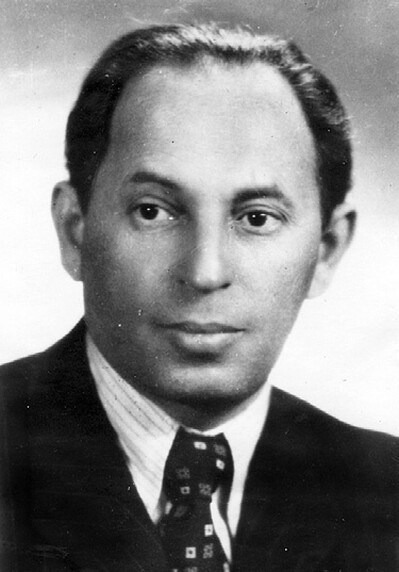
Kotlyar, Yoysef
April 12, 1908–September 16, 1962
He was a poet, born in Berdichev. He studied in religious elementary school and later in a Soviet Jewish school and in a technical teaching institution, and he graduated from the Jewish division of the Pedagogical Institute in Kharkov where he had moved with his family—after graduating from a school for mechanics and a polytechnic. Until 1941 he lived in Kharkov and from 1945 in Vilna.
When he was a student in the first years of school, he wrote stories, short plays, and numerous poems, many of them for children. In the late 1920s he began working in the editorial office of the Kharkov newspaper Zay Greyt (Get Ready), as well as for the Ukrainian State Publishers.
He published his first poems in Di Vokh (The Week) in Berdichev in the 1930s. He went on to contribute work to: Yunge Gvardye (Young Guard), Yunger Boy-Klang (Young Sound of Construction), Royte Velt (Red World), Prolit (Proletarian Literature), Farmest (Competition), Sovetishe Literatur (Soviet Literature), and Warsaw’s Folks-Shtime (Voice of the People) (in 1962, a joyful story about Mars, published serially), among others.
His work also appeared in such almanacs and anthologies as: Shlakhtn (Battles) (Kharkov-Kiev: Ukrainian State Publishers for National Minorities, 1932), Litkomyug (Literary Communist youth) (Kharkov-Kiev: Ukrainian State Publishers for National Minorities, 1933), Deklamator fun der Sovetisher Yidisher Literatur (Declaimer of Soviet Yiddish Literature) (Moscow: Emes, 1934), Zay Greyt (Kharkov, 1934), Komsomolye (Communist Youth League) (Kiev, 1938), Tsum Zig (To Victory) (Moscow: Emes, 1944), and Di Froy in der Yidisher Poezye (Women in Yiddish Poetry), ed. Shmuel Rozhanski (Buenos Aires: Yoysef Lifshits Fund, 1966).
He was an estimable lyricist, and as such a master of sonorous verse, and this afforded considerable merit to his work. He accomplished much in the field of literature for children. Of over twenty collections which he published, almost half were aimed at readers of preschool and school age. Many of his writings were in the prewar years selected for textbooks and school readers, as well as a collection of variety-theater scenes, and they would often ring out from the stage of young people’s clubs. A series of his poetic writings were published in translation into Ukrainian, Lithuanian, and Russian. Well-known Yiddish singers in Soviet Russia performed his songs. He died in Vilna, where he had settled after the war and was writing works for concert programs.
His own works include:
Likhtike Geboyrn, Lider far di Yorn 1926-1930 (Brilliant Birth, Poetry for the Years 1926-1930), (Kharkov: Literatur un kunst, 1930), 147 pp.;
Entuzyastn, 1929-1931 Yorn (Enthusiasts, 1929-1931), poetry (Kharkov: Literatur un Kunst, 1932), 159 pp.;
Kinder fun Mayn Land, 1927-1932 (Children from My Country, 1927-1932), poetry (Kiev-Kharkov: Ukrainian State Publishers for National Minorities, 1934), 184 pp.;
Glentsndiker Veter (Splendid Weather), poetry (Kharkov: State Literary Publishers, 1935), 230 pp.;
Ay, a Gortn (Oh, a Garden) (Kharkov-Odessa: Kinder farlag, 1935), 12 pp.;
Zumer-Lider (Summer Poetry) (Kharkov: Ukrainian State Publishers for National Minorities, 1935), 23 pp.;
Pyonerishe Lider-Zamlung Mit Notn (Poetry Collection for Pioneers with Notes), lyrics by Kotlyar, music by Zagranichny (Kharkov: Kinder farlag, 1937), 88 pp.;
Af der Freylekher Gas, Lider un Mayses (On a Happy Street, Poems and Stories) (Kiev: Ukrainian State Publishers for National Minorities, 1938), 123 pp.;
Der Shtekhler, Maysele in Ferzn far Kinder (The Hedgehog, a Story in Verse for Children) (Odessa: Kinder-farlag, 1938), 12 pp.;
Mayn Velt, Lider, Mesholim, Mayselekh far Kinder (My World, Poems, Fables, Stories for Children) (Kiev, 1939), 192 pp. (Tel Aviv rpt.: Perets Publ., 1993), 265 pp.;
Af Azoyne Hozn Kon Men Zikh Farlozn (You Can Depend on Hares Like That) (Odessa: Kinder Farlag, 1939), 11 pp.;
Lider-Mayselekh (Poems-Stories) (Kiev, 1940), 58 pp.;
Far Kind un Keyt (For Kith and Kin) (Kiev-Lvov: Ukrainian State Publishers for National Minorities, 1940), 127 pp.;
Oysgeleyzte Erd, Lider (Earth Redeemed, Poetry) (Moscow: Emes, 1948), 144 pp.
In B. Riskind’s Tsen Lider (Ten Songs) (Kharkov: Central Publishers, 1927), the lyrics to Riskind’s songs are those of Kotlyar.
Kotlyar’s wife and two daughters were last living in Israel (1981).
“Y. Kotlyar emerged in literature,” wrote Avrom Gontar, “when with a refined poetic language our great pleiade spoke—Hofshteyn, Markish, Fefer, Kharik, and many others, and then his voice…became a voice of a soloist in poetry.”
“Kotlyar’s poetry,” noted Yoysef Kerler, “knew of no discrepancies between form and content. He was profound and clear…. [Although] economic in his artistic methods,…he [was] capable of affecting and emotionally shocking the reader and listener.”
Sources: Chone Shmeruk, comp., Pirsumim yehudiim babrit-hamoatsot, 1917-1961 (Jewish Publications in the Soviet Union, 1917-1961) (Jerusalem, 1961), see index; Shmuel Niger, in Tsukunft (New York) (February 1930); A. Vevyorke, Der Stil fun der Proletarisher Literatur (The Style of Proletarian Literature) (Kharkov, 1932), p. 17; V. Druker, in Farmest (Kharkov) (October 1933); H. Bloshteyn, in Sovetishe Literatur (Kiev) (August 1939); Sh. Kupershmid, in Sovetishe Literatur (November-December 1940); A. Gontar, in Sovetish Heymland (Moscow) 2 (1968); M. Altshuler, Yahadut berit-hamoatsot baaspaklarya shel itonut yidish bepolin, bibliyografya 1945-1970 (The Jews of the Soviet Union from the Perspective of the Yiddish Press in Poland, Bibliography) (Jerusalem, 1975), p. 158.