
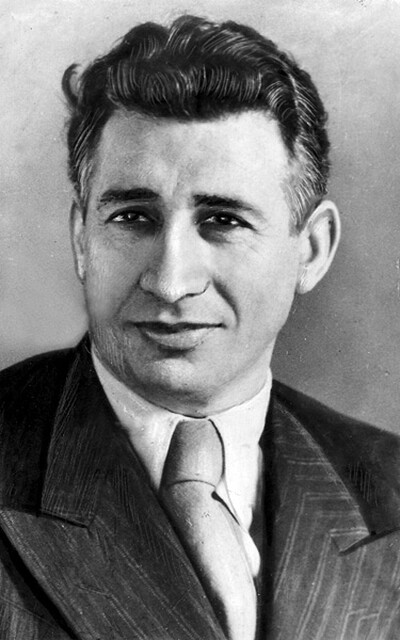
Katsovitsh, Leyzer
October 5, 1903–June 13, 1953
A poet, prose author, and playwright, he was born in Minsk into the family of an office employee. He engaged in a variety of labors—in a store as a delivery boy and as in a courier in a bank after the Russian Revolution; and for a short time was also an actor and assistant director with a wandering troupe in Byelorussia. In 1927 he graduated from a technical school for printshop workers in Minsk and until 1931 worked as an engraver and lithographer. A couple of years later he joined the Communist Party. In 1939 he graduated from the state institute for cinematography in Moscow and went to work in a cinema studio. During the years of WWII, he was an editor at Moscow’s All-Soviet Radio Committee.
He wrote poetry, stories, fables, and humorous sketches. He debuted in print with poetry in 1920. He published in: Naylebn (New Life) in New York; Heymland (Homeland) in 1948; and the Minsk journal Shtern (Star), and from late 1931 he was also a member of its editorial board; among others. He worked successfully as well as a playwright.
His first collection of stories appeared in 1926: Kivke der Ligner (Kivke the Liar). He demonstrated considerable talent as a humorist and author of fables. His work appeared in various collections and anthologies: Shloglerishe Trit (Traumatic Steps) (Minsk: Byelorussian State Publishers, 1932); Atake (Attack) (Minsk: Byelorussian State Publishers, 1934); Deklamater fun der Sovetisher Yidisher Literatur (Declaimer of Soviet Yiddish Literature) (Moscow: Emes, 1934); Sovetishe Vaysrusland (Soviet Byelorussia) (Minsk: Byelorussian State Publishers 1935); Tsum Zig (To Victory) (Moscow: Emes, 1944); Zinovi Kompanayets’s, Finf Lider fun Yidishe Sovetishe Dikhter (Five Songs from Soviet Yiddish Poets) (Moscow: Muzyka, 1960); and Af Naye vegn (Along New Paths) (New York: Yidisher Kultur Farband, 1949). His fables were republished several times after his death in Sovetish Heymland (Soviet Homeland) (1966-1968).
He died in Moscow.
His writings include:
Kivke der Ligner, stories for children (Minsk: State Publishers, 1926, 1936), 21 pp.;
In Yene Teg, a Pyese in Dray Aktn Mit a Prolog (In Those Days, a Play in Three Acts with a Prologue) (Minsk: State Publishers, 1927), 62 pp.;
Humoreskes (Humorous Sketches) (Minsk: State Publishers, 1933), 116 pp.;
Zhukes in Kolvirt, Eynakter (Beetles on a Collective Farm, One-Act Play) (Minsk: State Publishers, 1933), 18 pp.;
Kurts un Sharf, Humoreskes (Short and Poignant, Humorous Sketches) (Minsk: State Publishers, 1936), 113 pp.;
“Antshuldikt Mayne Fraynd” (“Pardon My Friends”), parodies of Soviet writers (Minsk: State Publishers, 1937), 64 pp.;
Di Mishpokhe (The Family), a novel (Moscow: Emes, 1946), 158 pp.;
Fun Heym tsu Heym (From Home to Home), a story (Moscow: Emes, 1946), 223 pp.
His translations include: Mikhas' Lyn'koŭ, Vegn dem Dreystn Kemfer Berele un Zayne Voyle Khaṿeyrim, a Dertseylung far Kinder (The Courageous Fighter Berele and his Fine Comrades, a Story for Children) (Minsk: State Publishers, 1938), 70 pp.
Several other books were due to come out, but they do not seem to have seen the light of day.
Sources: Chone Shmeruk, comp., Pirsumim yehudiim babrit-hamoatsot, 1917-1961 (Jewish Publications in the Soviet Union, 1917-1961) (Jerusalem, 1961), see index; F. Sito, in Shtern (Minsk) (December 1936), p. 106; A. Kushnirov, in Naye Prese (Paris) (July 27, 1945); D. Begelson, in Eynikeyt (Moscow) (October 19, 1946); N. Y. Gotlib, in Keneder Adler (Montreal) (March 30, 1953); Sovetish Heymland (Moscow) 7 (1968); Yeshurin archive, YIVO (New York).