

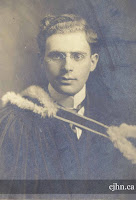
Robak, Avrom-Arn
June 19, 1890–June 5, 1965
He was born in Gnyondz (Goniądz), Bialystok district. He moved with his parents in 1892 to Montreal. He attended a secular school, a Talmud Torah, and had private tutors. He graduated in psychology and philosophy in 1913 from McGill University and in 1917 received his doctoral degree from Harvard University, where he was a lecturer in psychology for a time.
Over the years 1926-1949, he was linked to the Education Department of Massachusetts, and he was professor of psychology (1949-1958) at Emerson College in Boston.
His literary activity began in English around 1907. He contributed to Keneder Adler (Keneder Odler, Canadian Eagle), for various newspapers in New York and the provinces, and for such serial publications as: Dos Naye Leben (The New Life), Literarishe Velt (Literary World), Literatur un Leben (Literature and Life), Dos Idishe Folk (The Jewish People), Idisher Kemfer (Jewish Fighter), Fraye Arbeter Shtime (Free Voice of Labor), and Shriftn (Writings) (vol. 8)—all in New York; Filologishe Shriftn (Philological Writings) (Vilna, 1928); Bikher-Velt (Book World) (Warsaw, 1928); and Davke (Necessarily) (Buenos Aires); among others.
He wrote mostly on Jewish cultural issues, folklore, music, humor, writers, and their works. He published studies of psychology in Dertsiungs-Entsiklopedye (Encyclopedia of Education) (New York, 1957-1959). He was the first to run a Yiddish course at a university, 1929 in Massachusetts.
He catalogued the Leo Wiener Collection at Harvard University and enriched it with new publications. He wrote a great many essays in English on Yiddish literature, such as: “The Euphemism in Yiddish,” Jewish Forum (1918); “Yiddish Influences on American Language,” in Better English; and Why Yiddish? (New York, 1958), 14 pp.
Roback had much to say about Yiddish in his English-language books:
Jewish Influence in Modern Thought (Cambridge, Mass.: Sci-Art Publishers, 1929), 506 pp.;
Curiosities of the Yiddish Language (Cambridge, Mass., 1933), 227 pp.; and
I. L. Peretz, Psychologist of Literature (Cambridge, Mass.: Sci-Art Publishers, 1935), 457 pp.
The last of these works includes Roback’s writings on Perets from the special Perets issue of Literatur un Leben (New York, 1915), Shriftn (vol. 8), and Bikher-Velt (August 1928). Also, his major work: The Story of Yiddish Literature (New York, 1940), 448 pp. Concerning this book, Shmuel Niger wrote three critical articles in Tog (Day) (October 20, October 27, and November 3, 1940), and Roback replied with a pamphlet entitled Kritik un Kritsenish (Critic and Criticism) (Cambridge, Mass.: Sci-Art Publishers, 1941), 50 pp.
Roback’s main works in Yiddish were:
Di Imperye Yidish (The Empire of Yiddish) (Mexico City, 1958), 554 pp.;
Der Folksgayst in der Yidisher Shprakh (“The Genius of the Yiddish Language”) (Paris, 1964), 705 pp.
He translated into Yiddish:
Ferdinand Lassalle, Bastya-shultse oder kapital un arbet (Bastiat-Schulze or capital and labor [original: Herr Bastiat-Schulze von Delitzsch, der ökonomische Julian, oder Kapital und Arbeit]), in Lassalle, Geklibene Shriften (Selected Writings), vol. 1 (New York, 1916).
He wrote a large number of essays and several dozen books in English on psychology, which was his main area of specialization
“Roback was a trained researcher,” noted Ezriel Naks, “a disciplined scholar, a proficient psychologist. And, while he was probing the Yiddish language in a purely philological and literary manner, there was revealed before him not only the riches and beauty of Yiddish, but he took in as a scholar…the historical, ethnic, and psychological factors that brought about the origin, boom, and development of Yiddish.”
“Both of Roback’s Yiddish books,” wrote Moyshe Shtarkman, “are filled with…interesting historical and linguistic facts concerning the Yiddish language, Yiddish literature, Jewish spirituality generally. At the same time, [they possess] the most sensible arguments…in the struggle for the existence of Yiddish and for the life of an original, creative Yiddish.”
“A. A. Roback is indeed an inestimable phenomenon,” in the words of Yudel Mark, and “…he is through and through bicultural, meaning that he succeeds at each level that we believe is an ideal for every Jewish intellectual…. The learned psychologist in him led him to psychological types in Yiddish literature. He thus became the inspired Perets aficionado and the seeker of the peculiar and even grotesque in literature and language.”
He died in Cambridge, Massachusetts.
Sources: Zalmen Reyzen, Leksikon, vol. 4; Bikher-Velt (Warsaw) 5 (1928); Y. Rapoport, in Fraye Arbeter Shtime (New York) (May 6, 1955); Shloyme Bikl, in Tog-Morgn-Zhurnal (New York) (September 29, 1957); Y. Zilberberg, in Kultur un Dertsiung (New York) (November 1958); Yidishe Shriftn (Warsaw) 196/197 (1963), p. 20; A. Leyeles, in Tog-Morgn-Zhurnal (November 15, 1964; December 13, 1964); Moyshe Shtarkman, in Fraye Arbeter Shtime (August 1, 1965); Yudel Mark, in Tsukunft (New York) (September 1965); Ezriel Naks, in Kultur un Dertsiung (October 1965); American Jewish Yearbook (1966), vol. 67, p. 540.