
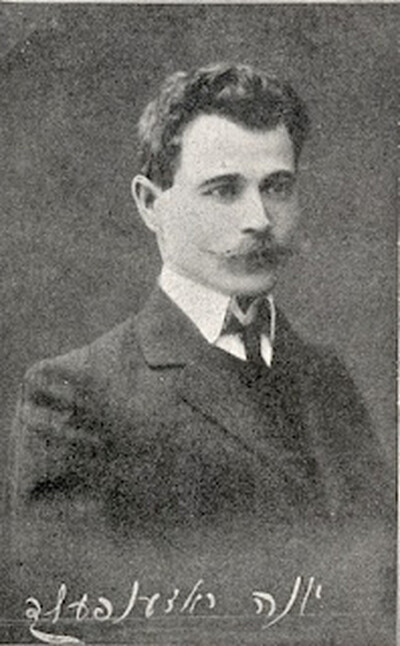
Rozenfeld, Yoyne
1880–July 9, 1944
The author of stories, novels, and plays, he was born in Tshartorisk (Staryi Chortoryis'k), Volhynia. His father was half classroom teacher and half itinerant tutor. He studied in religious elementary school until age twelve. At thirteen, both of his parents died of cholera. He had to interrupt his studies at the Pohost yeshiva and leave for Odessa, where his brothers consigned him to an apprenticeship with a turner. For ten years he worked in this trade. This entire time, he neither read nor wrote anything.
In 1902 he wrote his first two pieces and showed them to Perets who had come to Odessa at that time. From 1914 he lived in Kovel (Kovle) and Kiev, and in 1921 he emigrated to the United States, and from that point lived in New York. He was ill the last seven years of his life with cancer.
Perets brought out Rozenfeld’s first published work, “Dos Lerenyungel” (The Apprentice) in the St. Petersburg journal Fraynd (Friend)—according to N. Mayzil, this was done by Y. Kh. Rabnitski.
From 1905 he abandoned his work as a turner and devoted himself wholly to literary pursuits.
He published stories, novels, impressions, one-act plays, and dramatic sketches in: Fraynd, Literarishe Bleter (Literary Newspaper), Moment (Moment), Yidishe Velt (Jewish World), Der Shtrahl (The Beam [of Light]), Vokhnshrift far Literatur (Weekly Writing for Literature), and Teater-Velt (Theater World), among other serials; and in America, Tsukunft (Future), Veker (Awakener), Tealit (Theater-Literature), and especially Forverts (Forward) where he was for many years a regular contributor and published numerous stories and novels.
During the last six or seven years of his life, the Forverts discontinued publishing his work. The reason had to do with a major debate between Rozenfeld and the editor Ab. Cahan who argued that Rozenfeld’s stories of life in America were not at the same level as his writings about the old country. Rozenfeld held a different point of view on the quality of his final stories and did not want to adapt them to the demands of Ab. Cahan. The result was that the Forverts embraced his stories all the more, paid full honoraria for them, but did not publish them.
One of Rozenfeld’s first stories, entitled “Konkurenten” (Rivals), made a great impression and was later dramatized by the author and was produced with great success by Maurice Schwartz’s Yiddish Art Theater and on other Yiddish stages as well.
His stories appeared as well in such anthologies, almanacs, and collections as: Kunst-Ring, Literarishe-Kinstlerisher Almanakh (Art Ring, Literary-Artistic Almanac) (Kharkov: Idish, 1917); Froyen, Literarishe Zamlung (Women, Literary Collection) (Moscow: Central Publ., 1928), an anthology of works about women; Der Arbeter in der Yidisher Literatur, Literarishe Zamlung (The Worker in Yiddish Literature, Literary Collection) (Moscow-Minsk: Central Publ., 1931); Aḥisefer (New York, 1943/1944); Hermann Hakel, Jiddische Geschichten aus aller Welt (Tübingen-Basel, 1967); Max Rosenfeld, Pushcarts and Dreamers (London, 1967). Rozenfeld’s stories were also to be found in Yiddish-language textbooks, such as Dos Yidishe Vort (The Yiddish Word) (Vilna, 1913), among others.
His first novel of workers’ lives was published around 1912 in Odessa’s daily newspaper, Sholem-Aleykhem (How Do You Do). His other works would include:
Shriften (Writings) (Warsaw: Progres, 1909), 2 vols.;
In di Shmole Geslekh, Ertsehlungen (In the Narrow Alleys, Stories) (Warsaw: Velt-biblyotek, 1909/1910), 79 pp., also (B. Shimen, 1910);
Geklibene Verk (Selected Works) (Vilna: B. Kletskin, n.d.), 8 vols., second edition (1929);
Nakht un Toyt (Night and Death), novellas and stories (Warsaw: Progres, 1912), 193 pp.;
Gezamelte Shriften (Collected Writings), six vols. —
1. Tsvishen Tog un Nakht (Between Day and Night);
2. In Shotens fun Toyt (In the Shadows of Death);
3. Froyen (Women);
4. Nohente un Vayte (Near and far);
5. Ikh (I);
6. Af Grenetsen (At the Borders)—(New York: Rozenfeld-Komitet, 1924);
Er un Zey, a Togbukh fun a Gevezenem Shrayber (He and They, a Diary of a Former Writer) (New York, 1927), 268 pp.;
Eyner Aleyn, Oytobyografisher Roman in Tsvey Teylen (All Alone, Autobiographical Novel in Two Parts) (New York: N. M. Mayzil, 1940), 392 pp., translated into Hebrew by Jacob David Abramsky as Boded lenafsho (Tel Aviv: Am Oved, 1964), 228 pp.;
Geklibene Verk, with a biographical-critical introduction by Shmuel Niger (New York: CYCO, 1955), 238 pp.
Of Rozenfeld’s dramatic works, the following were published in newspapers and journals:
”Der Shvartser Shlayer” (The Black Mantle), Forverts in New York (April 23, 1922);
“Ver iz Shuldik” (Who Is Guilty), Forverts (August 26, 1923);
“Man un Vayb a Kurtse Tsayt Nokh der Khasene” (Man and Wife a Short Time After Marriage), Ilustrirte Vokh (Illustrated Week) in Warsaw 48 (1924);
“Fun Liebshaft un Has” (Of Love and Hate), a drama in one act, Tsukunft in New York (July 1925);
“Ayz” (Ice), Forverts (May 1, 1926);
“Di Tragedye fun a Farlibter Man” (The Tragedy of a Beloved Husband), Forverts (June 13-14, 1926);
a one-act play, “Bankrot” (Bankrupt) in New York, Forverts (April 24, 1927);
“Aropgenumen fun Shtrayk” (Laid Off by Strike), Forverts (July 31, 1927);
“Dos Harts Hot Gezogt” (The Heart Has Spoken), Forverts (December 1, 1929);
“Vi Azoy Unmeglikhes Iz Meglikh” (The Impossible Is Possible), Forverts (March 16, 1930);
“Hayntige Tsayten” (Contemporary Times), Forverts (April 27, 1930);
“A Farplonterte Libe” (An Entangled Love), a three-act drama, Tsukunft (January-March 1931).
”Hayntige Tsayten” and the comedy Arayngefalen (Deceived) were staged in New York and failed. Rozenfeld’s first story, “Dos Lerenyungel,” was dramatized by M. Rayzman and published in Vilna in 1938 (6 pp.).
“One of the most prominent contributors to Yiddish literature,” wrote Zalmen Reyzen, “Rozenfeld had already in his first, often utterly clumsy, stories demonstrated the distinctive inclination of his original talent as a portrayer of the mutilated soul, and already in his first works the sharpness of his psychological analysis is evident. He was the first to cultivate in Yiddish literature the depiction of bizarre, morbid, pathological phenomena of psychic life.”
“Intellectualism, consciousness, prudence,” noted Shmuel Niger,” —this is the keenest reason behind his writing, just as the opposite—the wild, incomprehensible, and subconscious—are his main themes…. It is rare among writers who come from the people and derive everything from themselves to find such richness of thinking life and such poignance of intellect. He is [internally] a man of truly fine intellectual culture…. Initially, one only sensed this in content, not in the style, of his writings, and there was often a discrepancy between the finely nuanced ideas and feelings that he described, and the primitiveness and unevenness of his manner, how he depicts them. This discrepancy becomes weaker and weaker, as his style and his language tighten with a membrane of intellectuality and thoughtfulness.”
In the words of Gershon Sapozhnikov: “Yoyne Rozenfeld is not an external describer of the surrounding reality. He comprehends life actively, hotly, passionately. He cries out from his artistic visions with an incisive fury against social injustice, against economic need, against the meanness of men…. His style is thus densely charged with emotional material, dynamically, dramatically taut…. Rozenfeld created no general types of characters,….only general psychological tendencies, like human loneliness which he evinced in all of his figures. He did not model any ideas, but he did model and artistically gave form to people’s senses. He outfitted the psychic complexes of living figures.”
As Y. Varshavski (Yitskhok Bashevis) put it: “He was always looking for the motives behind the motives, the instinct behind reason. One more thing, Yoyne Rozenfeld’s psychology was not objective, as with Freud or Adler, but always had an ethical background. His realm was good and bad, the evil inclination and the good inclination. He showed man in his perpetual wrestling between unconscientious egotism and the will to rise above it…. Yoyne Rozenfeld was not appreciated by Jewish critics. I believe that people will someday discover Rozenfeld, and it will be the work of a younger generation that will ignore earlier settling of scores and falsehoods. They will discover that the ostensibly primitive man was a writer of refinement and one of our best.”
He died in New York.
Sources: Zalmen Reyzen, Leksikon, vol. 4; Zalmen Zilbertsvayg, Leksikon fun Yidishn Teater (Lexicon of the Yiddish Theater), vol. 4 (New York, 1963); Nakhmen Mayzil, Forgeyer un Mittsaytler (Forerunner and Contemporary) (New York, 1946), pp. 275-88; B. Rivkin, Undzere Prozaiker (Our Prose Writers) (New York, 1951), pp. 140-56; Hillel Rogof, Der Gayst fun Forverts (The Spirit of the Forverts) (New York, 1954), pp. 72-73; A. Mukdoni, In Varshe un in Lodzh (In Warsaw and in Lodz), vol. 1 (Buenos Aires, 1955); L. Kussman, Amanim uvonim (Artists and Sons) (Tel Aviv, 1955), pp. 57-60; Gershon Sapozhnikov, Fun di Tifenishn, Eseyen (From the Depths, Essays) (Buenos Aires, 1958), pp. 51-123; Zishe Vaynper, Shrayber un Kinstler (Writer and Artist) (New York, 1958), pp. 214-21; Shimen-Dovid Zinger, Dikhter un Prozaiker, Eseyen vegn Shrayber un Bikher (Poets and Prose Writers, Essays on Writers and Books) (New York: Educational Dept. of Workmen’s Circle, 1959); Leyvik Khanukov, Literarishe Eseyen (Literary Essays) (New York: IKUF, 1960), pp. 47-50; Moyshe Kats Bukh (Volume for Moyshe Kats) (New York, 1963), pp. 228-31; Y. Varshavshi (Yitskhok Bashevis), in Forverts (New York) (July 5, 1964); B. Grin, in Morgn Frayhayt (New York) (March 16, 1980); Yeshurin archive, YIVO (New York).
Yoyne Rozenfeld contributed to literary collection Shvalben (Swallows)/ redagirt durkh Z.-Z. Shneur.- Varsha, 1909.- 30 pp.
שװאלבען
רעדאגירט דורך ז.-ז. שניאור
There was a separate edition of Yoyne Rozenfeld's Froyen: Ertsehlungen un noveln (Women: stories and novels).- Kiev: Kooperative gezelshaft Yidisher Folks - ferlag, 1919.- 150 pp. (34+10+15+30+12+8+21+10+10, [1]). Each novel has separate pagination.
פרױען: ערצעהלונגען און נאװעלן
יונה ראזענפעלד
בײם ברעג טײך Baym breg taykh
בײ דער נאכט ארבײט Bay der nakht-arbeyt
רבקה Rebeka/Rivke
דער פלאנטער Der plonter
א באשערטע זאך A basherte zakh
״מאנקא״ "Manka"
קאנקורענטן Konkurentn
דער מאנעקען Der maneken
צו חלום Tsu kholem