
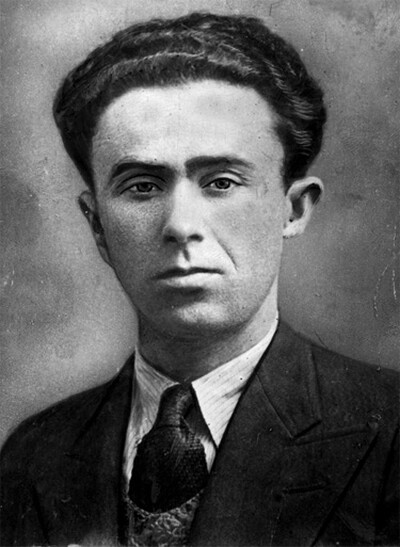
Goldshteyn, Moyshe Z.
1900–August 11, 1943
He was a prose author, born in Loshits (Losice), Shedlets (Siedlce) region, Poland, later moving to Warsaw. In 1923 he emigrated to Argentina and worked in the knitwear industry. In his youth, he began publishing stories, sketches, and miniatures, the majority drawn from Argentine Jewish life, in such Yiddish venues as Di Prese (The press) in Buenos Aires. In 1932 he moved to the Soviet Union and settled in Birobidzhan. He lived in the commune Ikor founded by immigrants from the United States. He worked in the fields, rolled timber, and took up fishing. At the same time, he continued writing stories and sketches about the new life of the migrants, which he published in Birobidzhaner shtern (Birobidzhan star) and in Moscow’s Der emes (The truth); and the leftist press in Argentina also willingly published his work. In the Birobidzhan local archive, documents are preserved concerning how this young writer was sent to Moscow to study, but with a condition: when he graduated, he would return to Birobidzhan. So, he moved to Moscow with his family, studied at the Pedagogical Institute there, and continued his writing. In 1934, the publisher “Emes” brought out his first book of stories and later another volume as well. In the newspapers Der emes and Birobidzhaner shtern, he published his stories and jottings. But he never returned to Birobidzhan. In 1941 he proceeded from Moscow to the war front. He sent his story “Der mames vort” (Mother’s word) from the front to Perets Markish, and it was included in the collection Heymland (Homeland) in 1943. In a second collection (Moscow, 1944), Markish placed another of Goldshteyn’s stories, “An aynfal fun a daytsh” (An idea from a German). These publications appeared after his death. He died on the battlefield near Taganrog.
His books include: a Yiddish translation of Vladimir Korolenko, Turme-vanderungen (Prison wanderings [original: Sibirskie rasskazy (Siberian tales)]) (Warsaw: Farlag Yudish, 1920), 149 pp.; Birobidzhaner afn amur, dertseylung (A man from Birobidzhan on the Amur River, a story) (Moscow: Emes, 1934), 103 pp.; Birobidzhaner dertseylungen (Tales from Birobidzhan) (Moscow: Emes, 1937); Birobidzhaner afn amur un andere dertseylungen (A man from Birobidzhan on the Amur River and other stories) (New York, 1944), 174 pp.
Sources: Antologye fun der Yidisher Literatur in Argentine (Anthology of Yiddish Literature in Argentina) (Buenos Aires, 1944); Sh. Klitenik, in Forpost (Birobidzhan) 2 (1936); M. Notovitsh, in Eynikeyt (Moscow) (August 31, 1943); T. Zalmenson, in IKUF (Buenos Aires) (1943); Y. Dobrushin, in Yidishe Kultur (New York) (January 1945); N. Mayzil, in IKUF (May 1946); Y. Botoshanski, in Algemeyne entsiklopedye, vol. 2, “Yidn H” (New York, 1957), p. 381.
[Additional information from: Chaim Beider, Leksikon fun yidishe shrayber in ratn-farband (Biographical dictionary of Yiddish writers in the Soviet Union), ed. Boris Sandler and Gennady Estraikh (New York: Congress for Jewish Culture, Inc., 2011), p.70.]