


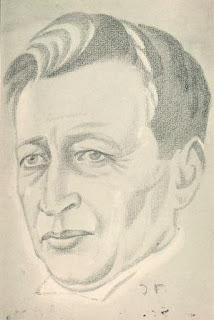
Gorin, B.
April 13, 1868–April 13, 1925
This was the pen name of Yitskhok Goyde, born in Lide (Lida), Vilna region, into an observant, well-to-do family. He studied in religious elementary school, as well as in the Mirir Yeshiva, later in the state school and with private tutors. At age sixteen he moved to Vilna where he made the acquaintance of Ayzik Meyer Dik.
His initial writings—among them “Zikhroynes fun Kheyder” (Memoirs of Religious Elementary School)—he sent to M. Spektor in 1889 for Hoyz Fraynd (House Friend). He later came by himself to Warsaw and published in the first volume of Peretz’s Yudishe Biblyotek (Yiddish Library) the story “Shakhne un Shrage” (Shakhne and Shrage). He became a frequent visitor at Peretz’s home. He published two Hebrew stories in Ben-Avigdor’s series Sifre Agora (One-Penny Books) under the titles “Hanaga hanaor” (The Enlightened Carpenter) and “haaguna” (The Abandoned Wife). (According to E. R. Malachi, Gorin wrote the stories in Yiddish.) In 1893 he returned to Vilna where he published a series entitled Kleyne Ertseylungen (Short Stories) in Yiddish, following the example of Ben-Avignor’s Sifre Agora series. He included in the series some of his own stories: Fun Zavod in Bod (From Factory to Bathhouse), Der Nayer Protsentnik (The New Userer), and Der Sovest iz Farfalen (The Moral Conscience Is Doomed [a translation]), as well as stories by I. L. Peretz and Dovid Pinski.
He also translated Charles Dickens’s novel, David Copperfield (under the title Dovid ben Dovid [David son of David], Vilna, 1894).
In 1894 he emigrated to the United States and became a regular contributor to the socialist Arbayter Tsaytung (Workers’ Newspaper) and Abent-Blat (Evening Newspaper). There he published sketches and stories. For Tsukunft (Future) he wrote about Yiddish literature and theater.
For a short time in 1895 he edited Filadelfyer Shtaats-Tsaytung (Philadelphia City Newspaper). He then restarted the Vilna publication Kleyne Dersteylungen Under the Title Idishe Folks-Biblyotek (Jewish People’s Library) [Yudish-Amerikanishe Folks-Biblyotek (Jewish American People’s Library)?] with his own works: Di Geshmisene (The Whipped one) under the pen name A. Lebenzon; Di Agune (The Abandoned Wife); Vemes Korbm? (Whose Sacrifice?), Di Mazikim (The Mischievous Children); Der Ben-Yokhed (The Only Child); Mosrim (Reprimands); Peysekh in Shnipishok (Passover in Shnipishok)—1898-1900.
In 1898 he took over from Aleksander Harkavy editorship of the monthly Der Nayer Gayst (The New Spirit). In 1901 he began publishing the biweekly Teater Zhurnal (Theater Journal), later titled Teater Zhurnal and Familyen-Blat (Theater Journal and Family Newspaper). In 1904 he became a contributor to the Forverts (Forward). At that time he also published in Fraynd (Friend), in St. Petersburg, over the course of two years a series entitled “Der Yidishe Vanderung in dem Goldenem Land” (Jewish Migration to the Golden Land).
From 1906 he was a regular contributor to Morgn-Zhurnal (Morning Journal), with an interruption in 1908 when he served as editor of Yidisher Farmer (Jewish Farmer). Gorin also contributed to the English-language press with original and translated stories and with reviews of Yiddish theatrical works and new works of Russian literature.
He translated many longer and shorter works by Leo Tolstoy, Balzac, de Maupassant, Berthold Auerbach, Chekhov, Gorky, Andreev, Nathaniel Hawthorne, George Eliot, Robert Louis Stevenson, and others. Many of these translations appeared in book form, such as: Tolstoy’s Krig un Fridn (War and Peace [original: Voina i Mir] in abridged form); Émile Zola’s Der Toyt-Shleger, oder Nanas Muter (The Violent Person, or Nana’s Mother [original: L’Assommoir (The Drinking Den)]; Zola’s Der Fargifteter Kos (The Poisoned Cup [original: ?]); and Lessing’s Nosn der Khokhem (Nathan the Wise [original: Nathan der Weise].
In 1924 he made a trip to Europe and published his travelogue in Morgn-Zhurnal.
Among his hundreds of sketches and stories, Gorin depicted with acute realism Jewish life in the old country and to a certain extent in America as well. He also made considerable earnings as a theater critic.
Over the course of some three decades, he fought for realism on the Yiddish stage. He also tried out his own capacities in the field of drama and published the plays: Der Vilner Balebesl (The Young Gentleman of Vilna) of 1898, a drama in four acts, staged in the same year in New York (no relation to the historical Vilna “Balebesl” [R. Yoyel-Dovid Levnshteyn] embodied by Mark Arnshteyn’s play with the same title); Borekh Shpinoza (Baruch Spinoza) of 1902, a dramatization of Berthold Auerbach’s novel Spinoza, which Gorin translated into Yiddish (two printings, New York, 1917, 137 pp.); Lebedike Keytn (Living Links) of 1910; A Baron af a Tog (Baron for a Day) of 1912, adapted from Hauptmann’s Schluck und Jau (Schluck and Jau), staged in 1924 by Maurice Schwartz’s Art Theater. This last comedy was considered one of his best works. In 1917 he directed and staged for the first time Aaron Wolfssohn’s comedy Laykhtzin un Fremelay (Frivolity and Piety) under the title Der Tsvuak (The Hypocrite). In 1918 he arranged for the stage Mendele’s Der Priziv (Military Conscription), performed that year in New York. Gorin also composed the plays: Yitskhok von York (Isaac of York), a historical drama in five acts, adapted from Walter Scott’s Ivanhoe; Der Kortn-Shpiler (The Card Player), adapted from Charles Dickens’s The Old Curiosity Shop; and Zamd (Sand), a drama in four acts drawn from American Jewish life.
He assembled a rich body of material on the history of Yiddish theater. He wrote a string of monographs, initially published in Tsukunft (1913-1916), and later appearing as a book entitled Di Geshikhte fun Idishn Teater, Tsvey Toyzent Yor Teater bay Idn (The History of Jewish Theater: 2000 Years of Theater Among the Jews) (New York, 1918); the second, enlarged edition was illustrated, vol. 1 (New York, 1923), 256 pp., and vol. 2, 282 pp., with a “listing of the Yiddish plays in repertoire.” There were 2,000 items, listed by the authors in alphabetical order, with dates of publication or first stagings. A third edition, published by the Forverts, appeared in 1929.
Among his books: Kleyne Ertseylungen, der Nayer Protsentik (Short Stories, the New Userer), “a tale by Y. Goyde” (Vilna, 1893); Fun Zavod in Bod (Vilna, 1893); Der Sovest iz Farfalen, after Shchedrin (Vilna, 1894); Peysekh in Shnipishok, in Nyu York, in Bronzvil, un Andere Ertsyelungen, Bilder fun Idishn Lebn (Passover in Shnipishok, in New York, in Brownsville, and other stories, images of Jewish life) (New York, 1899); Di Mazikim un Andere Ertseylungen fun Idishn Lebn in Rusland (The Mischievous Children and Other Stories of Jewish Life in Russia) (New York, 1900), 57 pp.; Nana, a Realistishe Shilderung fun Parizer Aristokratishn Lebn (Nana, a Realistic Description of Parisian Aristocratic Life), “by Émile Zola, adapted into ‘zhargon’ by B. Gorin” (New York, 1906); Fun Khupe Tsum Keyver, Moderne Khasenes un Moderne Kvures (From Wedding to the Grave, Modern Weddings and Modern Burials), “by Émile Zola, translated into ‘zhargon’ by B. Gorin” (New York, n.d.), 67 pp.; Der Ben-Yokhed (New York, 1909), 46 pp.; Zelde Geyt in Teater (Zelda Goes to the Theater) (New York, 1909); Nebakh (Sad sack) (New York, 1909), 16 pp.; Di Mosrim (New York, 1909), 57 pp.; Shifre di Ferfirte, Ertseylung (Shifre the Querulous, a Story) (New York, 1910), 68 pp.; Sofye, Ertseylung (Sophia, a Story) (New York, 1909), 14 pp.; Nosn der Khokhem, by G. E. Lessing, “adapted to story format by B. Gorin” (New York, n.d.), 71 pp.; Der Toyt-Shleger, oder Nanas Muter, “adapted by B. Gorin” (New York, ), 225 pp.; Di Geshikhte fun Idishn Teater (see above); Di Idishe Korbones, oder di Haydamakes (The Jewish Victims, or the Haidamaks) (New York, 1919), 168 pp.; Fargesene Nigunim (Forgotten melodies), vol. 1, “Yontefdike Ertseylungen” (Holiday Stories), vol. 2, “Amol is geven” (As it once was), “impressions from religious elementary school, from the house of study, from the Enlightenment era, and from small towns” (New York, 1919), 512 pp.; and Di Yudishe Prese in Amerike (The Yiddish Press in America) (New York, n.d.), 51 pp.
After his death, his wife Elizabeth published his Gezamlte Shriftn (Collected Writings) (New York, 1927), with critical biographical introductory articles by R. Brainin, Litvak, A. Harkavy, Vernik, and Elizabeth Gorin, in three volumes: (1) 318 pp.; (2) 320 pp.; (3) 320 pp. His wife wrote of Gorin’s “Life and Literary Activities” as her introduction to the collected works.
Sources: Zalmen Reyzen, Leksikon, vol. 1; Z. Zilbertsvayg, Teater Leksikon, vol. 1; Dr. Y. Shatski, in Dos Naye Lebn (New York) (August 1923); Tsaytshrift (Minsk), vol. 1 (1926) and vols. 2-3 (1928); Dr. A. Mukdoni, Teater (Theater) (New York, 1927); E. R. Malachi, in Tsukunft (December 1929); D. Pinski, in Tsukunft (May 1945); Shmuel Niger, Dertseylers un Romanistn (Storytellers and Novelists), vol. 1 (New York, 1946), pp. 154-56; Z. Turkov, Shmuesn vegn Teater (Chats About Theater) (Buenos Aires, 1950); N. Mayzil, Y. l. Perets un zayn Dor Shrayber (I. L. Peretz and his Generation of Writers) (New York, 1951); M. Ḥizkuni (Shtarkman), in Metsuda 7 (1954); Y. Likhtnboym, in the anthology Hasipur haivri (The Hebrew Story) (Tel Aviv, 1955), p. 516.
The story Nayer Protsentnik has 2 parts. The author's name has one more form of spelling - Y. Goydo.
NOTE: See image of 2 books.