
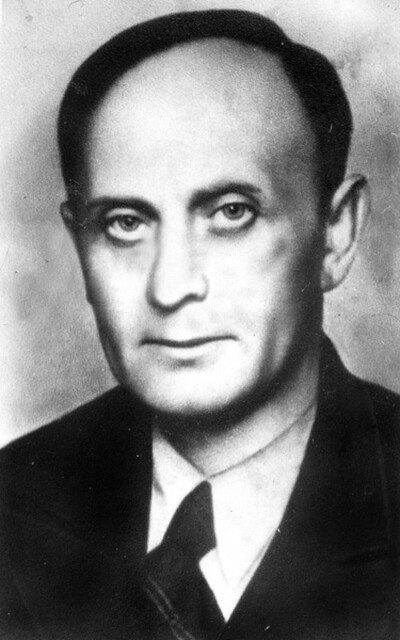
Gutyanski, Binyumen
1903–1956
He was a Soviet Yiddish poet and playwright of the post-revolutionary generation, born in the village of Glubochek, Podolia, Ukraine. His father was a carpenter and died when Benyomen was three years old. When he was still very young, his musical aptitude was recognized. He went to Odessa to study violin with Professor Peysi Stolyarski, and although he did not complete the education and music did not become his profession, he nonetheless remained faithful to this art. In the 1920s, he entered the Jewish Pedagogical Technicum in Kiev.
There he became acquainted with a number of other students, later leaders among Soviet Yiddish literature—the dramatist Moyshe Gershenzon, folklorist Zalmen Skuditski, and literary researcher Shloyme Brianski. They brought out a literary wall newspaper in which each of them published their own work.
They also created an amateur cabaret group using the name “Mishlakhes” (Calamity) which was very popular among the young Kievan spectators. After graduating, he entered the physics and mathematics department at Kiev State University. He began working in a Jewish school as a teacher of mathematics, literature, and language.
In 1936 a Minsk publishing house brought out his first collection of poetry, Far Kleyne Kinder (For Small Children) (Byelorussian State Publishers), 72 pp. Several further books by him also appeared in print before WWII: e.g., Alerley Zakhn (All Manner of Things), Mesholim (Fables), and Far Kinder (For Children). During the war, he published in Moscow his collection of satirical anti-fascist poetry, Zalts in di Oygn (Salt in the Eyes). He was also the author of a series of textbooks for Jewish schools, which went through a number of editions. Many of his children’s poems and fables were anthologized in literary readers at the very beginning of his creative path.
In the middle of the 1930s, he wrote a play for the puppet theater, entitled Leyzer der Beyzer (Wicked Leyzer), which was initially staged in Ukrainian (in his own translation) and later in Yiddish. In 1936 the Kiev Yiddish puppet theater put on a play at the festival of puppet theaters in Moscow and took second place after the famous puppet theater under the direction of Sergei Obraztsov. To this day, the puppets from this performance are held in a museum of the Moscow Central Puppet Theater.
During WWII, Gutyanski evacuated to Ufa, the capital of Bashkiria, and worked for a Ukrainian publisher, “Front and Hinterland.” After the war he returned to Kiev and continued his literary activity. He was, however, arrested in 1950 and sent to a forced-labor camp in the North. In 1956 he was “rehabilitated” (i.e., exonerated). Broken physically and psychologically, he returned to Kiev, but soon thereafter died.
Among his writings: Zay Gezunt, for Gezunt (Be Well, Go Healthily), poetry (Kiev: Kultur-Lige, 1930), 10 pp.; and A Rebn Kumt Azoy (Thus Comes a Raven) (Kiev: Kultur-Lige, 1930), 10 pp.; Brivntreger (Mailman) (Kiev: Kultur-Lige, 1930), 11 pp.; Tsip-Tsap Hemeln (Little Hammer) (Kiev: Central Publishers, 1932), 12 pp.; Naft (Oil), a story told in verse (Kiev: Ukrainian State Publishers for National Minorities, 1934), 14 pp.; Geklibene Mesholim (Collected Fables) (Kiev: Ukrainian State Publishers for National Minorities, 1936), 107 pp.; Azelkhe un Azoyne (Such and Such) (Kharkov-Odessa: Kinder farlag, 1936), 37 pp.; Artikl 2, Komedye in Eyn Akt (Article 2, a Comedy in One Act) (Kiev: Ukrainian State Publishers for National Minorities, 1937), 20 pp, with Fayvl Sito.; Alerley Zakhn, poetry (Kiev: Ukrainian state publishers for national minorities, 1937), 94 pp.; Bulye, Krokevyake, Tsvey Stsenkes far Kleyne Kinder (Bulye, Krokevyake: Two Scenes for Small Children) (Odessa: Kinder-farlag, 1937), 32 pp.; Nokh der Arbet (After Work) (Kiev, 1938), 109 pp., with Dovid Foynitski; Mesholim (Kiev: Ukrainian State Publishers for National Minorities, 1940), 61 pp.; Far Kinder (Kiev: Ukrainian State Publishers for National Minorities, 1940), 102 pp.; Leynbukh farn Ershtn Klas fun der Onfang-Shul (Reader for the First Class in Elementary School) (Kiev-Lvov: Ukrainian State Publishers for National Minorities, 1940), 116 pp., second printing (Kaunus, 1940); Literarishe Khrestomatye Farn 4 Klas (Literary Reader for the Fourth Class) (Kiev: Ukrainian State Publishers for National Minorities, 1941), 191 pp., with Sh. Horovits; Zalts in di Oygn (Moscow: Emes, 1944), 38 pp.; Leynbukh far Onfanger, Khrestomatye (Reader for Beginners) (Moscow: Emes, 1947), 132 pp.
His translations include: M. Il’in, Der Groyser Plan (The Great Plan [original: O Velikom Plane]) (Kharkov: Central Publishers, 1931), 207 pp.; N. Mitrofanov, Der Batalyon iz Opgeshnitn (The Battalion Is Cut Off [original: Batal’on Otrezan]) (Kharkov: Ukrainian State Publishers for National Minorities, 1934), 62 pp.; Miguel de Cervantes, Don Kikhot (Don Quixote) (Kharkov: Ukrainian State Publishers for National Minorities, 1936), 478 pp.; Korney Chukovsky, Der Doktor Oystutvey (Dr. Ow-It-Hurts [original: Doktor Aybolit]) (Kiev: Ukrainian State Publishers for National Minorities, 1937), 103 pp.
Sources: Kh. Loytsker, in Eynikeyt (August 31, 1943); M. Notovitsh, in Eynikeyt (January 11, 1945); A. Kushnirov, in Naye Prese (Paris) (July 27, 1945); M. Z., in Naye Prese (December 27, 1947).
BINYUMEN GUTYANSKI translated from Ukranian into Yiddish Aleksander Kopilenko's novel A shtot vert geboyrn (orig.: Народжуэться мiсто = A city is being born).
א שטאט װערט געבױרנ
א. קאפילענקא; פונ אוקראיניש - ב. גוטיאנסקי
קיעװ; כארקאװ : מעלוכע-פארלאג פאר די נאציאנאלע מינדערהײטן אין אוססר
1934.- 277, [2] pp.
A shtot vert geboyrn
A. Kopilenko; fun ukrainish - B. Gutyanski
Kiev; Kharkov : Melukhe farlag far di natsionale minderhaytn in USSR
BINYUMEN GUTYANSKI translated from Ukranian into Yiddish Aleksander Kopilenko's novel Zeyer gut (orig.: Дуже добре = Very good).
זײער גוט
א. קאפילענקא; ײדיש פונ אוקראיניש - ב. גוטיאנסקי
קיעװ : מעלוכע-פארלאג פאר די נאציאנאלע מינדערהײטן אין אוססר
1938.- 456, [3] pp.
Zeer gut
A. Kopilenko; yidish fun ukrainish - B. Gutyanski
Kiev : Melukhe farlag far di natsionale minderhaytn in USSR
BINYUMEN GUTYANSKI translated from Russian into Yiddish collection fables of Ivan Krilov Geklibene mesholim (orig.: Избранные басни/Вибиранi байки (Ukranian)).There were 3 editions in 1936-1937.
געקליבענע מעשאלים
אי. א. קרילאװ; ײדיש - ב. גוטיאנסקי
קיעװ : מעלוכע-פארלאג פאר די נאציאנאלע מינדערהײטן אין אוססר
Geklibene mesholim
Y. A. Krilov; yidish - B. Gutyanski
Fables:
;די קרא און דער פוקס ; די גענדז ; דער שפיגל און די מאלפע ;דער װאלף און דער בושל דער פױער און די שאף ; דער קװארטעט ; דער װאלף און דאס שעפעלע ; די קוקאװקע און דער האן ; די מאלפע און די ברילן ;צװײ הינט
Di kro un der fuks; Di gendz; Di shpigl un di malpe; Der volf un der bushl; Der poyer un di shof; Der kvartetDer volf un dos shefele; Di kukavke un der hon; Di malpe un di briln; Tsvey hint
BINYUMEN GUTYANSKI translated from Russian into Yiddish Aleksey Tolstoy's fairy tale for children Dos goldene shlisele oder di pasirungen fun Buratino (orig: Золотой ключик или приключения Буратино = A small gold key or the adventures of Buratino).
דאס גאלדענע שליסעלע אדער די פאסירונגענ פונ בוראטינא
אלעקסײ טאלסטױ; פון רוסיש - ב. גוטיאנסקי
קיעװ : מעלוכע-פארלאג פאר די נאציאנאלע מינדערהײטן אין אוססר
1937.- 137, [2] pp. ill.
Dos goldene shlisele oder di pasirungen fun Buratino
Aleksey Tolstoy; fun rusish - B. Gutyanski
Kiev : Melukhe farlag far di natsionaleminderhaytn in USSR