
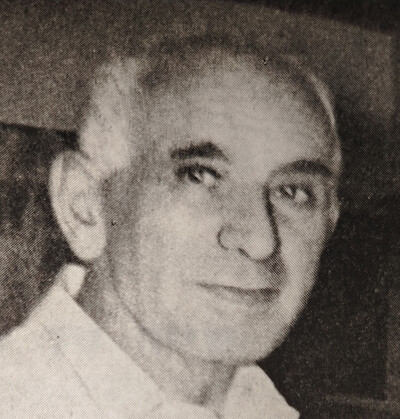
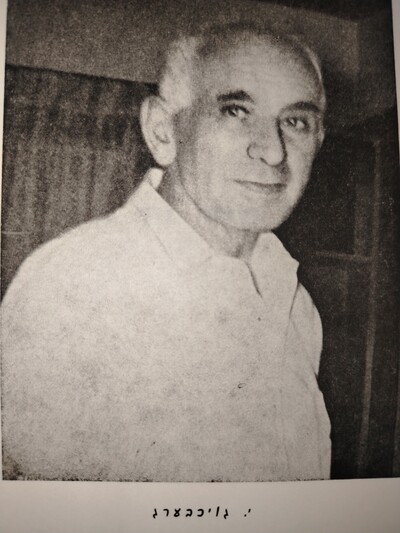
Goykhberg, Yisroel
January 1, 1894–June 9, 1970
He was born in Telenesht (Telenesti), Bessarabia. His father Velvl was a cantor, and his mother Khaye Gutman was a cousin of the Hebrew-Yiddish writer S. Ben-Tsiyon (Simḥa-Alter Gutmann). At age two he moved with his parents to Shargorod (Sharhorod), later to Nemirov (Nemyriv), and then later still back to Telenesht, and there in 1903 they experienced a pogrom around their town which claimed the life of one of his brothers. He studied in religious primary school, with private tutors, and Hebrew in a cheder metukan (improved religious elementary school). He graduated from the municipal school in Khotyn, and he sat for the high school examinations in Kamenets-Podolsk (Kamianets-Podilskyi) to be a student of pharmacy. He worked for several years as an assistant in a pharmacy in poor small towns. In 1913 he emigrated to the United States, settling in Boston where he engaged in various lines of work.
During the era of WWI, he was working in a shoe factory. Over the years 1917-1921, he studied in Iowa and graduated in engineering technology. At the same time, he founded a Yiddish-Hebrew school (one of the first in America). He was a teacher, 1921-1926, in a Workmen’s Circle school in Boston. From 1926 he taught in the schools of the Sholem-Aleykhem Folk Institute in New York.
In his childhood years, he began writing Hebrew poetry on Zionist themes. In Yiddish he first published a poem in Fraye Arbeter Shtime (Free Voice of Labor) (November 14, 1914). In addition to this newspaper, he published poems and translations in: Idisher Kemfer (Jewish Fighter); the Anthology Eygns un Fremds (One’s Own and Strangers’) (Boston, 1922) in which he brought out a translation of the first part of Lermontov’s Demon (Demon), two sonnets of Petrarch (following the literal translation provided by Dr. Yoysef Tsheskis), and a series of Judezmo folksongs (also following Tsheskis’s literal translation); Der Oyfkum (Arise), Bodn (Ground), Kinderland (Children’s Land), and Kinder-Zhurnal (Children’s Journal), among others.
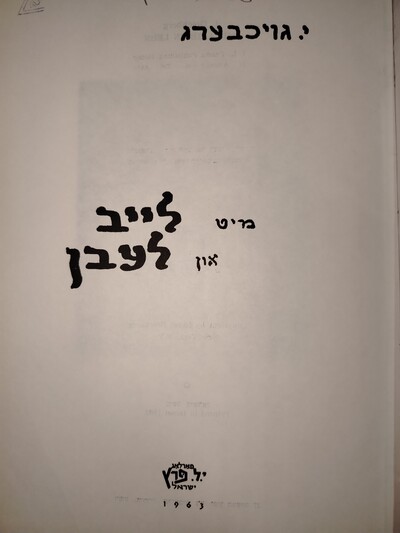
Among his books: Gezangen fun Unzer Dor (Songs of Our Generation), songs of the American metropolis (Boston, 1925), 60 pp.; Gut Morgn (Good Morning), children’s songs, illustrated by Note Kozlovski, (New York, 1928), 64 pp.; Kamtsa un Bar Kamtsa (Kamtsa and Bar Kamtsa), a story in verse, with woodcuts by Note Kozlovski (New York, 1931), 60 pp.; Vertikaln (Verticals) (New York, 1935), 94 pp.; Nemirov (Nemirov [Nemyriv]), a chronicle in verse (New York, 1946), 96 pp.; Mit a Shmeykhl (With a Smile) (Tel Aviv: Peretz Publ., 1963), 87 pp.; Mit Layb un Lebn (With Body and Soul) (Tel Aviv: Peretz Publ., 1963), 96 pp.
He also edited a collection of poetry entitled Di Goldene Pave (The Golden Peacock) (New York, 1948). His poems can be found in many Yiddish readers.
He translated into Russian the poem by Yehoash entitled Iev (Job), published on September 20, 1920, in Russkii Golos (Russian Voice) in New York. Many of his poems were written to music, such as: Dray Ingelekh (Three Little Boys), drawn from his children’s poems, with music by N. L. Zaslavski (New York, 1923); Amol un Haynt (Once and Today), cantata by Lazar Veyner, staged for the twentieth anniversary of the Workmen’s Circle Choir in 1935 in New York; Der Mazldike Hoz (The Lucky Hare), with music by Pinkhes Yasinovski, published in Grininke Beymelekh (Little Green Trees) (Vilna, 1936), and later with music by Elye Kanter, published in Argentiner Beymelekh (Little Argentine Trees) in Buenos Aires (September 1946), among others.
He died in New York.
Sources: Zalmen Reyzen, Leksikon, vol. 1; Shmuel Niger, in Tog (New York) (October 8, 1922); Tsukunft (New York) (August 1925); Kalmen Marmor, in Frayhayt (New York) (September 1925); M. Melamed, in Di Idishe Velt (Philadelphia) (July 12, 1925); Benern, in Dos Naye Vort (Boston) (August 1925); Leyzer Greenberg, in Oyfkum (New York) (January-February 1931); Alef Kats, in Idisher Kuryer (Chicago) (May 17, 1936); L. Zhitnitski, in Di Prese (Buenos Aires) (January 6, 1937); Avrom Reyzen, in Di Feder (New York) (1937); Y. Botoshanski, in Di Prese (February 19, 1947); Kh. Liberman, in Forverts (New York) (November 12, 1954); N. Mayzil, ed. and comp., Amerike in Yidishn Vort, Antologye (America in the Yiddish Word, an Anthology) (New York, 1955), see index; Sh. Slutski, Avrom Reyzen Biblyografye (Avrom Reyzen’s Bibliography) (New York, 1956), nos. 4748, 4895, 5335.