


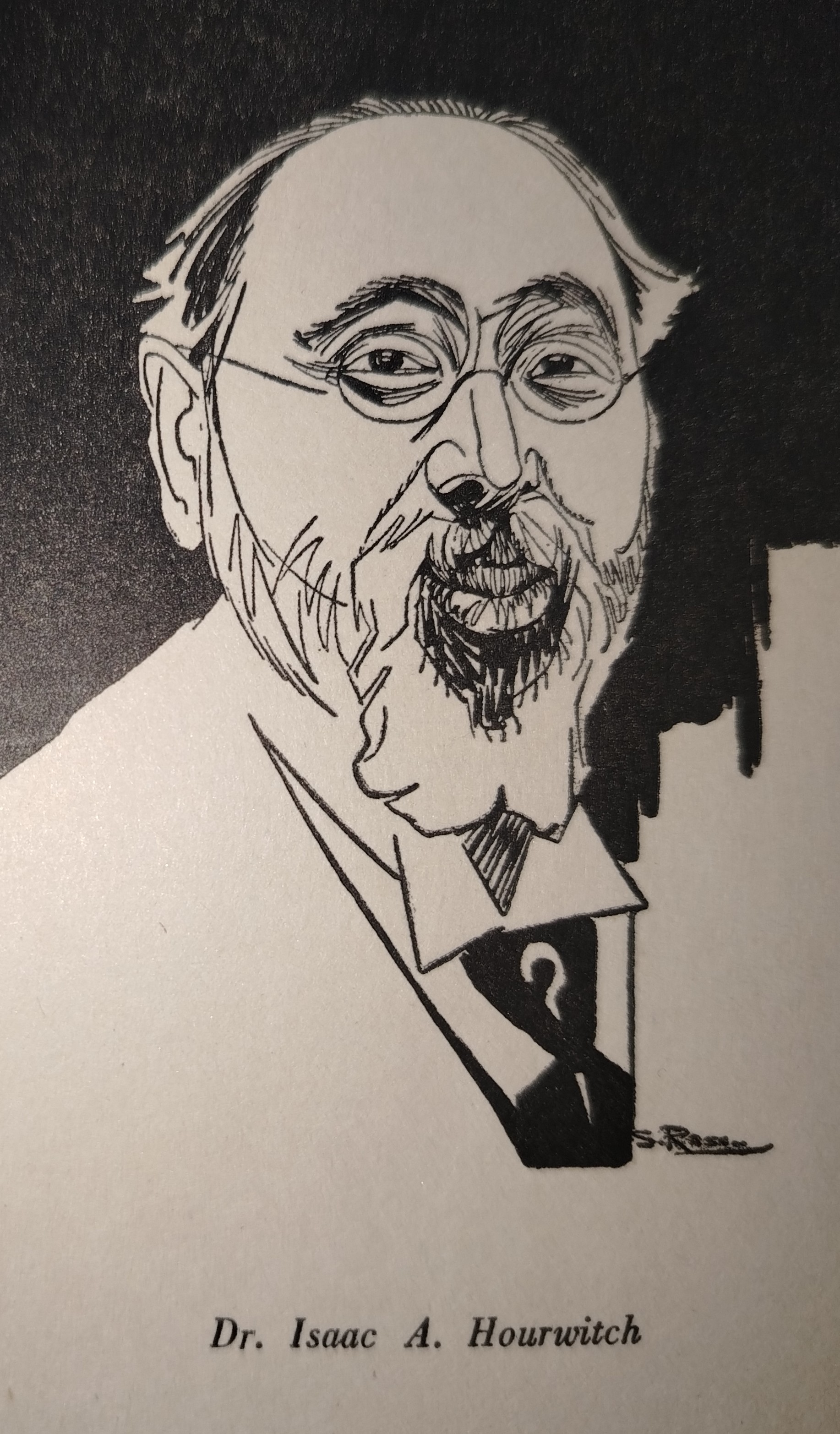
Hurvitsh, Yitskhok-Ayzik Ha-Levi
April 14, 1860–July 9, 1924
He was born in Vilna, into a family of great rabbinic pedigree. His father, Arye-Tsvi (Adolf), who drew his lineage from Rabbi Yeshayah Horowitz, studied Talmud until age eighteen, but under the influence of Avraham Mapu, he became one of the pioneers of the Jewish Enlightenment in Lithuania. He was an employee of the St Petersburg-Warsaw railway, later a private teacher of German and French, and later still worked in a bank in Minsk. Hurvitsh’s mother as well hailed from the Shevelovitsh rabbinical family and already in the 1850s was a modern woman studying languages and literature. Hurvitsh was raised in this highly free-thinking home. He studied for a short time in religious primary school, later with private tutors—Hebrew Bible and Hebrew language—and in 1877 graduated from high school in Minsk, and then over the course of three years studied in St. Petersburg, initially in the Academy of Medicine and Surgery, later in the mathematics department of St. Petersburg University, where he became involved in politics, was arrested, and in 1881 deported to Siberia.
In his years in Siberia, Hurvitsh investigated the forced migration of Russian peasants and the results of his research were later (1888, Moscow) published in his Russian-language book on the “migrations of peasants to Siberia.”
Returning from exile, he studied law at St. Petersburg’s Demidov Lycée, and in 1887 sat for the examinations to be a candidate (Russian equivalent to PhD) in jurisprudential science. He then moved to Minsk, and there over the course of two or three years organized the first socialist circles among Minsk Jewish laborers—one of the pioneering beginnings of the Jewish labor movement in Russia (see his article on the “first Jewish workers’ circles” in the Russian journal Byloye [The past] 4 [1907] in St. Petersburg).
Hurvitsh could not for political reasons remain in Minsk for long, and in 1890 he settled in New York, studied at Columbia University, and for his dissertation on The Economics of the Russian Village, he received his doctoral degree in 1893; this was a quintessential Marxist analysis of the Russian agricultural economy, and when it was later published in Moscow in a Russian translation (1896), it made a strong impact on Russian Marxist circles.
With the title of private docent, over the years 1893-1894, he held a chair in statistics at the University of Chicago, but he had to resign from this position because of his role in Edward Bellamy’s populist movement (a movement of progressive farmers).
He proceeded to practice law for several years in New York. In 1900 he received a position in the government in Washington as a statistician.
After the first Russian Revolution (October 1905), he returned to Russia, stood for candidacy in the second “state Duma,” and was elected as an “elector” (vyborshchik), but the Tsarist Senate abrogated his mandate, and Hurvitsh returned to the United States.
He always worked with the socialist movement in America, but from an organizational standpoint he belonged to no particular socialist group. Daniel De Leon’s S. L. P. (Socialist Labor Party) was too sectarian for him, and Eugene Victor Debs’s S. P. (Socialist Party) was too reformist.
“He was no Jewish national romantic,” wrote A. Liessin in Tsukunft (Future) in August 1924), “though the Labor Zionists count him as one of their own. He was a national realist, like the Bundists, though he could neither live in peace with the Bundists nor oppose them, as the Jews needed a national home in the Land of Israel.”
At one point, he was very close to joining the trade union movement, and there was a great fuss made of this in America. In 1913 the Cloakmakers Union, the trade organization for women tailors, in New York—in agreement with the well-known “protocol” (contract) which was concluded between the union and the contractors in September 1910 during a major strike of the cloakmakers—hired Hurvitsh to be its “chief clerk” and representative in arbitration court, whose job it was to reconcile the feuding between the union and the association of manufacturers. Hurvitsh was uncompromising vis-à-vis the owners, and thus there ensued a sharp conflict between the union and the manufacturers who threatened a lockout if he was not removed from his post. The union leaders were in no position to spare Hurvitsh, departed from the trade union standpoint, and took a stance opposed to him. Irrespective of the fact that Hurvitsh was immensely popular with and indeed beloved of the great majority of the union membership (the workers organized two large protest demonstrations on his behalf), the chairman of the arbitration court, Louis D. Brandeis, ruled that Hurvitsh should, for there to be peace between the parties, resign his post, and this he did. The commotion around this story was so great that the government appointed a special commission to investigate the matter.
Hurvitsh was also active in the Jewish congress movement of 1916 and worked out the first electoral laws for the first American Jewish Congress in Philadelphia in 1918. That year he was elected president of Jewish National Workers Association, and in his name there still exists [a/o 1960] a branch of this group. He also took part in workers’ congresses for Jewish rights in Israel over the years 1917-1918.
Hurvitsh began his journalistic and writing activities in Russian in 1882 in the Moscow Russian-language newspaper Severnii kur-yer (Northern Courier).
From that point in time over the course of forty years he contributed to various Russian (mostly Marxist), English, German, and Swedish newspapers, among them: Novoe Slovo (New Word) in 1896-1897, Zhizn’ (Life) in 1900-1902, Pravda (Truth) in 1904, Sovremenii Mir (Contemporary World) in 1907 and 1911, Journal of Political Economy, Political Science Quarterly, The New Review, International Socialist Review and many others.
Over the years 1891-1894, he edited the weekly, later biweekly, independent socialist periodical in Russian Progress (Progress), which initially appeared in New York and later in Chicago. At the moment when he was socially active among Jewish laborers in America, he began writing in 1897 for Yiddish socialist serials and was one of the most prominent Yiddish-language journalists in the United States.
He placed pieces in Forverts (Forward), Varhayt (Truth), Tog (Day), the Labor Zionist Di Tsayt (The Times), and Fraye Arbeter Shtime (Free Voice of Labor).
He wrote longer treatises on issues of the day for the monthly Tsukunft (Future) and Zhitlovsky’s Dos Naye Lebn (The New Life), among others.
In 1922 he traveled through England, Germany, and the Soviet Union, and his impressions from the trip were published in Tog. The trip to the Soviet Union sobered up his earlier sympathies for the Bolshevik regime, and after returning to New York he published in Forverts a series of articles in which he strove to acquaint Yiddish-language readers in America with the real situation in revolutionary Russia.
Among his books are the following: Oysgevehlte Shriftn (Selected Writings) (New York: “Yitskhok Ayzik Hurvitsh’s Publication Committee,” 1917), 4 vols.—(1) Imigratsye in Amerike (Immigration in America), 197 pp., in which he conveyed in popular form the content of his well-known book Immigration and Labor (New York, 1912, 561 pp.; second edition, New York, 1922, 611 pp.), with specially added chapters on Jewish immigration and the stance of the American socialist party with respect to immigration; (2) Idishe Fragn (Jewish Issues), 250 pp., a collection of articles on nationalism and internationalism, assimilation, Zionism, anti-Semitism, on Jewish-Polish relations, Jewish problems in the United States, on Yiddish and the Yiddish press, and the congress movement, among other topics; (3) and (4) Shtrayt-Fragn fun Sotsyalizm (Issues of Conflict in Socialism), 239 and 425 pp., respectively. He also published: Di Antviklung fun Der Amerikaner Demokratye (The Development of American Democracy) (New York: Kultur, 1922), 270 pp.
From the five-volume edition of Karl Marks Oysegevehlte Verk (Selected Work of Karl Marx) (New York: Karl Marx Literary Society), Hurvitsh edited the two volumes on economic writings, a popularization of Marx’s Das Kapital and an abridged form of his “Toward a Critique of Political Economy” (New York, 1919), 319 and 322 pp.
He was also the editor of the “Scientific Library” which in the years 1919 and 1920 brought out translated works with such titles as: Evolutsye (Evolution), Kunst (Art), Antropologye (Anthropology), Filozofye (Philosophy), and Psikhologye (Psychology).
Remaining unpublished in book form were: Hurvitsh’s autobiography, Zikhroynes fun an Apikoyres (Memoirs of a Heretic), in Fraye Arbeter Shtime (beginning December 11, 1921); a series of articles entitled “Di Sotsyale Artiklen fun Karl Marks” (The Social Articles of Karl Marx), published in various periodicals on the centennial of Marx’s birth; his series Politishe Portretn (Political Portraits), on American political leaders; a series of articles on American trusts (in Tsukunft); an early adaptation of Karl Kautsky’s “From Utopia to Socialism” (in Forverts); and more. His last work was “Der Sof fun Imigratsye in di Fareynigte Shtatn” (The End of Immigration in the United States), Tsukunft (July 1924) in New York.
“Dr. Hurvitsh was a man with a fighting character,” wrote Tsvien, “and he was open, detested anything inappropriate. When in battle he had something to say, he said it fully and with words that he held to be correct…. As a journalist Yitskhok-Ayzik helped in the spread of socialist ideas, the socialist standpoint, and socialist teachings among the Jewish laboring masses. He had a special aptitude to make the most difficult matter so clear and distinct that even the simple reader would understand, and it was true as well of his most rigorous scholarship that the intelligent reader would be able to learn something…. He wrote in a popular and clear style, because that was his way of writing, his style, and his talent. He was a true journalist, the likes of which we have very few in Yiddish literature.”
“Yitskhok-Ayzik wrote important books in Russian and in English,” noted A. Liessin, “but he excelled among us in the field of Yiddish journalism, which he so enriched with his extraordinary knowledge and his great talent.”
He signed his name: “Yitskhok-Ayzik son of Arye-Tsvi Halevi.”
Sources: Zalmen Reyzen, Leksikon, vol. 1 (with a bibliography); Dr. A. Ginzburg, in Hadoar (New York) (July 18, 1924); Ab. Cahan, Bleter fun Mayn Lebn (Pages from my Life), vol. 4 (Vilna, 1929), pp. 456-58; Sh. Ts. Zetser, Figurn (Figures) (New York, 1928), see index; Moyshe Shtarkman, “Tsu der Geshikhte fun der Yidisher Sotsyalistisher Prese” (On the History of the Yiddish Socialist Press), YIVO-Bleter (Vilna) 4.4-5 (1932); H. Rogof, in Vilna anthology, ed. Y. Yeshurin (New York, 1935), see index; Avrom Reyzen, Epizodn fun Mayn Lebn (Episodes from My Life), part 3 (Vilna, 1935), pp. 205-7; M. Regalski, Tsvishn Tsvey Velt-Milkhomes (Between the Two World Wars) (Buenos Aires, 19446), see index; Sh. Yanovski, Ershte Yorn fun Yidishn Frayhaytlekhn Sotsyalizm (The First Years of Free Jewish Socialism) (New York, 1948), see index; Tsvien, Far Fuftsik Yor (For Fifty Years) (New York, 1948), pp. 318-25; K. Marmor, Dovid Edelshtadt (Dovid Edelshtadt) (New York, 1950), see index; Y. Sh. Herts, Di Yidishe Sotsyalistishe Bavegung in Amerike (The Jewish Socialist Movement in America) (New York, 1954), see index; M. Tzhakobin, in Forverts (New York) (June 22, 1954); B. Ts. Goldberg, in Tog- Morgn Zhurnal (New York) (August 1, 1954); A. Liessin, Zikhroynes un Bilder (Memoirs and Images) (New York, 1954), see index; Geshikhte fun der Tsienistisher Arbeter-Bavegung in Tsofn-Amerike (History of the Zionist Workers’ Movement in North America), 2 vols. (New York, 1955), see index; A. Kritshmer-Yisroeli, in Idisher Kemfer (New York) (March 26, 1956); B. Y. Byalostotski, Kholem un Vor, Eseyen (Dream and Reality, Essays) (New York, 1956), see index; Meyer Braun, Mit Yidishe Oygn (With Jewish Eyes) (New York, 1958), pp. 243-44.