
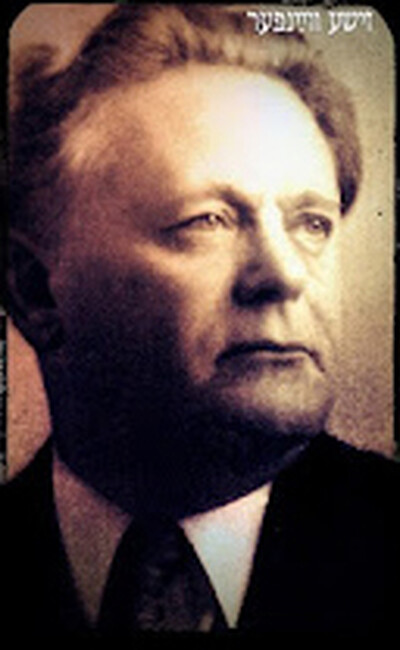
Vaynper, Zishe
March 15, 1893[1]-January 27, 1957
This was the literary name of Zise Vaynperlikh, born in Trisk (Turiysk), Volhynia, Ukraine. He was raised in a Hassidic environment of the Trisker rebbe’s court, where his father (Yitskhok-Leyb) was a cantor and an intimate of the rebbe, R. Yankev-Leybenyu.
He studied in religious elementary school, in the yeshivas of Rovno and Brisk, and in the small Hassidic synagogue. At age sixteen, he turned his attention to secular subjects, diligently read Hebrew and Yiddish literature, lived in a number of cities and towns in Ukraine and Poland, made his way by teaching or bookkeeping, and began to test his capacity with Yiddish poetry.
In 1910 he lived for a time in Warsaw where he published for the first time a pair of poems in one of the holiday pages at that time.
He moved to the United States in 1913, worked in various trades in New York, mostly as a house painter, and later became a teacher in one of the secular Jewish schools that sprung up just at that time.
In 1914 he published his first poem in America in Dos Idishe Folk (The Jewish People). Between the two world wars and later (with a break of just two years, when in 1918 he joined the Jewish Legion of the British army and left to fight in the Near East, by the borders of the Land of Israel), he published poems and later stories and articles on literature and community cultural topics in: Morgn-Zhurnal (Morning Journal), Fraye Arbeter Shtime (Voice of Free Labor), Varhayt (Truth), Naye Velt (New World), Tsukunft (Future), Kinder Zhurnal (Children’s Journal), and Fraynd (Friend), organ of the Workmen’s Circle—all in New York; and Literarishe Bleter (Literary Newspaper) in Warsaw; among others.
He contributed as well to the anthologies: Mentsh tsu Mentsh (Person to Person) and Ist-Brodvey (East Broadway)—in New York.
He edited the small monthly Der Onhoyb (The Beginning), around which gathered poetry beginners, in New York (1918—before he joined the Jewish Legion); published and edited over the course of four months the literary journal Baym Fayer (By the Fire) in Philadelphia (1920); edited (together with B. Grobard and M. L. Halpern) the two volumes of the journal Otem (Breath) (New York, 1922); edited from 1924 the monthly literary and art journal Di Feder (The Pen); and later (1932) edited the monthly Oyfkum (Arise), three issues with M. L. Halpern.
His books include: Fun Unzer Land (From Our Land) (New York, 1920), 98 pp.; Ratmya (Ratmya) (Phiadelphia, 1921), 76 pp.; Bay der Greblye (By the Embankment), a poetry collection (New York, 1922), 128 pp.; Gold un Grin (Gold and Green) (New York, 1925), 188 pp.; Der Bafrayter, Operete in Eyn Akt (The Liberator, an Operetta in One Act) (New York, 1925), 40 pp.; Der Gildener Hon (The Golden Rooster) (New York, 1925), 125 pp., second enlarged edition (Buenos Aires, 1948), 173 pp.; Eygns (One’s own) (New York, 1929), 160 pp.; Geklibene Lider (Collected Poems) (New York, 1932), 304 pp.; Idishe Shriftshteler (Yiddish Writers), vol. 1 (New York, 1933), 158 pp., vol. 2 (New York, 1936), 158 pp.; Untervegs (Paths), poetry (New York, 1935), 64 pp.; Moyshe-Leyb Halpern (Moyshe-Leyb Halpern) (New York, 1940), 124 pp.; Mitn yidishn legyon (With the Jewish Legion) (New York, 1942), 318 pp.; Dos Gezang Funem Gloybikn (The Song of the Believer) (New York, 1943), 313 pp.; Af di Zamdn fun Yehude (On the Sands of Judah) (New York, 1946), 253 pp.; Baym Grend Kenyon (At Grand Canyon) (New York, 1947), 143 pp.; Poemen Vegn di Neviim (Poems About the Prophets) (New York, 1951), 200 pp.; A Gast fun Amerike, Roman (A Guest from America, a Novel) (New York, 1953), 308 pp.; Leyd un Freyd, Lider un Poemen (Sorrow and Joy, Poetry) (New York, 1954), 288 pp.; Shrayber un Kinstler (Writer and Artist) (New York, 1958), 348 pp. An anthology of Vaynper’s poems in English translation was also published in New York in 1936.[2]
Vaynper’s first poems, written in Ukraine (1918), possessed a freshness and an authentic melodiousness of nature. His ideological orientation can be found in the first half of his writing career until roughly 1937—he was always moving; he stood with the ethnic radicalism of the Sholem Aleichem Folk Institute and indeed to the left Labor Zionists.
Following the first Congress for Jewish Culture in Paris (September 1937), Vaynper switched to the camp of the Communist Morgn-Frayhayt (Morning Freedom) and from that point in time was one of the most important leaders in IKUF (Jewish Cultural Association)—the organization that arose in the wake of the Parisian congress of 1937.
He died in New York.
As Froim Oyerbakh put it: “His lyrical poem has a narrative quality, and he wrote a great number of narrative poems that possess a lyricism, both humorous and with the charm of a Jewish folktale. The looseness of their narrative quality emerges in his verse. He is not restrained in his verse, but it pours out broadly with a poetic spaciousness which often froths over the edges…. From his Hassidic environment, from Ukrainian nature, he conveys a celebration that we sense in his poems, even in the sad ones. He rejoices in sadness, and he does not lament it.”
[1] According to Zalmen Reyzen, Leksikon, vol. 1, his birth date should be April 14, 1892. [2] Probably: At the Rich Man’s Gate: Poems, trans. Morton Deutsch (New York, 1935)—JAF.
Sources: Zalmen Reyzen, Leksikon, vol. 1; M. Olgin, in Yidishe Kultur (New York) (September-October 1939); Kalmen Marmor, in Yidishe Kultur (February-March 1942); N. Mayzil, in Yidishe Kultur (April 1943; March 1952; August 1953); B. Rivkind, in Yidishe Kultur (January 1947); Avrom Reyzen, in Di Feder (New York) (1949); A. Glants, in Tog- Morgn Zhurnal (New York) (January 30, 1957); Y. B. Beylin, in Frayhayt (New York) (February 11, 1957); Oyerbakh, in Tog- Morgn Zhurnal (February 4, 1957); Kh. Liberman, in Forverts (New York) (February 11, 1957); A. Almi, in Fraye Arbeter Shtime (New York) (March 8, 1957); A. Blum, in Tsukunft (New York) (March 1957); M. Rubinshteyn, in Di Shtime (Mexico City) (February 1, 1958).
missing from the list of vaynper's books is his poetry collection Birebidzhan, published in new york in 1935 by IKOR's Farlag "Kultur-Tsvayg".
source:
i've seen a copy myself, and it's listed here: https://search.worldcat.org/title/23545045
REPLY FROM CJC: Thank you for this! We will incorporate this into the biography. /Sh-R