
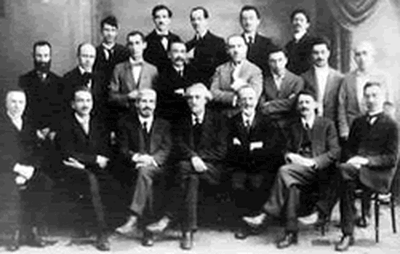
Virshubski, Avrom
December 21, 1869–September 1943
He was born in Vilna. Until age ten he attended religious primary school, thereafter high school, and then he studied medicine in Kazan University; upon graduation in 1896, he moved to St. Petersburg where he received his doctorate from the Military Medical Academy in 1900.
From 1901 he took up private medical practice in Vilna—he was a psychiatrist—and also directed the Division of Nervous Complaints and Mental Illness at the Jewish Hospital (it used to be called the Hospital for the Poor), of which he became chief doctor in 1924 and where he remained almost until the end of his life. He also contributed to general Vilna medical institutions and societies which were connected to his specialty.
He published—initially in Russian and German, later in Yiddish and Polish publications—approximately 150 treatises on medical issues, among them thirty works on manifestations of psychological diseases among Jews.
At the tenth Pirogov Conference in St. Petersburg, Virshubski read a paper on the topic of “Divorce among Jews Resulting from Insanity”; the work was then published in the journal Evreiskii Meditsinskii Golos (Voice of Jewish Medicine) (St. Petersburg, 1908). Other Jewish themes among his writings include: psychological epidemics in Jewish history, the problem of suicide among Jews, alcoholism among Jews, demonology among Jews, nervous and psychological illnesses in Tanakh and Talmud, psychopathology and Kabbala, the physiological basis for the prohibition on meat and milk, the psychopathological attributes of Jewish patients, the psychological character of Lithuanian Jews, the parallel neuropathology of Jews and Gentiles (which also appeared in a brochure from the publishing house of the brothers Voytsikevitsh) (Warsaw, 1935), psychopathological types in Perets’s writings, regarding An-sky’s dibbuk, on Shabbatai Tsvi and other messiahs among the Jews, and more.
He published works in Yiddish in: Hoyz-Doktor (House Doctor) (Warsaw, 1912); Di Yudishe Velt (The Jewish World) (Vilna, 1913); Ts. Shabad’S Vilner Zamlbukh (Vilna Anthology) (Vilna, 1918); E. Y. Goldshmidt’S Lite (Lithuania), Second Collection (Vilna, 1918); Folks-Gezunt (Public Health), a monthly, Vilner Tog (Vilna Day), a daily newspaper, and other Vilna Yiddish serials in the 1920s and 1930s.
He also published articles on general topics in Yiddish, Hebrew, Russian, and Polish periodicals over these same years. He was in addition a member of the editorial board—together with Sh. L. Tsitron and Dr. Tsemakh Shabad—of Pinkes far der Geshikhte fun Vilne in di Yorn fun Milḥome un Okupatsye (Records of the History from Vilna in the Years of War and Occupation), edited by Zalmen Reyzen (Vilna, 1922), 944 columns, in which he published his work “Dos Folksgezunt un der Meditsinisher Lebnsshteyger in Vilne Beys der Daytsher Okupatsye” (Public Health and the Medical Way of Life in Vilna During the German Occupation), cols. 81-108, and a report entitled “Der Vilner Yidisher Shpitol” (The Vilna Jewish Hospital), cols. 829-34.
Virshubski was chairman of the Jewish Scientific Literature Circle in Vilna before WWI and one of the founders (1913) of the Vilna society, Lovers of Jewish Antiquity, which later changed its name to the Sh. An-sky Jewish Historical Ethnographic Society (he served as chairman). He was also an honorary member of the Vilna Medical Association (1925), and he received an esteemed medal from the Polish government (1929). He was as well a member of the Zionist Organization in Vilna.
When the Nazis occupied Vilna, he was living in the Jewish Hospital—known thereafter as the Ghetto Hospital. Old and weak, he was at the time no longer working and spent most of his time in bed. The suicide of his friend, Dr. Gershon Gershoni, caused him psychological agitation. At the time of the liquidation of the Vilna ghetto (September 1943), when the last Jews were driven to No. 20, Subotsh (Subocz) Street, to be sorted, he was no longer capable of going anywhere, and the Nazis shot him in his home.

Sources: Zalmen Reyzen, Leksikon, vol. 1; E. Y. Goldshmidt, “Yidishe Doktoyrim, Velkhe Praktitsirn Itst in Vilne” (Jewish Doctors Who Are Now Practicing in Vilna), in Vilne (Vilna), anthology edited by Y. Yeshurin (New York, 1935), pp. 397-98; Sh. Katsherginski, in Khurbn Vilne (The Holocaust in Vilna) (New York, 1947), p. 191; Dr. M. Dvorzhetski (Mark Dvorzetsky), Yerusholayim Delite in Kamf un Umkum (The Jerusalem of Lithuania in Struggle and Death) (Paris, 1948), pp. 201, 220.