
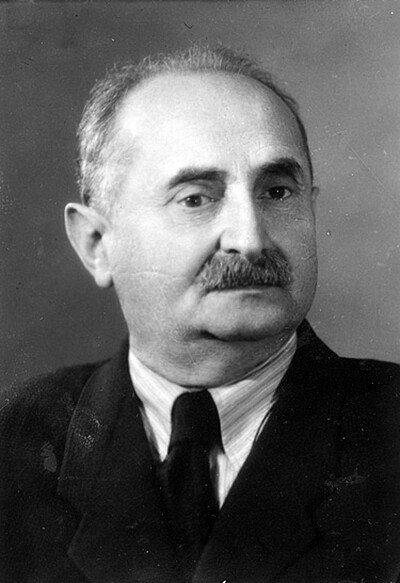
Velednitski, Avrom
1897–October 19, 1959
He was a poet and literary scholar, born in Radomyshl', Kiev district, Ukraine, into the family of an office worker. His elementary education came in the local school, and he began working in the office of a paper mill in Shklow, Mohilev district, Byelorussia.
In 1916 he started studying in the law department of the University of Kiev, but he was soon drafted into the Russian army in 1917. After the October Revolution, in 1918, he returned to Kiev. Then one year later, in 1919, he was again mobilized, this time into the Red Army. Following demobilization, he worked as the manager of a nursery school, 1921-1924, in Kiev. Over the years 1925-1932, he was a teacher at a technical school and at a Communist Party school. He was a research student, 1932-1935, at the Institute of Jewish Culture in Kiev and from 1935 a research assistant at the Institute, and he was also a lecturer at the Lysenko Theatrical Institute in Kiev.
He debuted in literature as a poet, and after the civil war he was a member of the Kiev Jewish literary group Vidervuks (Renaissance); in 1922 he published his first collection of poems. He published poetry in such venues as Proletpen (Proletarian Pen) in Kiev and the anthology Vusp (Ukrainian Proletarian Writers Group) in Kharkov.
In the late 1920s, in addition to poetry, he began publishing in various serials critical articles and, together with others researchers and pedagogues, a series of textbooks.
During WWII he was an officer in the Red Army. In 1946 he received a medal for valor. After the war, he returned to Kiev and defended a dissertation for which he received the title Candidate (Russian equivalent to PhD) in Philological Science.
He published poetry and articles in Eynikeyt (Unity) in Moscow and in the anthology Shtern (Star
He was arrested on March 23, 1951 and spent nearly five years in the Gulag, until he was “rehabilitated” (i.e., exonerated) in late 1955. He then returned to Kiev, but his health had been seriously damaged, and he died there prematurely.
His books include: Layternish (Suffering), poetry (Kiev: Lirik, 1922), 31 pp.; Onkum (Arrival), poetry (Kiev: Kultur-Lige, 1929), 78 pp.; Mit dem Yungn Klas (With the Young Class), poems (Kharkov-Kiev: Ukrainian State Publishers for National Minorities, 1932), 60 pp.; Lider (Poems) (Kiev: Ukrainian State Publishers for National Minorities, 1939), 92 pp.; A Tropn in Loytern Yam, Lider (A Drop in the Pure Sea, Poems) (Tel Aviv: Perets Publ., 1977), 79 pp. With Ivan Rodak, he prepared the textbook, Literatur, Lernbukh Farn 6tn Lernyor (Literature, Textbook for the Sixth School Year) (Kharkov-Kiev, 1932), 108 pp., second enlarged edition (Kiev, 1934), 127 pp., third edition (Kiev, 1935), 107 pp.; with Zalmen Skuditski, Lernbukh af Literatur Farn 6tn Lernyor (Textbook in Literature for the Sixth School Year) (Kiev, 1933), new editions for 1934, 1935, and 1936; with Zalmen Skuditski, Literarishe Khrestomatye, Farn 6tn Lernyor (Literary Reader, for the Sixth School Year) (Kharkov-Kiev, 1933), 230 pp., fourth edition (Kiev, 1936), 238 pp., fifth edition (Kiev, 1937), 238 pp.; Literarishe Khrestomatye Farn 6tn Klas fun der Mitlshul (Literary Reader for the Sixth Class of Middle School) (Kiev-Kharkov: Ukrainian State Publishers for National Minorities, 1934), new editions for 1936, 1937, 1938, and 1940.
He translated with Monye Shapiro into Yiddish: Mayselekh (Stories) by Mikhail Saltykov-Shchedrin (Kiev: Ukrainian State Publishers for National Minorities, 1936), 90 pp.; Di Shvimendike Festung (The Floating Fortress) by S. Black (Kharkov-Kiev: Ukrainian State Publishers for National Minorities, 1936), 77 pp.; and with Monye Shapiro, Vladimir Miroshevskii’s Tsu der Geshikhte fun Tsvishnfelkerlekher Proletarisher Yugnt-Baṿegung (Reader in the History of the International Proletarian Youth Movement) (Kiev: Kultur-Lige, 1925), 238 pp. With Shloyme Bilov, he prepared for publication Avrom Goldfaden’s Geklibene Dramatishe Verk (Collected Dramatic Works) (Kiev: Ukrainian State Publishers for National Minorities, 1940), 328 pp.
Sources: Shmuel Niger, “In der Sovetisher Yidisher Literatur” (In Soviet Yiddish Literature), Tsukunft (New York) (February 1930); Dr. Y. Shatski, in YIVO-Bleter (New York) 20 (1942), p. 109; A. Holdes, in Proletpen (Kiev) (March-April 1930); Morgn-Frayhayt (New York) (July 22, 1956); Y. Papyernikov, Heymishe un Noente (Familiar and Close) (Tel Aviv, 1958); N. Mayzil, Dos Yidishe Shafn un der Yidisher Arbeter in Sovetn-Farband (Jewish Creation and the Jewish Worker in the Soviet Union) (New York, 1959), see index; G-R, in Folks-Shtime (Warsaw) 167 (1959).
די שװימענדיקע פעסטונג
ס. בלעק; יידיש - א. װעלעדניצקי; הילע - אי. פלעשטשינסקי
כארקאװ; קיעװ: מעלוכע-פארלאג פאר די נאציאנאלע מינדערהײטנ אינ או.ס.ר.ר
1933.- 76, [3] pp
Di shvimendike festung
S. Blek; yidish - A. Velednitski; hile - Yi. Pleshtshinski
Kharkov;Kiev: Melukhe farlag far di natsionale minderkhaytn in USRR, 1933
full name of the author - Абрамович-Блэк, Сергей Иванович (1895-1942)
Place : RSL CVL (Moscow)
Code : Евр 13/215 Евр 13/216