

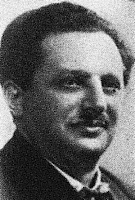
Zaludkovski, Elyohu
1886/1888[1]-June 29, 1943
He was born in Meytshet (Molchad), Slonim district, Byelorussia. His father, Noyekh Meytsheter, was a cantor in a number of Jewish cities, among them Lide, Vilna district, where he had become famous and from which he acquired the name “Reb Noyekh Lider.” When he was two years of age, Elyohu’s parents brought him to Kalish (Kalisz), Poland, where his father was to serve as the city’s cantor. He initially studied at a religious primary school, from age nine with the Kalish rabbi, R. Shimshen Orenshteyn, and secular subject matter with the “best teachers in the municipal government’s high school.” Early on he demonstrated musical talent, and he was taught to play the fiddle.
At age eighteen, he sat for the examinations for the sixth class in high school, and afterward he left (1905) for Milan, Italy, where he spent five months studying voice with Professor Augusto Broggi; he later studied for a short time in Vienna, Austria, with Professor Frank, and in 1906 he arrived at the Kaiser’s Music Academy in Berlin, later moving to the Stern Conservatory, from which he graduated with a silver medal in 1909. That same year (1909), he became the chief cantor of the Sinai Synagogue in Warsaw.
At that time he began writing about music and the cantorial art in the Hebrew-language Hatsfira (The Siren)—“Sirtutim Muzikalim” (Musical Sketches) and other pieces under the pen name “Even”—and in Yiddish for Shoyel Hokhberg’s Unzer Lebn (Our Life)—both in Warsaw.
In 1913 he moved to Rostov-on-Don, where he served as cantor in the Great Synagogue, voice teacher in the local state conservatory (1914-1917), and tenor in the opera (1918-1921).
He wrote on music for the Russian Jewish Razsviet (Dawn) in St. Petersburg and for the Russian-language Priazovskii Krai (Azov Region) in Rostov.
In 1922 he left Russia, worked for a specified amount of time as a cantor in the reform synagogue Taharat Hakodesh in Vilna, served as cantor in Bialystok and Lodz as well, wrote on music and cantorial work for Vilner Tog (Vilna Day) and Dos Naye Lebn (The New Life) in Bialystok, and compiled his work Manginot Yisrael (Melodies of Israel), a collection of songs and stock tunes.
In 1925 he arrived to serve as cantor at the Central Synagogue in Liverpool, England, wrote for Der Idisher Ekspress (The Jewish Express) in London, and published his book Di Muzik in 19tn Yorhundert, Historish-Byografisher Iberblik (Music in the Nineteenth Century, Historical-Biographical Survey) (London, 1925), 62 pp.—short biographical and critical essays on forty-five composers.
In 1926 he moved to the United States, served for a short time as cantor in a number of synagogues in New York, and then later moved to Detroit, Michigan, where he was cantor as Temple Shaarey Zedek from 1926 to 1932; later still, he served as cantor again in New York, as well as in other cities in America. He spent his last five year as cantor in Congregation Beth Shalom in Pittsburgh, Pennsylvania.
He published Finf Folkstimlekhe Lider far Gezang un Pyano (Five Popular Songs for Voice and Piano) (New York, 1926), 4 pp.—music and lyrics by Z. Segalovitsh, Avrom Reyzen, Moris Rozenfeld, and M. Goldman; and he published in Morgn-Zhurnal (Morning Journal) in New York a series of biographical articles on cantors and conductors which was later included in his book Kultur-Treger fun der Yidisher Liturgye, Historish-Byografisher Iberblik Iber Khazones, Khazonim un Dirizhorn (Culture Bearer of Jewish Liturgy, Historical-Biographical Survey of the Cantorial Art, Cantors, and Conductors) (Detroit, Michigan, 1930), 351 pp. and 8 pp., with a preface by the author, a biographical dictionary of cantors—among them, biographies of his father, his brothers who were cantors, and his own autobiography. He also compiled a cantor’s prayer book, entitled Tefilat noaḥ veavodat eliyahu (The Prayer of Noah and the Service of Eliyahu), his father’s and his own liturgical compositions and recitatives.
In the jubilee volume of Dos Naye Lebn (Bialystok) in 1929, he published “Khazonim un Khazones bay Yidn” (Cantors and the Cantorial Art among Jews), and in Shul un Khazonim Velt (The World of Synagogue and Cantors) (Warsaw, 1938) he contributed a series of articles entitled “Mayne Zikhroynes” (My Memoirs).
He was also the founder and president (1928-1932) of the cantors’ society of the Midwest.
He died in Pittsburgh.
[1] The birth date of 1888 is taken from his autobiography; 1886 comes from Zalmen Reyzen’s Leksikon. The later date from his autobiography fits better.
Sources: Zalman Reyzen, Leksikon, vol. 1; Z. Zilbertsvayg, Leksikon fun Yidishn Teater (Lexicon of the Yiddish Theater), vol. 1; his autobiography in his Kultur-Treger fun der Yidisher Liturgye (Detroit, 1930); P. Vyernik, in Morgn-Zhurnal (New York) (January 3 and February 14, 1932); M. Dantsis, in Der Tog (New York) (August 26, 1932); Y. Kirshenboym, in Morgn-Zhurnal (November 2, 1932); Byalistoker Leksikon (Bialystok Handbook) (Bialystok, 1935); M. Yardeni, in Der Tog (July 11, 1943); Drayshprakhik Yorbukh (Trilingual Yearbook), vol. 3 (New York, 1944), p. 76; Universal Jewish Encyclopedia (New York), vol. 10, p. 627.